
Iran accuses Trump of 'big lies' ahead of Geneva talks in face of major US military deployment
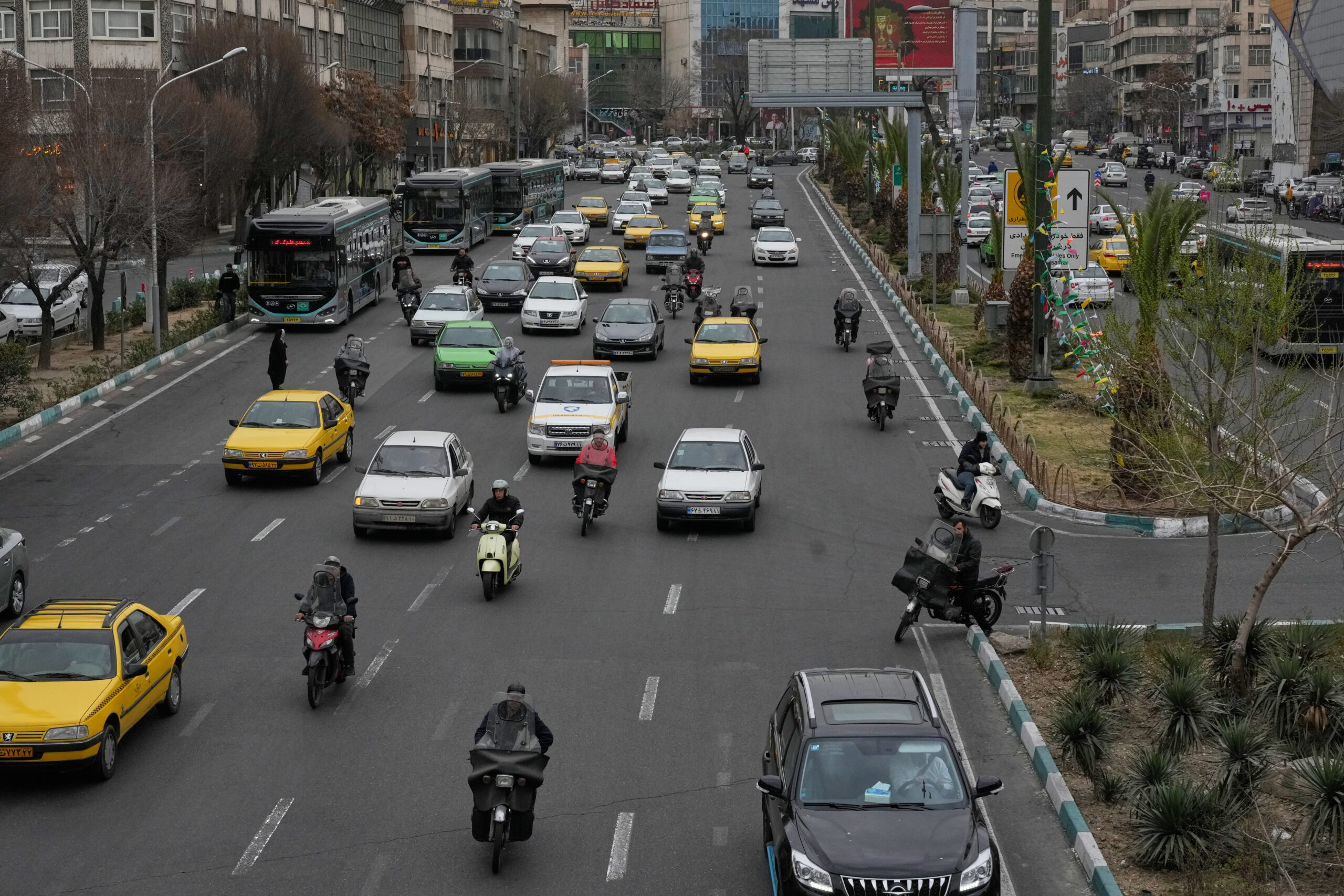
Vehicles drive in downtown Tehran, Iran, Tuesday, Feb. 24, 2026. (AP Photo/Vahid Salemi)
By JON GAMBRELL Associated Press
DUBAI, United Arab Emirates (AP) — Iran pushed back Wednesday against U.S. President Donald Trump’s pressure tactics ahead of critical talks in Geneva over Tehran’s nuclear program, alternating between calling his remarks “big lies” and saying negotiations may yield an agreement through “honorable diplomacy.”
The remarks by two Iranian officials came a day before the talks and as America has assembled its biggest deployment of aircraft and warships to the Middle East in decades. The buildup is part of Trump’s efforts to get a deal to constrain Iran’s nuclear program while the country struggles at home with growing dissent following nationwide protests last month.
Trump has repeatedly threatened to attack Iran if negotiations fail. Mideast nations fear an attack could spiral into a new regional war as the embers of the yearslong Israel-Hamas war still smolder. Already, Iran has said all U.S. military bases in the Mideast would be considered legitimate targets, putting at risk tens of thousands of American service members.
Satellite photos shot Tuesday by Planet Labs PBC and analyzed by The Associated Press appeared to show the American vessels that typically are docked in Bahrain, the home of the U.S. Navy’s 5th Fleet, all out at sea. The 5th Fleet referred questions to the U.S. military’s Central Command, which declined to comment. Before Iran’s attack on Qatar in June, the 5th Fleet similarly scattered its ships at sea to protect against a potential attack.
Iran responds to State of the Union speech
Trump touched on Iran and the nuclear negotiations in his State of the Union speech late Tuesday in Washington.
“They’ve already developed missiles that can threaten Europe and our bases overseas, and they’re working to build missiles that will soon reach the United States of America,” Trump said. “They were warned to make no future attempts to rebuild their weapons program, and in particular nuclear weapons, yet they continue. They’re starting it all over.”
Satellite photos analyzed earlier by the AP showed Iran beginning to rebuild its missile-production sites and doing some work at the three nuclear sites attacked by the U.S. in June. Iran has long maintained that its nuclear program is peaceful.
Secretary of State Marco Rubio told reporters Wednesday that Iran is “always trying to rebuild elements” of its nuclear program. He said that Tehran is not enriching uranium right now, “but they’re trying to get to the point where they ultimately can.”
The West and the International Atomic Energy Agency say Iran had a nuclear weapons program until 2003. Before the June attack, it had been enriching uranium up to 60% purity — a short, technical step away from weapons-grade levels of 90%.
Responding to Trump, Iranian Foreign Ministry spokesman Esmail Baghaei sought to compare him to Joseph Goebbels, Adolf Hitler’s propaganda minister. He accused Trump and his administration of conducting a “disinformation & misinformation campaign” against Iran.
“Whatever they’re alleging in regards to Iran’s nuclear program, Iran’s ballistic missiles, and the number of casualties during January’s unrest is simply the repetition of ‘big lies,'” Baghaei wrote on X.
Trump said in his speech that at least 32,000 people were killed in last month’s protests, which is at the far end of estimates offered by activists for the death toll. The U.S.-based Human Rights Activist News Agency has so far counted more than 7,000 dead and believes the actual figure is far higher. Iran’s government, which long has downplayed death tolls in other unrest, offered its only toll on Jan. 21, saying 3,117 people were killed.
Mohammad Bagher Qalibaf, Iran’s parliament speaker, said separately that the U.S. could either try diplomacy or face Iran’s wrath.
“If you choose the table of diplomacy — a diplomacy in which the dignity of the Iranian nation and mutual interests are respected — we will also be at that table,” Qalibaf said, according to the semiofficial Student News Network, a media outlet believed to be close to the all-volunteer Basij force of Iran’s paramilitary Revolutionary Guard.
“But if you decide to repeat past experiences through deception, lies, flawed analysis and false information, and launch an attack in the midst of negotiations, you will undoubtedly taste the firm blow of the Iranian nation and the country’s defensive forces.”
Talks hang in balance
Iran and the U.S. are to meet Thursday for their third round of talks under the mediation of Oman, long an interlocutor between Tehran and the West. A flight carrying Iranian Foreign Minister Abbas Araghchi and his team arrived late Wednesday in Geneva, where they will meet American officials led by special U.S. Mideast envoy Steve Witkoff.
Rubio said the discussions will be largely focused on Iran’s nuclear program and are important to gauge how serious the country is in reaching a deal to avoid potential U.S. military action. But he suggested a breakthrough was unlikely at this session, noting that the U.S. also has major concerns with Iran’s conventional weapons.
“We hope progress can be made,” Rubio told reporters during a trip to the Caribbean, saying diplomacy was Trump’s preference. “But it’s also important to remember that Iran refuses — refuses — to talk about the ballistic missiles to us or to anyone, and that’s a big problem.”
If the talks fail, uncertainty hangs over the timing of any possible attack.
If the aim of potential military action is to pressure Iran to make concessions in nuclear negotiations, it’s not clear whether limited strikes would work. If the goal is to remove Iran’s leaders, that will likely commit the U.S. to a larger, longer military campaign. There has been no public sign of planning for what would come next, including the potential for chaos in Iran.
The status of Iran’s nuclear program is another mystery. Trump said last year that American strikes “obliterated” it. Now dismantling whatever remains of the program appears to be back on the administration’s agenda. IAEA inspectors have not been allowed to inspect those sites and verify what remains.
There is also uncertainty about what any military action could mean for the wider region. Tehran could retaliate against the American-allied nations of the Persian Gulf or Israel. Oil prices have risen in recent days in part due to those concerns.
___
Associated Press writers Amir Vahdat in Tehran, Iran, Matthew Lee in Basseterre, St. Kitts and Nevis, and Konstantin Toropin in Washington contributed to this report.