Utah Gov. Cox promises US is still a welcoming place as state prepares to host 2034 Olympics
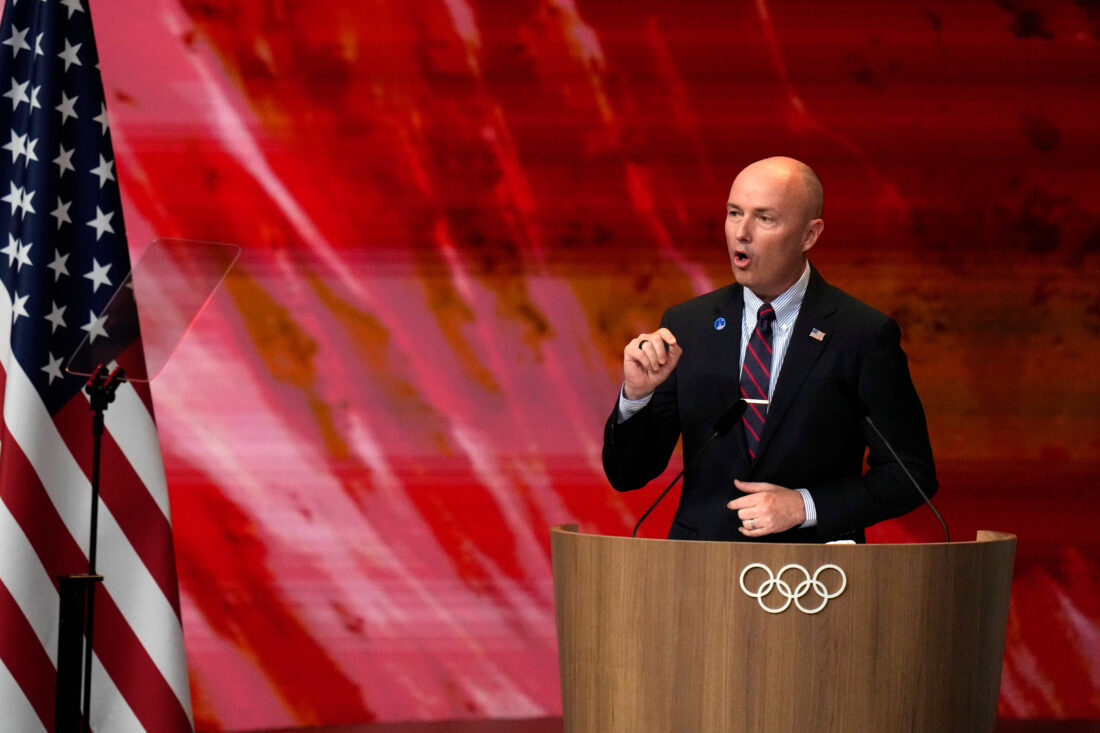
FILE - Utah Gov. Spencer Cox speaks about Salt Lake City's bid to host the 2034 Winter Olympics, during the 142nd IOC session at the 2024 Summer Olympics, Wednesday, July 24, 2024, in Paris, France. (AP Photo/Natacha Pisarenko, File)
MILAN (AP) — The United States is “still a very welcoming place,” Utah Gov. Spencer Cox said Tuesday at the Milan Cortina Olympics, which have been a focus of global concern about the country’s political direction.
The Republican governor faced pointed questions from European media at a news conference in Milan to promote the 2034 Utah Winter Games, exactly eight years before the opening ceremony.
The past Olympic week in Italy saw opinions on U.S. international diplomacy and domestic politics mixed liberally into the sports.
U.S. Vice President JD Vance was booed by fans at the opening ceremony; African members of the IOC quizzed organizers of the 2028 Los Angeles Summer Games about visas for visitors; and U.S. athletes were asked about representing their country at this time — with President Donald Trump joining a backlash against them.
“We care deeply about the political situation that is happening in the United States right now,” Cox said, when asked by a German reporter to compare an upbeat Olympic vision from Utah with news from the U.S. shaped by Washington.
“Those are political issues that will be worked through,” the governor said, reminding that eight years until the Winter Games return to Salt Lake City is “a long ways away, for sure.”
“We have elections just like your country, in Germany. We will see how those things turn out,” said Cox, whose political style has been to promote civility over polarizing divisions.
The governor chided the media for asking U.S. athletes questions beyond sports, while adding “I love that we get to live in a country where people get to speak their minds.”
He suggested what is broadcast on the television news “isn’t the only thing happening in our country.”
“You will find it still a very welcoming place. We are a very welcoming country,” he said. “There are some differences of opinion right now when it comes to the way that laws are being enforced. That will play out.”
Protecting athletes
Cox shared the news conference with Salt Lake City Mayor Erin Mendenhall and Utah Winter Games organizing officials including Sarah Hirshland, chief executive of the U.S. Olympic and Paralympic Committee.
Hirshland defended Hunter Hess, who Trump called a “real loser” after the freestyle skier said at a news conference he was “not the biggest fan” of all that is happening back home.
“It is important to us to ensure that anyone who is reacting to or commenting on something that someone said understands the totality and the context of what they said,” Hirshland said. “I have all the confidence in the world that every member of Team USA is proud to represent our country and understands the opportunity they have to bring people together.”
“We are all here for that and that’s exactly what we’re going to,” she said.
Snow making and storing
Another unpredictable element eight years out is the climate and weather for snow.
The International Olympic Committee said last week it is open to scheduling future Winter Games in January to create space for an earlier Paralympics, before temperatures rise in March.
Fraser Bullock, president of the Utah organizing committee, said the state’s cold nights in January and February offer reliability.
“So regardless of the amount of precipitation we’re getting, we can make snow,” he said. “We will also store snow to have available from the previous year.”
The current technology with thermal blankets to cover snow preserves about 70% of the stored supply from one winter to the next.
“The Olympic Games themselves should be just fine in February,” Bullock said. “We have got contingency plans to cover (the Paralympics in March).”
Ticket prices
High prices for tickets set by FIFA for the 2026 World Cup in men’s soccer have reminded fans that sports events in the United States are expensive by global standards.
The Utah Olympics has a plan for that: some higher-price seats, including for hospitality, to subsidize an offer of 34,000 tickets across the Winter Games at $34 apiece.
Bullock called it a “barbell strategy … where you have some very, very expensive tickets that include hospitality for the people that want to have the ultimate experience. And they are going to pay for the Games.
“That allows us to have very, very inexpensive tickets,” he said.
The Utah Winter Games has an operating budget of nearly $3 billion with three private revenue sources: sponsorship, ticket and a contribution the IOC gives to hosts.
National Sports
Winter Olympics recap: Shiffrin out of the medals again, Klaebo wins another gold

US skater Maxim Naumov makes an emotional Olympic debut one year after losing parents in plane crash
Utah Gov. Cox promises US is still a welcoming place as state prepares to host 2034 Olympics

Four players ejected after Pistons and Hornets tussle in physical game won by Detroit

Lindsey Vonn’s father tells the AP he wants her to retire after her Olympic crash