
Trending
Michigan forestlands have nearly a hundred species of trees, according to the Forest Service inventory program. Add a few more species if you count those in urban and residential areas. An eclectic group of obscurities occupy a small, but interesting, fraction of our forest volume.
As latitudes and annual precipitation increase, the complement of tree species gradually changes. Winter low temperature is key factor in this matrix of habitat characteristics.
Michigan straddles a broad east-west oriented transition zone between the central hardwoods and the northern hardwoods. From Canada, there's even a bit of the boreal that dips down into the state. This geography results in a host of atypical tree species that are more common outside the state lines.
About fifteen tree species wiggle into Michigan which are more common elsewhere. Collectively, they occupy about one percent of our tree volume, not much, but it's interesting to find them. Most knock around the southern part of the state.
Some of these species have had their ranges expanded by human activity. Widely planted, black locust is a prolific example that now grows in most Michigan counties. It's become a pest and is considered invasive. Originally, the range was across the Appalachians and the hill country of Missouri and Arkansas.
Buckthorn, a couple of species, is another common invasive, introduced as an ornamental. They're from Europe and have overtaken many areas to the demise of local plants and wildlife. Usually, buckthorn is a shrub but can reach small tree proportions. I have cut many myself.
Most of these oddball species have naturally slipped over Michigan's southern border, such as yellow poplar, sycamore, blackgum, red mulberry, catalpa, Kentucky coffeetree, Ohio buckeye, Osage orange, flowering dogwood, and pawpaw.
Each of these species have curious structures.
Blackgum, or black tupelo, has blue-black pulpy fruits about a half-inch long. Tupelo honey is a prized variety. The wood is a favorite among duck decoy carvers. The blotchy bark of sycamore appears perennially unhealthy and fruits seem like something invented by Dr. Seuss. Its sister species in Europe is called the plane tree.
Yellow poplar, or tulip tree, has tulip-shaped leaves and very showy flowers. A mature tree can grow very tall with diameters reaching four to five feet. The flowering dogwood also has very showy flowers, not to be confused with our other native dogwood shrubs.
Catalpa is a fast-growing tree with weak wood. It's large heart-shaped leaves make for a good shade tree, and has pretty flowers. The long thin beans reach lengths of about two feet. Red mulberry, not to be confused with the exotic white mulberry (silkworm tree), has curiously lobed leaves and red, then purple, fruits that look like giant blackberries. They're edible, too. Honeylocust is more of a central hardwood, but has been widely planted across Michigan and has "escaped" into the forests in some places. Interestingly, the "wild" honeylocust sports large and viciously branched thorns. The fruits are papery pods, somewhat similar to black locust. The large, thick kidney-shaped pods of the Kentucky coffeetree contain seeds that can be made into a coffee substitute, though it doesn't taste all that great and is toxic if done incorrectly. The expansive twice-compound leaves are unusual and the dense lumber produces fine furniture.
Sassafras is a lovely tree that pops-up here and there across the southern half of the Lower Peninsula. A delicious tea can be derived, if one knows what to harvest. Hackberry commonly occupies river bottoms, mostly in the southern counties. The curiously ridged bark is unusual and the fruits are berry-like. Once considered a cousin of the elms, the taxonomists have reclassified the species.
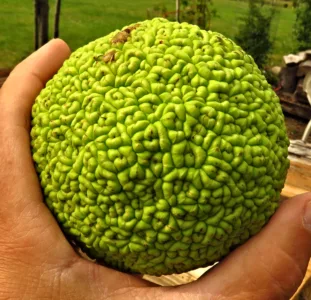
Osage orange and pawpaw sport particularly interesting large fruit. The weird Osage orange fruits are green with lots of warts, about the size of a baseball or softball. Pawpaw fruit is edible and looks a bit like an oversized mango. Some folks are working to grow pawpaw commercially.
The Ohio buckeye, a favorite in Ann Arbor, displays a palmately compound leaf, quite unusual. The dark brown roundish fruit has a light circle, rendering the name "buckeye". It's a cousin to the ornamental horse-chestnut.
Lastly, of special note is the highly invasive tree-of-heaven. It's an aggressive invader that can choke-out native trees, especially in disturbed areas. Interestingly, it's a favorite food of the exotic spotted lanternfly, which is a species of concern in agriculture and has attracted the attention of state agencies.
This collection of trees, of variable taxonomies, provides wonderful diversities. Most are fairly uncommon in Michigan and often overlooked by forest visitors. However, they are rich in appearance and utility.