
Prescribed fire: An art guided by science
Trending
Forest and wildlife management are arts, guided by science. While science provides the intellectual underpinnings, real-world issues such as diverse ownership goals, the dynamics of local markets for forest products, availability of other professionals to do the work, weather, and other variables create novel work situations that require creativity and adaptability.
Because of the above, landowners and professionals must understand that tradeoffs exist and that management is not a binary toggle switch: yes/no or on/off or right/wrong. Actions must be placed into the proper context and this must be done purposefully and explicitly. Planning is the process in which this is done. In other words, planning precedes management and consists of evaluating the science and the art needed to get work done.
In this column I have often discussed disturbances: events that regulate the amount of living material, or biomass, in a forest. Disturbances shape forests. A number of different disturbances exist, including those that are human derived and those that are not. For instance, logging is a human caused disturbance. Ice storms, insect and deer herbivory, and wind events are also disturbances.
Fire too is a disturbance and can be human caused, purposefully or not, or naturally ignited by lightning. Whether a "prescribed fire" or a naturally occurring "wildfire", the impacts of fire are profound. For instance, upland, pine-dominated, forest ecosystems of eastern white pine, red pine, or jack pine are different if they are fire maintained or not. However, humans have altered fire regimes in these and other ecosystems considerably, starting with logging in the late 19th century, then atypical wildfires fed by logging slash in the early 20th century, and finally fire suppression starting in the Smokey the Bear era of the mid-20th century.
For those interested in promoting more fire for ecosystem conservation and restoration, understanding the related science around natural disturbance regimes is a critical step. The text Forest Dynamics and Disturbance Regimes (2002, Cambridge University Press) is a good starting point for basic terminology that must be understood and appreciated before fire is applied.
To start, fire requires an ignition source, oxygen, and a "fuel." In wildland fire, ignition sources can include lightning, a drip torch, a downed power line, an unattended campfire, etc. Fuels are often different types of vegetation, but also can include human made structures. Fuels are rated based on how long it takes for them to dry out and burn efficiently. Pine needles and fuels less than 1" in diameter are called "fine fuels" and these often carry a fire from one point to another. As the fuels increase in size to entire trees, the behavior of the fire changes significantly and fire management can become more complicated.
There are three types of wildland fire based on the location of the fire: a "ground fire" (the fire burning tree roots or organic soils below the forest floor), a "surface fire" (fires burning on the forest floor), and a "crown fire" (fire that climbs a tree by burning lower, then top branches). The type of fire dictates, to a considerably degree, the effect of the fire on vegetation ("severity") and the cost of managing the fire. "Intensity" is the amount of energy released and this word is often used when severity should.
What forest ecosystems types are more or less fire prone?
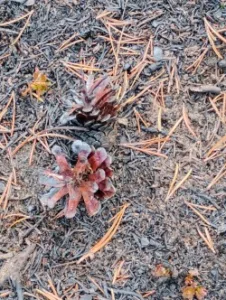
Different plant and animal species have evolved more or less with fire. The jack pine ecosystem inhabited by the Kirtland's warbler, upland sandpiper, clay-colored sparrow, American badger, thirteen-lined ground squirrel, and many other bird, reptile and amphibian, and mammal species is one of the more "fire-adapted" ecosystems of the Midwest. As an example of adaptations to fire, jack pine cones open and release their seeds when they are heated. These cones are called "serotinous." The seeds from these cones then fall on a forest floor prepared by fire that has removed the duff layer. Fire, therefore, is a necessary component of jack pine regeneration in most instances.
Conversely, plant and animal species of northern hardwood forests of American beech-sugar maple-eastern hemlock evolved with different disturbances and different regeneration strategies. These ecosystems rarely burn naturally and most of the plant species have different life history characteristics than those in jack pine and other fire-adapted ecosystems.
Forests of red pine-eastern white pine and forests of black spruce-balsam fir-paper birch are also fire-adapted, but the types of fire observed in natural settings differs. The fires burning in eastern Canada and producing the smoke seen in Michigan are mostly from crown fires in black spruce-balsam fir-paper birch. These fires have high severity and cause mortality of most (not all!) trees. Natural fires in red pine-eastern white pine are often different and of mixed severity, depending on conditions in the forest. Surface fire predominates and most trees are retained because thick bark provides protection from heat.
How does this information assist landowners?
Understanding how forests function can help us understand the impacts of disturbances and act accordingly. For instance, the ice storm of Spring 2025 caused the buildup of forest fuels. In some forest ecosystems this buildup may increase the probability of fire, or the severity of fire, more so than in other ecosystems. If the buildup occurs in drier, pine-dominated ecosystems one might be more concerned than if it happens in more moist settings of northern hardwood forests where decomposition rates are greater.
Understanding the complexities of forest ecosystems involves, to a large degree, understanding natural disturbances. For fire-adapted ecosystems, prescribed fire is an important tool to maintain or restore structure and composition. Prescribed fire requires creativity, safety in its application, and a foundation in science. One must understand and explicitly use the scientific literature if an evidence-based approach is of interest. Simply applying fire as a binary of yes/no or right/wrong misses the point. The correct answer to many forest and wildlife management questions, including fire management, often is, "it depends."
Dr. Greg Corace is the forest and wildlife ecologist for the Alpena-Montmorency Conservation District. For more information, including assistance with the Qualified Forest Program and related forest planning and management, email Greg: greg.corace@macd.org.