
Northeast Michigan residents reflect on Fitzgerald, Bradley maritime tragedies
Trending
ALPENA -- The Great Lakes are home to an estimated 6,000 shipwrecks, according to the National Oceanic and Atmospheric Administration (NOAA). Two well-known wrecks succumbed to their watery grave at the hands of dangerous stormy waters, known to many as the gales of November.
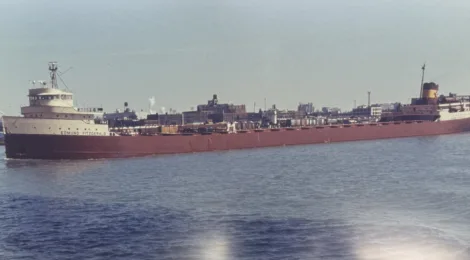
The S.S. Edmund Fitzgerald and the S.S. Carl D. Bradley were two wrecks that were swallowed up by these angry gales, also known as the Witch of November, nearly 20 years apart. The Fitzgerald sank on Nov. 10, 1975, taking all 29 crew members with her to the bottom of Lake Superior, near Whitefish Point in the Upper Peninsula. The Bradley sank on Nov. 18, 1958, and 33 of her 35-men crew also perished on Lake Michigan -- many of her crew members hailed from Rogers City.
David Burnham, a resident of Harrisville, said he witnessed the Fitzgerald be launched in River Rouge, Michigan when he was 11 years old in 1957. He said that it was an exciting event and that many of his peers went to the shipyard to watch the historic event take place.
"From the elementary school we could see it being built," he said. "It was a pretty close community ... there was a man who lived across the street from me and he worked at the yard. It was exciting because (the Fitzgerald) was the first big one on the lakes."
At the time of the fateful storm that took the Fitzgerald, Burnham was living in Wyandotte, Michigan at the time. He said he remembers the poor weather leading up to Fitzgerald’s demise.
"The morning was just beautiful ... blue sky, sunshine, and snow was on the ground, white as could be ... we started looking at slides of the picture of the ship not knowing what was coming up on the news," he said. "That storm started and it didn't stop. We turned on the news and, bang, there it was, disappeared."
Burnham added that the sinking of the Fitzgerald felt significant because he had followed her history through her lifespan.
"You see something this big, the first of the big ones ... and then you follow her history a little bit," he said. "It shocked everybody. We still think about it."
Burnham said that he thinks the fame of the wreck has overshadowed the tragedy, marketing the wreck as a tourist destination.
"Sometimes, when things like this happen, I think they are overdue, like souvenirs," he said.
Burnham said he also remembers learning about the Bradley sinking.
"I wasn't very old, but I remember her going down in Lake Michigan," he said.
Though Anne Belanger, the Director of Programming at the Presque Isle District Library, was not raised in Northeast Michigan, she worked on the film November Requiem to document and memorialize the Bradley tragedy, much like the Fitzgerald has been memorialized in popular culture. November Requiem documents the stories of widows, family members, and those close to the Bradley crew members who perished.
"These are stories of people who lost their loved ones," Belanger said. "First hand accounts that have been preserved. We were preserving the story for the future.
Belanger said that she moved to Rogers City in 2001. For the 50th anniversary of the Bradley's sinking in 2006, Belanger said that she and her brother embarked on the film project to tell the stories as authentically as possible.
Belanger added that she wanted the project to preserve the stories of the affected for years to come. By documenting the stories of the crew members' families, she believes that she was able to bring some closure to the Rogers City community.
"The devastation was so immense," she said. "If it wasn't a family member, it was someone you knew. The devastation, the impact, the trauma ... it was widespread."
"It was their husband, or their brother, or their cousins who were lost on the Bradley,” she added.
For one of the widows, Belanger said that she believes that the film brought some closure.
"His wife, his widow never really thought he was gone because they never recovered his body," Belanger said. "She was able to have closure."
Belanger said that she is thankful to the Thunder Bay National Marine Sanctuary (TBNMS) for continuing to screen the film at the Great Lakes Heritage Center. She recalled the positive response that the city of Rogers City had at the initial screening in 2006, and said that she appreciates the continued interest in the Bradley and the stories of those lost to Lake Michigan.
"I wanted to be very sensitive to the story," Belanger said. "I wanted it to be told by the women - the spouses, the sisters ... we wanted to honor the men who sailed, to preserve the story."
"The younger generation wants to preserve that story too," she added. "When there is tragedy, the community always pulls together."
Kayla Wikaryasz can be reached at 989-358-5688 or kwikaryasz@TheAlpenaNews.com.