
Motion to quash denied in Quintanilla case for accessory charge
Trending
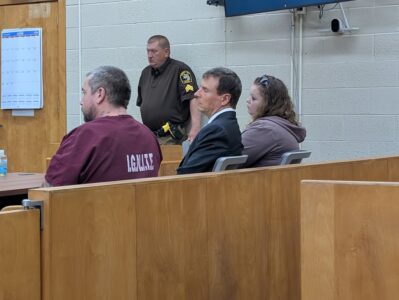
HARRISVILLE -- Cassandra Quintanilla, 36, had a hearing for a motion to quash on Tuesday in the 23rd Circuit Court in Alcona that was ultimately denied by Judge Laura Frawley.
Quintanilla is the co-defendant of Joshua Dohring, who is charged with assault with attempt to murder. Quintanilla is charged with accessory after the fact to a felony and two counts of lying to a peace officer in a violent crime investigation.
The alleged assault occurred on the evening of May 14 when witnesses Rodney Swalley and Stacy Matthews pulled up to the Mikado baseball fields.
The two encountered Dohring and Dohring's ex-wife there. Dohring and Swalley started a physical altercation. During that altercation, Dohring stabbed Swalley in the neck with a knife. The quick action of Alcona EMS, an Alcona County deputy, and Mikado first responders tending to Swalley’s injuries helped sustain his life.
Dohring left the scene and was later seen through video footage at Greenbush Market with Quintanilla pumping gas. Dohring could be heard saying that he killed someone in that footage.
Later when Quintanilla and Dohring were back at their residence, Alcona County deputy Andrew Wright arrived there and asked Quintanilla if she knew about the incident. She denied knowing anything.
Alcona County Prosecuting Attorney Elizabeth Reed said at the preliminary examination on June 10 that there was evidence Quintanilla had lied in a number of police interviews.
At Tuesday's hearing, Quintanilla's attorney Robert Bejesky argued that the charge of accessory after the fact should be quashed.
In a motion to quash, a defense attorney makes an argument before the court to nullify a charge based on a lack of evidence for probable cause. Probable cause is the reasonable belief that a crime occurred and that the defendant committed that crime.
Bejesky said that Quintanilla's actions as established in the preliminary examination did not hinder Dohring's arrest. When law enforcement arrived at Quintanilla and Dohring's residence, Quintanilla immediately identified Dohring's location inside. Following the arrest, law enforcement conducted interviews with Quintanilla where she allegedly made knowingly false statements.
"Even assuming that Ms. Quintanilla's statements were knowingly false, that does not automatically establish accessory after the fact liability," Bejesky said. "The prosecution still has to demonstrate that there's a reasonable basis to infer that the statements constituted assistance that was deliberately intended to protect Dohring from trial or punishment."
He said there is no evidence that Quintanilla fabricated an alibi for Dohring, or coordinated false testimony, or facilitated any type of flight, or concealed evidence. Any of those reasons would constitute an intent to protect Dohring.
The inference that Quintanilla had an intent to conceal cannot be supported by "labeling investigative inconsistencies as assistance," Bejesky concluded.
Frawley said she was interested in hearing Reed's response to the allegation that there is no evidence of specific intent.
Reed said she found no case that said a series of lying or equivocations cannot constitute an inference of specific intent to hinder trial or punishment.
Reed agreed that none of the lies affected law enforcement ability to apprehend Dohring. She said that Quintanilla's behavior was more likely intended to minimize his involvements to frustrate the finding of the truth. A jury could reasonably come to that conclusion from the series of lies that she told in the four interviews, especially after Dohring was already in custody, according to Reed.
As an example, Reed said that Quintanilla denied seeing any blood or anything on Dohring that day, which is probably implausible in light of the amount of blood evidence scattered throughout the residence and property.
All those lies together evidence an intent to frustrate and assist Mr. Dohring by avoiding liability for the incident.
"The people believe probable cause was established and it's up for a jury to decide whether it's beyond a reasonable doubt, what her intent was during the whole process," Reed said.
However, if officers can't find the knife, establish a timeline of events, if she's muddling with the facts such that it prevents the development of the truth of what’s happening, that leads to a frustration of trial and punishment in the case, Reed said.
Bejesky said that he is still not sure that it's clear the intent was there.
He said that Quintanilla was like a deer in headlights, having to undergo four interrogations.
"We don’t know exactly what was said between the two (Quintanilla and Dohring) and what her understanding of these events were," Bejesky said.
He said he didn't know what her rational understanding of the events was or what was going on in her head.
"But then why lie if it wasn’t going to affect anything?" Frawley asked.
"I will say, this is just just a prequel to what I'm going to say anyways, diminished capacity defense based on medications that she had," Bejesky said. "We're going to bring that up before the trial."
He said that maybe she felt like she was also being accused of something.
Frawley denied the motion to quash and said she is not sure that the evidence for the accessory charge would rise to the level of beyond a reasonable doubt to persuade a jury, but it meets the probable cause standard upon preliminary examination.
The trial will be Dec. 15 through Dec. 18. Dohring and Quintanilla will be tried together by one jury. There is no potential resolution pending.
All parties have to submit their final witness and exhibit lists and jury instructions no later than 14 days prior to trial date, same with jury instructions.
Frawley said that no pleas to a lesser count can take place after Tuesday, and the court will not take a plea on the date of trial.
Reagan Voetberg can be reached at 989-358-5683 or rvoetberg@thealpenanews.com.