
Ice storm or lost hunter: Unified Command adapts to the emergency
Trending
ALPENA - A multi-agency rescue effort in Alpena Township hinged on adaptability when an 83-year-old hunter went missing during opening weekend of firearm deer season.
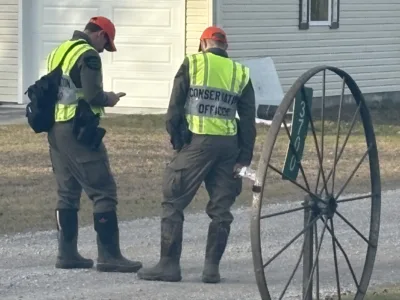
Led by the Michigan Department of Natural Resources conservation officers, responders used a Unified Command system that allowed them to seamlessly pivot from a woodland search to a difficult medical extraction when the man was found alive on Wednesday.
The man was reported missing Monday evening after failing to return from hunting. An incident command center was established that night near the intersection of Wessel and Kirchoff roads. Ground teams, K-9 units, aviation resources and thermal imaging searched thick forest. The search paused at sunset Tuesday and resumed Wednesday morning.
Around 2:30 p.m. Wednesday, a ground team heard the man faintly calling for help and found him conscious, sitting up and alert roughly three-quarters of a mile from his property. Responders chainsawed a path through the woods and carried him out on a stretcher. He was transported by ambulance to a hospital for evaluation. His family has asked for privacy.
Alpena Township Fire Department (ATFD) first became involved Sunday night just before 10 p.m., when it was called for medical stand-by.
"When units arrived, the DNR conservation officer was the Incident Commander and had ATFD and an Alpena ambulance stand-by while law enforcement searched," Fire Chief Tim Baker said.
One ATFD unit and personnel remained on scene from about 10 p.m. to 2:30 a.m.
On Monday there was no request for ATFD to join the search itself. Baker said the department's limited staffing, one person per station, meant on-duty personnel could not be released without leaving the township uncovered for other medical and fire calls.
The response changed again Wednesday afternoon once the man was found. ATFD was dispatched at approximately 2:40 p.m. for medical stand-by.
"Crews went to the location and were directed to the location of the hunter by responders on scene," Baker said. "Medical evaluation was done and two ATFD personnel assisted in carrying the person out of the woods. These crew members also assisted in clearing obstacles and to provide a pathway out for responders and the patient."
He was advised that ATFD personnel also ran a chainsaw as part of the multi-agency effort.
Baker described the terrain as a major obstacle.
"The dense wooded area, terrain, and soil conditions made removal a challenge," he said. "There was significant tree growth, stumps, downed limbs/trees, mud, standing water that made the walk out difficult."
Despite those conditions, Baker said the overall operation went smoothly.
"The rescue operation went very smoothly due to the effective use of the Incident Command System (ICS) and Unified Command," he said. "These are the types of incidents that emergency responders regularly train for. By utilizing ICS, resources were organized, assignments were clearly defined, and communication remained effective throughout the incident."
Baker added that Unified Command let leaders from fire, law enforcement, search-and-rescue and other agencies work together seamlessly, bringing their individual expertise and capabilities to the operation.
"The collaborative structure," he said, "Was instrumental in locating the hunter and bringing the incident to a safe conclusion."
County Emergency Management Director Sgt. JP Ritter noted that the same principles of Unified Command are applied differently depending on the emergency.
"During the ice storm, for example, both our agency and the city activated our Emergency Operations Centers and established a Unified Command at the city's facility to coordinate the response," Ritter said.
In the missing-hunter case, DNR conservation officers served as incident command because the primary mission was a wilderness search on and near state-managed resources. Once the hunter was located, fire and medical resources shifted to extraction and patient care while remaining under the established command structure.
Baker emphasized that even well-prepared hunters can become disoriented.
"This incident serves as an important reminder that even experienced hunters and outdoor enthusiasts can become disoriented in unfamiliar terrain," he said.
In a message from the department, ATFD stressed personal preparedness:
– Tell someone your plans
– Carry a signaling device
– Stay put if lost
– Pack water, high-energy snacks, a compass or GPS, extra clothing, a light with batteries, a first-aid kit, fire-starting materials and an emergency blanket
– Dress for changing conditions, and carry a fully charged phone without relying on it.
Hunting with a partner or maintaining clear communication before entering the woods also improves the odds of a quick recovery.
"The recent rescue highlights both the dedication of local emergency responders and the importance of personal preparedness," the department said in a statement. "While our responders train extensively for these types of incidents, the best outcome is one where a lost or injured person can be located quickly because they took simple precautions before entering the wilderness. A few minutes of planning and a few additional items in your pack can make a significant difference during an unexpected emergency."
Assisting agencies included the Michigan State Police and its canine unit, All County Search and Rescue, the Alpena County Sheriff's Office, Alpena City Fire Department, Oakland County Sheriff's Office Search and Rescue, the Huron Undercover Narcotics Team, community volunteers and family members. DNR Law Enforcement Division Chief Brandon Kieft thanked the agencies and volunteers for the teamwork that produced a successful outcome.
The incident underscores how local responders adapt command structures, staffing decisions and tactics to the specific demands of each situation, whether a multi-day wilderness search or a county-wide weather event, while relying on the same core systems of ICS and Unified Command.