
Health department unveils harm reduction program
Trending
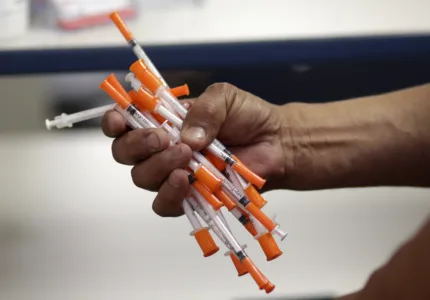
ALPENA -- District Health Department No. 4 (DHD4) unveiled its harm reduction program called ANCHOR, dedicated to preventing the spread of disease through needle sharing. The program aims to be a bridge between the community and resources which can help addicted individuals find help and stay sober.
According to Jess Morrow and Emily Schuster, DHD4 harm reduction administrators, Northeast Michigan is "ground zero" for the opioid crisis in Michigan. The DHD4 program aims to provide access to sterile supplies and overdose prevention resources; infectious disease education and connect individuals with care; and help community members navigate social-service systems and build trust with individuals who need support.
DHD4 Finance Director Michelle Konwinski and DHD4 Administrative Health Officer Chelsea Engle said that the department received state money to fund the harm reduction program because of the elevated levels of overdose deaths per capita in Cheboygan county and the rising levels across the DHD4 coverage area.
According to MDHHS, the average overdose death rate per 100,000 people is 19.1. The four counties DHD4 services had the following overdose death rates in 2024:
- Alpena: 6.9
- Montmorency: 20.4
- Cheboygan: 15.4
- Presque Isle: Inconclusive
According to the Center for Disease Control (CDC), three of DHD4's four counties - Cheboygan, Presque Isle, and Montmorency counties -- were ranked within 220 of the most vulnerable counties in the nation for rapid HIV or Hepatitis C outbreaks. This ranking system is based on factors that include drug overdose death rates, prescription opioid sales, low income, white non-Hispanic population, unemployment, and limited buprenorphine access.
According to Morrow and Schuster, 95% of opioid overdose deaths in the region are caused by fentanyl. In 2022, there were 2,422 deaths reported statewide. From 2010 to 2019, the national average for reported HIV and Hepatitis C cases have increased by approximately five times.
Schuster said that harm reduction aims to prevent the spread of disease and get addicted individuals back on the right path to sobriety.
"Harm reduction is pretty much what it sounds like," Schuster said. "You take practical steps to reduce risk, and we do it everyday without thinking about it. You might have worn your seatbelts on your way here. You ride a bike or motorcycle, you can choose to wear a helmet. We go to the dentist to prevent bigger problems down the road."
"We don't have to expect for something horrible to happen before we start enacting measures to be safer," Morrow added.
Schuster explained that the concept of harm reduction uses the same practical preventative measures as wearing a seatbelt to prevent harm resulting from substance abuse by community members.
"It recognizes that people use substances for different reasons," Schuster explained.
Schuster added that in order to get community members to stop abusing substances, those individuals have to be given the proper tools and resources to do so, while staying healthy and safe in the process of getting sober.
"It also acknowledges that there are ways to reduce those risks without waiting for the person to hopefully just stop using drugs," Morrow said.
Morrow and Schuster cited an outbreak of HIV cases in Scott County, Indiana back in 2015, which was reported as the largest outbreak of its kind in US history.
Scott County has a population size comparable to Otsego, Manistee, Roscommon, and Antrim counties. In late 2014, three cases of HIV were detected, and needle sharing was suspected as the cause. In April 2015, 135 cases were confirmed, with a final total of 237 cases. Those infected with HIV, 94% of cases were co-infected with Hepatitis C.
According to Morrow and Schuster, if a harm reduction program had been established within the first 10 cases reported, the total case count could have been reduced by 76%, or reduced to 57 cases. If a program had been established prior to the outbreak, the case count could have been reduced by 86%, or to 27 total cases.
Morrow added that harm reduction is not in opposition to recovery. She said that it helps bridge gaps in the community and meet people where they are at in their recovery journey.
"It's actually a bridge to those things," she said. "Its a way to stay safer and healthier, wherever they are in their life."
Kayla Wikaryasz can be reached at 989-358-5688 or kwikaryasz@TheAlpenaNews.com.