
Trending
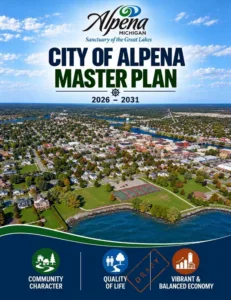
ALPENA - The Alpena Municipal Council on Monday unanimously approved releasing the draft of the Alpena's updated Master Plan for a required 63-day public review period, setting the stage for potential adoption early next year.
Mayor Pro Tem Karol Walchak introduced the motion, and councilman Danny Mitchell seconded it. All members voted yes.
Montiel Birmingham, director of planning, development and zoning, presented the draft at the meeting. The plan, developed through a first-of-its-kind joint process involving Alpena County and all eight townships, and facilitated by the Northeast Michigan Council of Governments, is intended as a policy guide rather than a binding list of projects.
"Everything is about taking the feedback and turning it into goals that should guide our direction going forward whether that's economic development, zoning or anything else," Birmingham told the council.
Unlike the city's previous comprehensive plan, adopted in 2020 and focused solely on the city, this update draws on collaborative input across the county while remaining a separate city document. That structure supports the city's status as a certified Redevelopment Ready Community under the Michigan Economic Development Corp. and allows for independent review, adoption and future updates.
The process began in January 2025 with meetings between the planning consultant and each participating municipality. A county-wide public survey ran from April through October 2025 and drew 1,268 responses. Results helped shape the plan's vision, goals, strategies and future land use recommendations. The Planning Commission reviewed the draft on Oct. 13 and recommended it to the council for the statutory review period.
Under the Michigan Planning Enabling Act (Public Act 33 of 2008, as amended), a master plan serves as a framework for future development based on analysis of demographics, economy, housing, land use and community facilities. It is a policy document, not a regulatory one. It does not guarantee specific projects will be completed or dictate precise property boundaries, tax parcels or the exact location of regulated features such as floodplains or wetlands. Instead, it provides direction for officials, the Planning Commission, staff and partners on growth, investment and community development, and forms the basis for future zoning decisions.
The draft organizes goals and objectives around three core themes identified through public engagement: Community Character, Quality of Life, and a Vibrant & Balanced Economy. It includes sections on community values drawn from the survey (covering topics such as downtown and waterfront strategy, recreation, natural resources, government services, healthcare access and community identity), joint and city-specific goals and objectives, future growth and land use designations (including low-density residential areas), and existing conditions.
Principles include smart growth approaches such as mixing land uses, encouraging compact development, providing housing choices, creating walkable neighborhoods and focusing investment on existing communities, along with Complete Streets concepts that support multiple transportation modes.
Birmingham said staff will review community feedback received during the review period and bring it to the Planning Commission in December.
"Between now and January we will be reviewing any feedback that we receive from the community, and I will be bringing that to the planning commission in December," she said. "If we have a lot of feedback we could possibly push the January public hearing to February."
February is the latest option for the public hearing. The city's goal is for the Planning Commission to hold a final public hearing and for the council to adopt the plan on Jan. 12, 2027, subject to any necessary revisions based on comments. The draft has been or will be made available through the city and NEMCOG, and notifications have gone to adjacent communities and other entities as required by law.
The plan notes Alpena County's history - from its Chippewa name Anamakee, which means thunder, and early European settlement in the mid-1830s, through logging, the 1871 fire, railroad arrival, cement and paper industries - and its location as the principal urban center of northeast Michigan's Lower Peninsula along Lake Huron. The county covers about 568 square miles; the city is surrounded by Alpena Township and bordered by Lake Huron to the east.
Realistic expectations for the plan center on its role as a living guide. Implementation depends on funding, priorities, partnerships and future decisions by the council, Planning Commission and other bodies. It is designed to be reviewed periodically as conditions change and to inform, rather than dictate, actions on economic development, infrastructure, housing, recreation and land use over the next several years.
Residents and stakeholders can provide comments during the 63-day period. Feedback will be considered before any final hearing and adoption.