
APS Board approves policy restricting girls athletics to biological females
Trending
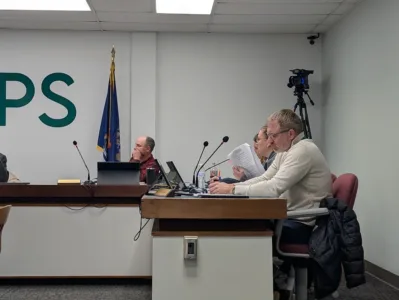
ALPENA -- In a five to two vote, the Alpena Public Schools Board of Education approved a new policy restricting girls' athletics and girls' locker rooms to biological females at their regular meeting on Monday.
Board members Sarah Costain, AJ MacArthur, Monica Dziesinski, Eric Hansen, and President Eric Lawson voted in favor of the policy, while board members Sarah Fritz and Anna Meinhardt voted against the policy.
Policy 2431.001 Girl's Athletic Participation and Facilities Use states:
"Participation in girls' athletics at Alpena Public Schools shall be restricted to biological females as documented on the birth certificate at the time of birth. Access to and use of girls' athletic facilities (locker rooms) shall follow the same restriction. This restriction does not apply when teams are assigned to locker rooms typically intended for a different biological sex due to the need for additional facilities."
The policy was introduced to the board at last Monday's workshop meeting, in response to a similar policy being approved in Monroe Public Schools (MPS).
A lawsuit was filed in that school district for an incident that occurred at an athletic event, Lawson said. MPS is currently under investigation by the Federal Department of Education Office of Civil Rights for violating Title IX.
The district crafted a policy that would protect them and help them pivot in what Collins and Blaha PC, a firm that specializes in education law, thought was an appropriate direction.
Colin Hainstock, an Alpena High School senior, explained his thoughts on the policy during public comment.
"How can we enforce this?" he said. "How are we honestly going to expect to enforce this? Can anybody tell if somebody, in my example, can anyone tell if somebody is transgender? No, no you can't...I don't have anything else to say except don't confuse having the authority to act with having a need to act."
Yvonne Johnson "You've repeatedly ignored the students, parents, educators, taxpayers, voters, the list goes on and on all of us who've told you that we do not support these types of culture war campaigns that violate the civil rights of Alpena's kids.
Johnson read from a letter sent to the Board of Education by the American Civil Liberties Union (ACLU) of Michigan Attorney Jay Kaplan.
Kaplan says he believes that the new policy violates the Elliott-Larsen Civil Rights Act, which is Michigan's civil rights law and prohibits discrimination on the basis of gender identity and gender expression in education, including sports activities and access to locker rooms. He says that federal executive orders do not supersede the state civil rights law.
After public comment, the board went into a closed session for the reason of attorney-client privilege.
When the new policy was brought up for discussion and a vote, Fritz asked whether there has been an issue with any of the teams coming in or any of APS's athletic teams, and how they plan to enforce the policy.
Fritz said she had a discussion with Mark Uyl, the Executive Director of the Michigan High School Athletics Association (MHSAA) and she was informed that they are not granting any new waivers for transgender students to participate on the team that matches their gender identity. Uyl said there is too much conflict between state law and the executive order from the federal government.
"I don't really see the necessity for this considering it’s pretty much a moot point," Fritz said.
Dziesinski made a motion to approve the policy as presented, and MacArthur offered support.
Meinhardt reiterated Fritz's concerns.
"We're kind of in a flux area...where the rights in Michigan don’t necessarily coincide with the executive order, and that personally I'm not willing to accept the risk for the district by adopting any policies one way or the other for such a gray area. Talk about how it's handled on a case-by-case basis and that seems to be like a legally safer place to be."
Lawson said he believes such a policy will protect APS student athletes.
"Personally, I feel like the physical safety of our students is even more important than legal safety, and that I think is at least for me is what drives my concern about this," Lawson said.
"So you're saying you're willing to risk lawsuits?" Fritz said.
"There's no great area to be in this question so I feel personally my conscience is telling me to protect the student athletes," Lawson responded.
Meinhardt asked whether Lawson feels that students have been unprotected under the current system where incidents are handled on a case-by-case basis.
"I think the potential is there," Lawson said.
Fritz asked whether there have been any complaints brought to the staff or the superintendent. Superintendent Dave Rabbideau responded that to his knowledge, no complaints have been made.
Fritz asked how it's going to be enforced and whether going through records to look at a student's birth certificate is a violation of privacy.
Lawson said that birth certificates are on record already and whether it's a violation of privacy would depend on how it's done and the circumstances. The superintendent would be responsible for that task.
"I can't imagine a scenario where we would be directed to look at the birth certificate without--there would have to be a complaint they filed versus verifying rosters, I’m not exactly sure," Rabbideau said.
Fritz asked about what would be done with opposing teams coming to the district.
Lawson responded that there would probably have to be a particular complaint, and Rabbideau agreed.
The board's next meeting will be a workshop at 5:30 p.m. on Dec. 14.