
Alpena native Chuck Blackaby receives FAA’s Wright Brothers Master Pilot Award
Trending
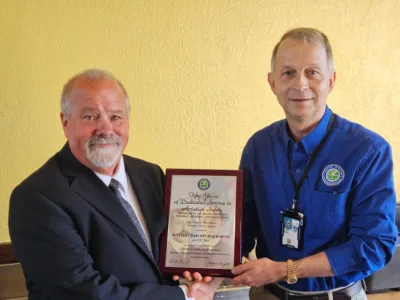
ALPENA - Chuck Blackaby has spent half a century in the cockpit without an accident or enforcement action against his certificate -- a 50-year record of safe flying recently recognized by the Federal Aviation Administration (FAA) with its highest honor for pilots.
Blackaby, an Alpena native, received the Wright Brothers Master Pilot Award, which honors pilots with 50 or more years of civil or military flying experience and an unblemished safety record. Named for aviation pioneers Orville and Wilbur Wright, the award requires recipients to hold a U.S. pilot certificate, have no certificates revoked, and demonstrate a sustained commitment to professionalism and safety.
"It was an honor, definitely an honor," Blackaby said. "It's 50 years, and it's hard to do anything for 50 years and be successful at it. It's primarily a safety award given if you haven't had any accidents or actions taken against your license, like a revocation."
The FAA does not automatically track candidates for the award. Pilots must be nominated by themselves or a colleague before the agency verifies their flight history and safety record.
Blackaby's aviation journey began in Romeo, Michigan, on his 16th birthday in 1976, when he soloed in a Cessna 150 at the youngest age permitted by law. He earned his private pilot certificate while living in the Detroit area and subsequently trained as an aircraft mechanic.
In 1987, Blackaby relocated to Alpena for his first paid aviation role: working as a mechanic for Welch Aviation at Alpena County Regional Airport. While maintaining aircraft, he built up his advanced pilot ratings under the guidance of operator Jeff Welch. He handled corporate flights -- including flying an aircraft operated by Besser -- before moving to Aviation North, an Alpena-based charter company, where he flew Part 135 charter flights.
By the mid-2010s, charter and local flying opportunities in Alpena had not fully recovered from the 2008-2009 economic downturn. Wanting to stay local while his daughter finished high school, Blackaby joined St. Louis-based regional carrier Trans States Airlines in 2016 for a year and a half.
In late 2017, he transitioned to Frontier Airlines, where he flew Airbus aircraft and earned a promotion to captain. He flew for Frontier until reaching the mandatory airline pilot retirement age of 65 in July 2025.
He and his wife have since relocated to Naples, Florida, where he flies a corporate turboprop.
"Now I'm just flying... semi-retired," Blackaby said. "When you love something enough, you're probably never fully retired."
Over his 50 years in the air, Blackaby experienced several in-flight engine failures -- all in multi-engine aircraft.
"It's an attention getter when an engine quits in flight or fails to the point where you got to shut it off," he said. "Thankfully, it was never in a single-engine airplane."
Blackaby advises aspiring aviators to stay passionate and remain dedicated students of the craft.
"Just love what you're doing and study - never, never ever stop learning," he said. "There's an old saying that as soon as you know all the answers, somebody changes the question."
In both charter and airline flying, crews routinely analyze safety incidents across the industry.
"You have to learn from other people's mistakes," Blackaby said. "Because you'll never live long enough to make them all yourself."
He noted that regulatory standards have tightened significantly since the 1980s and 1990s. The FAA has gradually pushed charter operators toward airline-style training and rigorous documentation.
"That's good for the flying public, but it makes it much more difficult for pilots to get the experience they need compared to back in the '80s and '90s," Blackaby said. "I don't want to say it was lax back then, but it was looser."
The financial barrier to entry has also risen dramatically.
"When I started flying at 16, I could cut grass for the neighbors Monday through Friday, and that gave me enough money to fly for an hour or so on Saturday," Blackaby said. "I really don't think somebody could do that these days. It is so bloody expensive."
While intensive flight academies accelerate training and prepare students directly for airline careers, many graduates emerge with $120,000 to $140,000 in debt before landing their first job.
"It's tough," Blackaby said.
Looking back, Blackaby credits several mentors and organizations for supporting his career. He singled out Welch for hiring him as a mechanic and guiding him through his pilot ratings. He also highlighted his time with the Civil Air Patrol, where members worked together to foster safe flight operations.
Above all, he acknowledged the support of his family.
"I'd like to thank my family because they made a lot of sacrifices -- particularly early mornings, late nights, missed holidays, and long stretches away from home," he said. "They made a great sacrifice for my career."
Blackaby plans to continue flying corporate aircraft in Florida while enjoying semi-retirement. The Wright Brothers Master Pilot Award formally honors the half-century of safe flying that began with a 16-year-old soloing a Cessna 150 and progressed through northern Michigan charter flights, regional and major airline cockpits, and corporate aviation.
Josh Jambor can be reached at jjambor@thealpenanews.com.