
Thunder Bay history sits behind Monday’s dual observance
Trending
ALPENA - Monday is both Columbus Day, a federal holiday since 1937, and Indigenous Peoples Day, an observance a growing number of cities and states mark on the same date. In Alpena, the two share a calendar day and a local history that runs from Thunder Bay to a 2015 mayoral proclamation and a museum gallery that opened last year.
The city formally recognized Indigenous Peoples Day on Sept. 8, 2015, when then Mayor Matt Waligora read a proclamation at a Municipal Council meeting designating Oct. 12, 2015, as Indigenous Peoples Day in Alpena. That date was the second Monday in October, the federal Columbus Day holiday. The proclamation honored the long-standing history and contributions of the Saginaw Chippewa Indian Tribe and other Indigenous peoples of Michigan, and it cited the city's partnership with the tribe on the Lake Huron Discovery Tour.
Waligora read a similar proclamation at the Oct. 3, 2016, council meeting, designating Oct. 10, 2016, as Indigenous Peoples Day and tying it to a regional heritage project that included the tribe.
ClickOnDetroit later listed Alpena, with Traverse City, among the first Michigan cities to recognize the observance, in 2015. Ann Arbor, East Lansing and Ypsilanti followed in 2016. The 2015 and 2016 actions were mayoral proclamations presented at council, not an ordinance striking Columbus Day from the city calendar. Residents and groups here continue to mark either day, or both, according to their own traditions.
Columbus Day commemorates Christopher Columbus's 1492 landing in the Caribbean. Congress asked the president to proclaim it in 1934, and it became a federal holiday in 1937. Indigenous Peoples Day grew out of proposals by Native delegations beginning in the 1970s and is observed by many tribal nations, cities and states as a day to recognize the cultures and histories of the peoples who were already here. Michigan governors have issued Indigenous Peoples Day proclamations in recent years. Neither observance cancels the other on the federal calendar.
In Alpena, the date sits on ground shaped by both histories.
A plaque on the Second Avenue bridge over the Thunder Bay River marks the Treaty of Saginaw, signed Sept. 24, 1819, by territorial Gov. Lewis Cass and Chippewa leaders. The treaty ceded roughly 6 million acres in eastern Michigan. Its northern line followed the Thunder Bay River from its headwaters to the mouth at Thunder Bay. The river was also a boundary in the 1836 Treaty of Washington. Before the logging era, Anishinaabe families (Ojibwe, Odawa and Potawatomi, the Three Fires) used the lower river and bay as a seasonal fishing and gathering place. Anishinaabemowin names still sit under the English ones: Nimkii Wiikwedong, Thunder Bay, and An-a-ma-kee-zebe, the Thunder Bay River. (previous Alpena News stories from 2019 and April 2023)
The county's own name is part of that record. In 1840, Indian Agent Henry Schoolcraft first called the new county An-a-ma-kee, "thunder," for a Thunder Bay band chief associated with an 1826 treaty. He later coined Alpena, drawing on an Indigenous syllable and words for partridge or bird. Nineteenth-century accounts, including surveyor David D. Oliver's history of the county, describe Chief Mich-e-ke-wis and a small band living near the river and at Aw-pe-na-sing, Partridge Point. Euro-American settlement at the mouth of the river accelerated in the late 1850s, followed by the lumber boom.
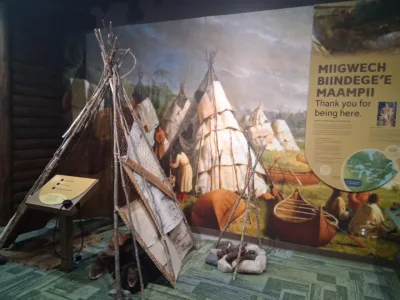
That history is now on the walls at the Besser Museum for Northeast Michigan, located at 491 Johnson St. The museum's "Discover Northeast Michigan History" exhibit opened to the public in January 2025 after a multi-year rebuild of a Native American gallery first installed in 1971 from the Haltiner collection.
A welcome panel, written by Charlee Brissett and Colleen Medicine of the Sault Ste. Marie Tribe of Chippewa Indians and guided by an Anishinaabe advisory council, artists and elders, greets visitors to Nimkii Wiikwedong and describes nibi, water, as a living relative and the bay as a place of abundance.
Other panels follow Anishinaabe communities across northeast Michigan, including the Oscoda Indian Mission, Ojibwe pastors such as the Rev. Simon Greensky and the Rev. John Silas, and families who remained in the region after treaty-era removals. The George R. and Edith M. (Angell) Cook family helped fund the reinterpretation.
Museum officials have said the goal was to tell the story with tribal elders rather than only through objects collected decades ago. The Saginaw Chippewa Indian Tribe, through its Ziibiwing Center of Anishinabe Culture & Lifeways in Mount Pleasant, has also worked for years under the federal Native American Graves Protection and Repatriation Act to return ancestral remains, including ancestors from Alpena County held by universities and museums.
Monday will mean different things to different people in the Alpena area. For some it's Columbus Day, a federal holiday marking a voyage that reshaped the Atlantic world. For others it is Indigenous People's Day. When the proclamation was signed in September of 2015, the city did not replace one name with the other. It added a local recognition beside a holiday already on the calendar.