
AMA ESD special education millage renewal to be on Nov. 3 ballot
Trending
ALPENA -- Voters across Alpena, Montmorency, and Alcona counties will consider a renewal of the Alpena-Montmorency-Alcona Educational Service District (AMA ESD) special education millage on the upcoming Nov. 3 ballot.
According to a Sept. 10 press release from the AMA ESD, The millage was originally approved in 1989 and has been renewed four times since. The ballot proposal requests a continuation of the current rate of 1.2872 mills for the next 10 years, covering 2027 through 2036.
A residence with $50,000 in taxable value would owe approximately $64 in taxes annually at that millage rate.
That rate is lower than the 1.3318 mills approved by voters during the previous renewal in 2016. The estimate of the revenue the intermediate school district will collect if the millage is approved and levied in 2027 is approximately $3,536,404.
The AMA ESD partners with Alpena Public Schools, Alcona Community Schools, Atlanta Community Schools, and Hillman Community Schools, and many of the programs and services funded by the millage are delivered directly within the local school districts.
AMA ESD Superintendent Justin Gluesing said in the press release that the AMA ESD is focused on providing residents with clear information about the millage and the programs and services it funds.
"We want residents to understand how the revenue is used across our three-county service area," Gluesing said. "We are focused on making sure voters have a clear picture of what the millage funds, who receives those services, and how the revenue is distributed throughout the AMA ESD region."
The funding generated by the millage is used in three primary areas:
Pied Piper School and specialized classroom programs: The millage helps fund programming at Pied Piper School, which serves students with moderate to severe cognitive impairments, severe multiple impairments, and autism. That includes the early childhood special education and emotional impairment programs housed within local districts.
That includes an early childhood special education program at Lincoln Elementary and an emotional impairment classroom at Ella White Elementary.
Pied Piper students come from all over the AMA ESD school districts, with buses traveling south of Harrisville to west of Atlanta, and everywhere in between, Gluesing said.
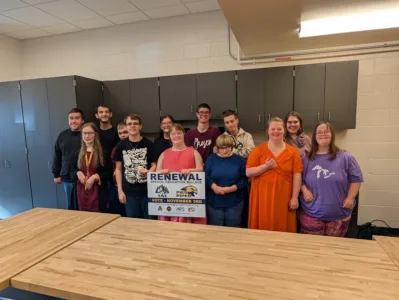
Pied Piper Principal Lauren Grulke said that the school educates students from ages 3 to 26. Students are placed into classrooms based on the severity of their disabilities.
There are two programs for Severely Cognitively Impaired (SCI) students, a primary program for elementary aged students and a secondary program for middle and high school aged students.
The Moderately Cognitively Impaired classrooms, called MoCI classrooms, are also split into primary and secondary along the same grade level lines.
Students in the age range of 18 to 26 years old are part of the transition program, where they learn more about daily living and are taught skills to help them function as independently as possible in the community. Transition students learn how to cook for themselves, find items grocery shopping, learn to use a washer and dryer, and more.
Some of those students spent most of their education at Pied Piper, while others may have graduated from local high schools and moved on to the transition program afterwards.
Special education services: The millage helps fund in-home and school-based special education services, including physical, occupational, and speech therapy, school psychological and social work services, behavioral support, Early On and early intervention programming, and post-secondary planning.
Direct district financial assistance to local districts: The millage helps reimburse local school districts to offset special education costs. Since 2016, the AMA ESD has distributed more than $12,000,000 back to Northeast Michigan public school districts.
"Special education students by the nature of their disabilities cost much more to educate beyond those other dollars that flow into the school aid picture," Gluesing said.
Grulke and Gluesing said that their favorite part of working within special education is seeing the students progress towards their goals.
"Just seeing them being able to engage and have that independence, again, whatever that might look like for individual students--always brings me the greatest satisfaction," Gluesing said. "It fills me up every time because that’s what you want for kids, you want them to be able to get on to what's next and be prepared for what’s next, whatever that might be."
"Sometimes we work on the same thing for years and then it finally clicks, those are the most rewarding things, or to see them come into the building at a young age and what they might struggle with and to see how independent they are now, is pretty fulfilling," Grulke said.
"The proposed renewal is for 10 years, which is consistent with the previous two renewals approved by voters," Gluesing added in the press release. "Given the election costs associated with placing a proposal on the ballot, we also wanted to be mindful of those expenses while maintaining a term that has been familiar to voters in past renewals."
To learn more about the renewal or the services provided by the AMA ESD, visit the AMA ESD’s website (amaesd.org) and click on the "Millage Renewal" link at the top of the page.