
The Alpena Bi-Path at autumn’s arrival
Trending
Autumn has arrived in Northeast Michigan, bringing crisp air and an invitation to experience the beauty of the Alpena Bi-Path as the seasons change and the fall colors arrive. As we continue to mark the anniversary of the Bi-Path and reflect on the Sestercentennial--the 250th anniversary of the Declaration of Independence--fall provides an opportunity to appreciate the art, history, and natural beauty along the pathway as the backdrop of this great natural canvas changes.
The original vision of the Alpena Bi-Path as the Alpena Sculptured Walkway/Bikeway was connected to our nation’s Bicentennial celebration in 1976, thus the name "Bi-Path". Nearly fifty years later, that vision continues to be realized through the integration of public art into our community’s natural spaces as we celebrate the Bi-Path’s evolution, much like the passage of the seasons, time, and history.
Art in Nature
One of the distinctive features of the Bi-Path is the opportunity to encounter art while enjoying the outdoors. Sculptures near the Wildlife Sanctuary at Washington Avenue and Sytek parks, as well as monuments and memorials in the vicinity, encourage us to experience familiar places from different perspectives as the seasons change, and on the west side of town, along the Thunder Bay River and the Alpena Wildlife Sanctuary running through the heart of our town.
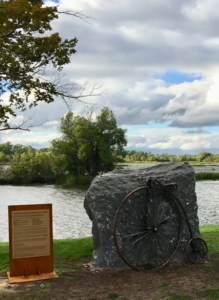
At Washington Avenue Park, High Wheel Bicycle, a hand-forged steel-and-copper sculpture by Jacob Moss Idema, represents the importance of recreation and tourism to Alpena and Northeast Michigan as they have evolved over time. The historic bicycle evokes both the spirit of early bicycling and the original vision of the Sculptured Walkway/Bikeway. Set against a limestone pillar overlooking the Thunder Bay River and Wildlife Sanctuary, it suggests a traveler pausing to enjoy the scenery.
The sculpture also reminds us that recreation contributes to community development, health, prosperity, and quality of life. Sometimes, it is simply about taking time to stop, look around, and appreciate where we live.
Nearby, Idema’s The River Intertwined offers an even more contemplative experience, leaving much to interpretation, as all good art should. Its flowing hand-forged steel form is intended to reflect the Thunder Bay River and the trees and forests along its banks. Rivers have long been lifelines of communities, supporting transportation, industry, recreation, and human development.
The sculpture also carries a deeper meaning. Dedicated to those who lost their lives during the COVID-19 pandemic and constructed during the pandemic, it acknowledges loss and hardship while reflecting life’s unpredictability. Like a river, life includes calm stretches, unexpected turns, and passages. Standing beside the river provides an opportunity to remember those we have lost and reflect on what we have experienced.
From just beyond Washington Avenue Park, one can visit these memorials and monuments along the Alpena Bi-Path as well:
· War of 1812-Civil War-Spanish-American War Memorial -- at Evergreen Cemetery, honoring veterans from those three conflicts.
· Alpena County Civil War Soldiers and Sailors Monument -- also at Evergreen Cemetery, honoring Alpena County soldiers and sailors who served during the Civil War.
· Bicentennial Veterans Memorial / Little Flanders Field -- at Evergreen Cemetery. The site includes 167 crosses representing service members from the Civil War through more recent conflicts, along with
memorials related to POWs, MIAs, and Agent Orange -- especially appropriate because it was established in 1976, connecting directly to the Bi-Path’s original Bicentennial origins.
At Sytek Park, Fishing with Papa, created by Ann Gildner of Gildner Studio, offers another perspective on recreation and relationships. Inspired by the life of Randy Donakowski, the sculpture celebrates the spirit of a fisherman, an inspiration, and a person connected to his community.
Fishing represents more than an outdoor activity. It can create opportunities for conversation, companionship, and memories shared across generations. In an increasingly busy world, the simple act of spending time together is worth celebrating.
Together, these sculptures demonstrate how public art can transform a recreational pathway into a place for discovery, connections, and reflection.
Fall, History, and Beginnings
Autumn is not just the prelude to winter; it provides an opportunity to reflect on a great summer passed and the coming of a new year. From the perspective of the history that shaped our nation, the summer and fall of 1776 marked a critical transition in the American Revolution. Following the adoption of the Declaration of Independence on July 4, Americans moved from declaring independence to defending and fighting for its reality.
By August, British forces had launched a major campaign to regain control of New York. The fighting continued through September and October as Washington’s Continental Army faced overwhelming British forces and was forced to retreat from New York. At the same time, American forces were attempting to carry the Revolution northward into Canada.
These months, over the course of eight long years of fighting, remind us that independence was not achieved simply by declaring it. It required years of sacrifice, uncertainty, perseverance, and commitment. The difficult winter at Valley Forge in 1777/1778 would become one of the most enduring symbols of that struggle amid the seasonal shifts of time and the passage of circumstances.
As we continue to celebrate the Sestercentennial and reflect on the Bicentennial vision that helped inspire the Alpena Bi-Path, the changing seasons offer a natural opportunity to consider the experiences of those who came before us, where we are, how we got here, and what comes next. The challenges of the Revolutionary era, the hardships of later generations, and even the experience of the COVID-19 pandemic remind us of the resilience required of individuals and communities.
History becomes more meaningful when we connect it to the places and experiences around us. Along the Bi-Path, the river, the sanctuary, the changing landscape, and the sculptures provide opportunities to pause, remember, and reflect on relationships.
Before Winter Arrives
Before another Northern Michigan winter arrives, take advantage of the weeks ahead.
Walk the Bi-Path. Ride a bicycle. Visit High Wheel Bicycle, The River Intertwined, and Fishing with Papa among the other opportunities for reflection. Bring a friend, family member, or child and experience the sights, sounds, and smells of fall.
Notice the changing leaves. Listen to the river. Take time to appreciate the sculptures and the stories they tell.
The Alpena Bi-Path offers more than physical recreation. It is a place to encounter public art, reconnect with nature, remember the past, and strengthen our connections with one another.
As we look forward as the Sestercentennial continues, the Bi-Path also reminds us that the vision of a sculptured walkway and bikeway, first imagined during the Bicentennial, continues to hold meaning nearly fifty years later. It is an enduring example of how art, recreation, history, and public spaces can become part of a community’s identity.
The Alpena Bi-Path: a place to recreate, a place to reflect, and a place to rediscover the connections between nature, art, history, and community.