
Rain gardens take root in Alpena
Trending
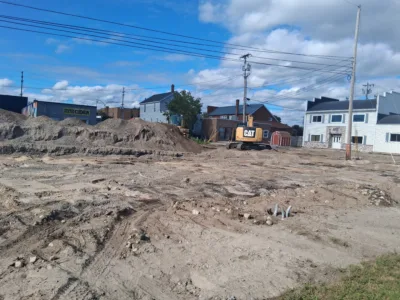
ALPENA - The newest planting along River Street and behind PIF Cider are not fall flower beds. They are shallow basins built to catch rain and snowmelt before the water can race off pavement, into a storm sewer, and out into Thunder Bay.
That distinction matters in a city that has drawn its drinking water from Lake Huron since 1905. Stormwater is not treated at the water plant. It runs to outfalls, carrying road salt, fertilizer, sediment, pet waste, and litter with it. A rain garden filters that runoff in place, with soil and plants instead of another length of pipe.
The design is simple on purpose. Crews find a low spot where water already gathers, excavate a few feet, layer in stone and pea gravel, cap the basin with sand, topsoil and organic matter, and plant natives whose roots punch deep into the ground. After a storm, water ponds briefly, soaks downward and is taken up by the plants. Microbes break down nutrients. Sediment settles. What leaves is slower and cleaner, and it puts less strain on underground sewers.
The plants do the work. Milkweed, goldenrod, blue vervain and other natives are chosen less for color than for roots that hold soil, tolerate wet-and-dry cycles and, once established, need little irrigation. Huron Pines staff have said the plantings become drought-tolerant after a couple of growing seasons and can reseed themselves.
The same idea is already in the ground at Bay View Park, where a 1,000-square-foot rain garden sits in a pocket that used to pond after heavy rain or when waves washed over the breakwall. That standing water made mowing miserable for public works crews. City Engineer Steve Shultz previously told The News that Department of Public Works staff handled most of the excavation and Huron Pines handled the planting. Early planning lists put the Bay View rain garden near $6,000 and a companion native planting near $21,000; a dune restoration extension at Mich-e-ke-wis Park was estimated around $38,100. Those were conceptual figures and do not include later in-kind labor.
Maintenance is the question that follows the first bloom. After Huron Pines' two-year establishment window at Bay View, City Manager Rachel Smolinski said the work is not meant to become a new weeding route for DPW employees.
"The gardens will be maintained through regular volunteer events hosted by Huron Pines and the City," Smolinski said. "Since these are native plants, they should grow in after two to three years with minimal weeding and there should be no watering required."
A lawn in a wet pocket has to be mowed whenever it dries enough to take a machine. A rain garden asks for weeding and watering up front, then is built to stand on its own.
Asked how the park gardens fit the city's source-water work and the downtown projects that went to council with Huron Pines (the River Street parking lot and the Washington Avenue/Chisholm Street bump-out), Smolinski treated them as one set of tools.
"They are all green stormwater infrastructure projects designed as nature-based solutions for stormwater management to capture and filter runoff," Smolinski said. "This all helps protect Lake Huron, which is the source of our drinking water and also supports our commitment to the Lake Huron Forever Pledge."
The pledge, signed in September 2023 by Smolinski, then-Alpena Township Supervisor Nathan Skibbe and then-County Administrator Mary Catherine Hannah, puts Lake Huron in front of planning and spending. The city's list includes building green infrastructure at priority sites with Huron Pines, so runoff is captured before it reaches the Thunder Bay River and the lake and continuing to re-naturalize coastal parks.
Council packets put numbers under the downtown phase. On Aug. 3, the Municipal Council awarded the Green Stormwater Infrastructure Project - Phase I to MacArthur Construction of Hillman for $248,375.10 after two bids came in from 14 solicitations. Huron Pines used a $115,000 National Fish and Wildlife Foundation grant to pay for design by Drummond Carpenter and to offset construction.
The city is matching the rest from Local Streets and Public Works accounts, and a budget action carried $192,440 into the current year for the green stormwater line. The contract rebuilds the lot at Third Avenue and River Street and converts the lawn bump-out beside the DDA building. City Engineer Stephen Shultz told council the point is to clean stormwater before it reaches the sewer, the river or the lake.
The River Street lot had sat on the Capital Improvement Plan for years. Grant money made stormwater the reason the lot moved, not an add-on. Earlier planning lists had priced a River Street bioswale near $76,000 and a Washington Street bioretention cell near $14,200; the awarded package is larger because it rebuilds the lot rather than planting beside it.