
Get the tattoo, not a communicable disease
Trending
ALPENA -- What was once a social taboo, collecting tattoos on one's body has become a modern day norm. New tattoo shops are coming to Northeast Michigan and artists and shop owners want to let the community know that hygiene and cleanliness are their number one
priorities.
Stella Johnson recently opened Pin Cushion Body Art on U.S. -23 South. She said that her number one priority is making people feel safe and comfortable.
"Sterilization is the absolute most important thing," Johnson said. "It's not something that the public thinks about, which they shouldn't have to. When you go to a hospital, you don't think 'Oh, I hope everything's clean.' Everything should be clean."
She said that tattoos and piercings are considered open wounds and should be treated like open wounds.
"That's what a tattoo is, that's what a piercing is," Johnson said. "The people that do the job really need to appreciate how important it is."
She explained that a new fad in the tattoo world is that untrained people can order tattoo machines online and will try to start tattooing their friends, families, or paying customers from their homes.
"Learn how you want and everything, but there's a huge risk," Johnson said. "People don't realize if you are tattooing somebody with Hepatitis B, even as bad HIV, like these serious bloodborne pathogens, and you don't have the proper equipment to sterilize … you can pass it on to somebody else."
She said that she will clean equipment between uses even if back-to-back clients are family
members.
"We're not sharing needles," Johnson said. "It's not going to happen."
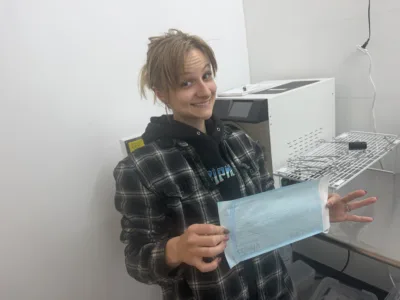
Johnson explained that when getting a piercing, the piercer should open their tools from sterilization pouches in front of you. She said if they don't do this, you should not get a piercing or tattoo from that facility.
"I tell a lot of my clients … if you ever get a piercing and there's something metal and does not come out of one of these, leave," she said. "Because you just don't know."
Johnson said that the sterilization process is a multistep process that ensures tools are clean and free from bloodborne pathogens.
First she scrubs her tools using Dial Gold antibacterial soap and toothbrushes. Then the tools go into a digital ultrasonic cleaner after a 10 minute soak in a hospital grade cleaner.
"It's a way of chemical sterilizing, just to soak that stuff and help get all the yuckies out," Johnson said. "The ultrasonic cleaner, they actually use this for not just instruments, but like car parts. It uses sound waves to break off the itty bitt, tiny little pieces of debris and yuckiness that you can't see."
The tools are left to air dry on a drying rack to avoid rust. Next, Johnson said that the tools go through an autoclave, which is a machine that uses pressurized steam to kill bacteria, viruses, fungi, and spores on equipment.
Johnson explained that the local health departments in Michigan, under the Michigan Department of Health and Human Services (MDHHS), inspect body art facilities to
ensure that they have an autoclave and that it is working properly.
Her facility and sterilizing equipment was inspected by the District Health Department No. 4 (DHD4).
According to Johnson, body art facilities in Michigan have to have a Class B autoclave, which is the grade of machinery used in dentist offices. Class S autoclaves are used in hospital and surgical settings.
The pouch that holds the equipment will have a blue arrow on the package that turns black.
That indicates that the equipment has reached an appropriate temperature to kill bloodborne pathogens and bacteria.
Chelsea Engle, DHD4 medical director, explained that DHD4 routinely inspects body art facilities and state law requires those facilities to have the proper equipment and safe practices to protect the community.
"The body art facility licensing law was enacted to reduce the risk of bloodborne disease transmission like Hepatitis B, Hepatitis C, and HIV." Engle said, via email. "It is important for body art facilities to have the right safety practices in place to keep our communities safe, especially those who get tattoos or body piercings."
"DHD4 inspects facilities where tattooing and body piercings are done," she added. Check out the list of licensed body art facilities to make sure you are going to a place that has been inspected for safety."
People wishing to get a tattoo or piercing should visit michigan.gov/mdhhs/doing-business/licensing/body-art to ensure the facility is licensed and inspected by MDHHS.
Kayla Wikaryasz can be reached at 989-358-5688 or kwikaryasz@TheAlpenaNews.com.