
From Alpena’s tarmac, to the hospital’s door
Trending
ALPENA - For Kathy Manning, specialized treatment is not down the street. It is hundreds of miles from home, beyond winter weather, long hours on Interstate 75, and the fatigue that follows cancer care.
LifeLine Pilots exist to help narrow the gap between out of town appointments and care at home in Northeast Michigan.
The Peoria, an Illinois-based non-profit group, is not an air ambulance service and doesn't fly medical emergencies. Instead, Communications Manager Andrea Pietrowsky said it is one of the oldest operating volunteer pilot organizations in the United States and a pioneer in the charitable aviation movement.
The group coordinates free flights for medically stable people who need non-emergency medical and humanitarian transportation across 10 Midwest states, including Michigan.
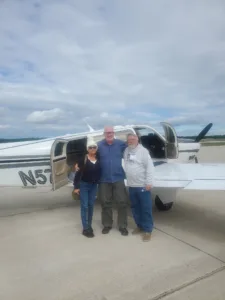
Kathy's husband, Bryan Manning, said the service has become part of their treatment routine.
"LifeLine Pilots have been absolutely amazing," Bryan Manning said. "They have the most amazing volunteer pilots that are there to help any way they can. They pick us up at the Alpena airport and fly us to the airport 10 minutes from the hospital. We found out about them by chance through another patient at the hospital, so I signed up and they have always been there."
That path, the word of mouth from another patient to another, is common. Pietrowsky said hospital social workers, nurse navigators, case managers, physicians, nonprofit partners, former passengers and online searches all lead people to the organization.
Once someone contacts LifeLine Pilots, staff determine eligibility, collect physician clearance and match the trip with a volunteer pilot. Bryan Manning said the paperwork is not a barrier.
"The sign-up process was simple and there is no income requirement, so everybody can use this amazing program," he said.
Pietrowsky said the flights are scheduled, not urgent. "Unlike paid air ambulance services, our free flights are typically scheduled weeks in advance," she said. "We help people who are medically stable but need transportation to reach specialized treatment, follow-up appointments, evaluations, or other essential care that may be hundreds of miles from home. It does not transport patients during medical emergencies or provide in-flight medical care."
Passengers must be able to board and sit upright in a small four- to six-seat airplane and be cleared to fly by a treating physician. Volunteer pilots fly general aviation aircraft that are not staffed or equipped like medical helicopters.
"Our role is to eliminate transportation barriers so patients can reach treatment, not to provide emergency medical transportation," Pietrowsky said.
The idea began in 1981 with Wanda Whitsitt of Champaign, Illinois, who started coordinating flights from her garage. Whitsitt believed, "Pilots have a special skill, and my hope is that they will use this skill outside the limits of their life and make a difference in somebody else's life."
Forty-five years later, Pietrowsky said, LifeLine Pilots "has evolved from a volunteer effort operated by founder Wanda Whitsitt in her garage into a major Midwest healthcare-access organization that has coordinated more than 13,000 flights and flown more than 7 million miles." Hundreds of volunteer pilots still donate aircraft, fuel, expertise and time.
Passengers do not pay. "Our volunteer pilots generously donate their time, aircraft, and fuel," Pietrowsky said. "In 2025 alone, LifeLine Pilots volunteer pilots donated more than $2 million worth of flight services to help passengers reach critical medical care."
An adult passenger may bring one companion; a pediatric passenger may bring up to two. Approved medical equipment can come aboard if reviewed in advance. Space is limited: passengers and companions are restricted to a combined 40 pounds of carry-on baggage.
Weather remains the hard variable. Volunteer pilots serve as pilot-in-command and decide whether a flight is safe. If it is not, staff try to reschedule or reassign the mission. Pietrowsky said passengers should keep backup plans, "which typically means rescheduling their appointment until it is safe to fly."
When one small plane cannot cover the whole distance, the nonprofit builds a relay. One volunteer flies part of the route and meets a second pilot at a connecting airport. Staff handle the handoff so the passenger can board the first flight and continue to care - and home again.
Rural communities such as Alpena are a large part of the work.
"A significant portion of our passengers come from rural and smaller communities where specialized medical care simply isn't available," Pietrowsky said. About 1 in 5 Americans live in rural areas, and transportation is one of the largest non-medical barriers to care.
"For people living in places like Alpena, the challenge isn't just distance. It's time, cost, as well as the physical toll of traveling for medical care hundreds of miles from home," she said.
A small-airport departure near home and an arrival near a medical center can spare hours of driving or commercial connections - the difference Bryan Manning described as a 10-minute hop from the hospital instead of a grinding road trip.
On repeated treatment schedules, those flights can become relationships. "When a passenger needs to fly multiple times over weeks, months, or even years, it's common for genuine friendships to develop," Pietrowsky said. "Pilots become invested in a passenger's well-being, and families often remember those acts of kindness long after treatment ends."
So far, more than 13,000 missions have been flown for more than 7 million miles. More than $2 million is donated for flying in a single year.
"Every flight represents a patient, a family, and a healthcare journey made easier," Pietrowsky said. "A free flight doesn't just save time or money. It reduces stress and allows patients and families to focus their energy where it belongs: on their health and having hope."
"We believe access to healthcare shouldn't depend on where you live," she said. "For the past 45 years, LifeLine Pilots has helped bridge that gap one flight at a time."
People seeking a flight can call 800-822-7972, email Missions@LifeLinePilots.org or visit www.LifeLinePilots.org. Licensed pilots who want to volunteer can apply at https://lifelinepilots.org/pilot-information/.