
DNR hosts lake sturgeon hatchery tours
Trending
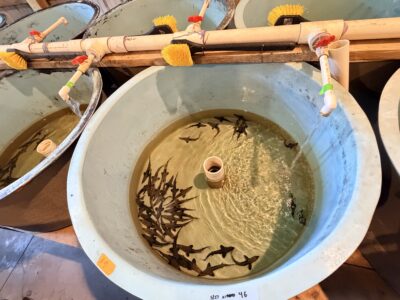
ALPENA -- The Department of Natural Resources (DNR) hosted tours of the lake sturgeon hatchery facility on Black River in Onaway on Saturday. Visitors had the opportunity to see the facility and the lake sturgeon raised there that will eventually be released into Black River and other parts of the state.
According to a DNR press release on Aug. 17, the streamside rearing facility is part of lake sturgeon rehabilitation efforts in the Cheboygan River watershed. The facility conducts research to increase understanding of lake sturgeon. Research results provide the DNR with guidance for lake sturgeon recovery efforts.
Neal Godby, a DNR fisheries biologist, told The News on Saturday that the facility is run from a partnership between Michigan State University (MSU), the DNR, Sturgeon for Tomorrow, and Tower-Kleber Limited Partnership, the company which operates and runs the dam near the hatchery facility.
Godby said that the dam company provides the property and building for the hatchery.
He explained that lake sturgeon hatchery "completes the cycle" to spawn new lake sturgeons that will hopefully out wit predators and grow to spawning maturity.
"Basically, this kind of completes this process, completes a cycle," Godby said. "The MSU crew here and DNR staff, in the spring, during the spawning run, are out in the river and tag the adults as they’re coming up for the river."
He explained that at night, hatchery staff use nets to catch hatched lake sturgeon which are then raised at the facility and then re-released.
"After those sturgeon spawn . . . the eggs are laid, fertilized, and then those eggs hatch, and the larvae will come down and drift at night. And the researchers here have drift nets out and stay out all night. They collect those larvae, bring them back here, and raise them for several months until they’re ready to be stocked."
Godby explained that some of the lake sturgeon are put back into the Black River fishery system while some others are released into Mullet Lake and other fishery systems throughout the state.
According to Godby, the stocking process has been occurring for 25 years. He said that researchers caught a spawning lake sturgeon this past spring that had returned to its stocking location.
"That’s exciting," he said. "We’re excited about the impact it's having."
Godby added that it can take a lake sturgeon up to 25 years to reach spawning maturity and then they will usually only spawn up to five years.
"That’s what takes so long to rebuild the population," Godby said.
He explained that the lake sturgeon had historically been depleted through a combination of over fishing and environmental changes which disturbed their preferred spawning grounds.
Kayla Wikaryasz can be reached at 989-358-5688 or kwikaryasz@TheAlpenaNews.com.