
Council authorizes September goose hunt at county fairgrounds
Trending
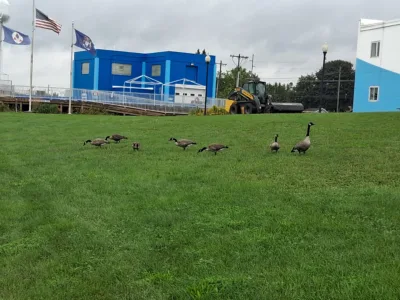
ALPENA - The Alpena Municipal Council voted 3-2 on Tuesday to authorize a controlled Canada goose hunt at the Alpena County Fairgrounds after rejecting a similar request during last month's meeting, citing limited success with nonlethal controls as a result of spring flooding, amid widespread droppings that have drawn complaints from residents and visitors.
Voting in favor were Mayor Cindy Johnson, as well as council members Danny Mitchell and Kevin Currier. Council members Bridget Hollinshead and Karol Walchak voted against the motion.
The hunt is scheduled for Sept. 17, 24 and 30. An earlier proposed date of Sept. 10 was dropped because the Department of Public Works said it would not have enough time to prepare. Hunting inside city limits requires council approval even though the dates fall during Michigan's regular goose season.
Last year, council voted 4-1 against a hunt - the first year without one since 2015. Mitchell was the lone yes vote then. The 2024 hunt harvested 41 geese, down from 118 in 2023. There was no authorized hunt in 2025. Mitchell was the lone yes vote during last month's vote on the hunt.
City Manager Rachel Smolinski told council the hunt remains one of the most cost-effective tools available. She said April flooding prevented a successful egg-oiling program this spring, a method she described as "extremely effective each year." Egg oiling, permitted through the USDA APHIS Wildlife Services program, coats eggs with vegetable oil so they do not hatch and geese typically do not renest in the same location. Reaching some nests requires a boat.
"I feel like the goose hunt is an approach that is one of the most cost effective that we have," Smolinski said. "Obviously the extenuating circumstances here with the April flooding did not allow us to be successful with our goose egg oiling."
Smolinski also brought up the option of buying a Tow and Collect 1500 Pro, a towed machine with powered brushes designed to pick up goose droppings, aeration cores, leaves and other debris from turf. Officials said Mackinaw City has used a similar unit with good results, but Alpena would still need a vehicle to pull it.
Alpena County Administrator Jesse Osmer spoke on behalf of the Alpena County Board of Commissioners, which asked the city to reconsider after last month's rejection.
"Following the vote to turn down the goose hunt some commissioners received communication from constituents expressing support for the hunt," Osmer said. "Likewise, I'm sure some of you noticed the pictures being passed around on social media showing the aftermath of our visits from our feathered friends."
Osmer added that the county was asking only for reconsideration and noted that storms and flooding limited alternative measures this past spring, leaving a problem that still needs attention.
Bob Kraft, a volunteer at Thunder Bay National Marine Sanctuary who said he was speaking for himself, described greeting cruise ship visitors and escorting them on a golf cart so they would not have to walk as far. He said he regularly must shovel goose droppings between the sanctuary and the ramp to the Lady Michigan.
"It's unbelievably disgusting and it's a shame that our guests have to experience that," Kraft said. "There are times I must drive the golf cart 20 to 30 yards off the path because it's full of goose droppings. It's not a good presentation for our guests from around the country and the world."
A single Canada goose can produce about one to two pounds of droppings a day, according to wildlife and municipal reports. Concentrations of geese have left feces on parks, ball fields, parking lots, the bi-path and waterfront areas used by tourists.
Don Gilmet, a member of the Goose Management Committee who has organized the city's hunts for years, urged officials to remove as many geese as possible.
"Get rid of as many as you can because they are still going to be here," Gilmet said. "A lot of them will leave and not come back just because they are going to get harassed for six or seven hours, three times this month."
Council members again noted there is no agreed-upon target number of geese to remove. Critics of past hunts have said harvest figures alone do not prove the hunts reduced the local population or the amount of droppings.
Johnson, who opposed last year's hunt, said she contacted state Rep. Cam Cavitt after the prior meeting to discuss the problem and spring conditions. She told Cavitt that Department of Natural Resources hunt dates do not work well in northern Lower Michigan and asked for different dates next year.
"I don't take this lightly, I'm not for the hunt but I am out in the community, and we all see the pictures," Johnson said. "We have an issue, the weather was not kind to us this year for egg collecting, which I believe is the most humane route. In order to deal with the issue, I believe we need to authorize a hunt this year and continue to work on solutions that work for all of us."
"My hope is the conversations will continue and that something will change between now and next spring," Johnson added.
Currier said two sides of the debate often talk past each other -- one focused on reducing birds to cut droppings, the other asking whether hunts actually solve the mess.
"The problem is we have two different groups thinking about the same thing and trying to talk to each other about it," Currier said. "We have one with the main goal of decreasing the goose population to eliminate some of the poop, but it's like throwing spaghetti at the wall. Meanwhile the other side is asking how that correlates with the poop situation."
Currier said he does not believe a hunt answers the basic question of whether it helps, but that at this point in the season it is a tool the city must use.