
Trending
ALPENA -- July and August have now passed, and the excitement surrounding Independence Day and the 50th anniversary of the Alpena Bi-Path has become a cherished summer memory--what a fun celebration this town exhibited - the parade and all. But perhaps the most important lesson from both anniversaries is that celebrations of history should not simply mark an event for a moment. They should remind us that history is an ongoing story.
On July 4, 1776, our founders formally declared independence from Great Britain. Yet the Declaration of Independence was not the end of what became a protracted war for independence - what we call a revolution. In many ways, it was only the beginning.
What followed was a long and difficult struggle that lasted another eight years. The new nation faced military defeats, uncertainty, sacrifice, and the constant question of whether independence could actually be secured and last. The British surrender at Yorktown in 1781 marked a decisive turning point, but it was not until the Treaty of Paris in 1783 that American independence was formally recognized. And then there is the rest of the story...
The Fourth of July represents a moment in time, an achievement, and a beginning of something more enduring - a much more involved and protracted story of how we came to be, how we evolved.
Perhaps the same can be said about Alpena’s recent celebration of the 50th anniversary of the Alpena Bi-Path and what it represents for our local community, as it has come to be over time.
This summer, our community celebrated five decades of a project that began as part of America’s Bicentennial observance--originally known as the Alpena Sculptured Walkway/Bikeway --that combined recreation, nature, and public art. Over time, it evolved into what we now know as the Alpena Bi-Path.
The anniversary also provided an opportunity to celebrate the continuing development of the path and the many monuments, memorials, historical markers, artifacts, and works of public art that help create a sense of place while telling the story of Alpena, Northeast Michigan, and who we are.
But that celebration, too, should not be viewed as a solitary event or the culmination of that story. It should be viewed as the beginning of the next chapter, a continuing evolution of sorts.
Alpena has often been described as "the little town that would not die." The phrase captures something important about the history and character of this community. Alpena’s story is not one of standing still. It is a story of perseverance, transition, adaptation, and renewal.
Industries have come and gone. Economic conditions have changed. Natural resources have been developed and transformed into opportunities. Generations have faced challenges that could not have been anticipated by those who came before them. Yet the community has continued to find ways to adapt.
In that sense, Alpena has not simply survived. It has continually reinvented itself.
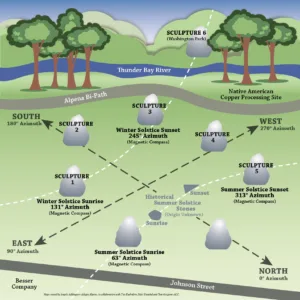
One important chapter in that story can be found along the Alpena Bi-Path and Johnson Street, next to Van Lare Hall on the Alpena Community College campus. There, on an absolutely beautiful stretch of landscape, stands the History of Industry Sculpture Series, a collection of limestone pillars with artistic installations that reflect the long history of human ingenuity, industry, adaptation, and perseverance in Northeast Michigan.
The site itself reminds us that Alpena’s story did not begin with the arrival of European settlers or the establishment of the modern community. A nearby historical marker recognizes an ancient Native American copper-processing site, where Indigenous peoples lived and worked thousands of years ago. Copper was transported to the region and fashioned into tools, weapons, and ornaments.
That history provides an important starting point for understanding this place where we live, work, and recreate.
Long before Alpena became Alpena, people were already finding ways to live, work, create, and prosper along the Thunder Bay River. They understood the value of natural resources and developed the knowledge and ingenuity necessary to use them.
Human communities have always depended upon their ability to understand their environment, use available resources, adapt to changing conditions, and create new opportunities. Those themes are at the heart of the History of Industry Sculpture Series.
Installed in 2018 through a collaboration among Thunder Bay Arts Council, Alpena Community College, and a host of community supporters, the six sculptures represent major phases of economic and community development in Alpena and Northeast Michigan. Together, they tell a story that begins with Indigenous copper processing and continues through fisheries, hunting, farming, forestry, lumber, concrete technologies, education, healthcare, recreation, and tourism. Each represents a different chapter, but none exists independently of the others.
The larger story is one of transition.
The forests that supported the lumber industry eventually changed. Markets changed. Technologies changed. Communities adapted. As timber resources became less central to the economy, Alpena and Northeast Michigan found new opportunities in limestone, cement, concrete technology, transportation, education, healthcare, recreation, and tourism.
The transformation of the sculpture site itself reflects that larger story.
The History of Industry Sculpture Series stands near the site where the Besser-Churchill Company once operated a sawmill that produced wooden shingles and barrel staves. Jesse Besser’s later innovation, the original Besser Block Machine, became part of another important chapter in the region’s industrial development. That site of the sawmill is now a center of higher education in the form of ACC, with a virtual reach extending well beyond 250 miles in this age of technology.
One industry gave way to another. Resources were reconsidered. Technology changed. Ingenuity created new possibilities.
That continuing ability to adapt may be one reason Alpena became known as "the little town that would not die."
The sculpture series also reaches beyond local history. Its limestone pillars are arranged with astronomical orientations associated with the summer and winter solstices. In that respect, the installation invites reflection upon ancient stone monuments and the ways earlier civilizations connected human activity with the natural world and the skies above.
The connection encourages us to consider a common human experience across time and the vast expanse of the universe that surrounds us.
For thousands of years, people have looked to the natural world for resources, knowledge, direction, and inspiration. They have built communities around rivers, forests, minerals, water, and trade. They have used creativity and ingenuity to solve problems and respond to changing circumstances.
The stones along the Bi-Path are therefore more than monuments to individual industries. They represent the cycles and connections that have shaped communities throughout time.
The sixth sculpture in the series, representing recreation and tourism, stands at Washington Avenue Park. Its hand-forged historic high-wheel bicycle intentionally recalls the origins of the Alpena Sculptured Walkway/Bikeway and the spirit of the original Bicentennial project.
In a sense, the sculpture brings the story full circle and the scope of the Bi-Path to scale. The artwork symbolizes how recreation has evolved.
The original Bi-Path connected movement, recreation, art, nature, and community. Fifty years later, those same ideas continue to provide a foundation for future development.
That is why the recent anniversary celebrations should not be considered the conclusion of anything, but rather the beginning of continued celebrations, explorations, and a deeper understanding of the events we celebrated.
Like the Declaration of Independence 250 years ago, an important moment has been commemorated. But the real question is what comes next.
What will future generations add to the story?
What new public art, historical interpretation, recreational opportunities, and community connections will emerge along the Bi-Path that weaves us together as a community during the next 50 years?
What new industries, ideas, technologies, and opportunities will shape Alpena and Northeast Michigan in the years ahead?
Those answers cannot be found entirely by looking backward. But history can offer some guidance.
The generations that came before us faced uncertainty as well. They experienced economic transitions and changing technologies. They depended upon creativity, collaboration, perseverance, and the willingness to see new possibilities when old ways no longer worked.
Those same qualities will be necessary as we consider the future.
Perhaps that is the real meaning behind the phrase "the little town that would not die." It is not simply about survival. Survival suggests enduring until circumstances improve. Alpena’s history suggests something more.
It is about adaptation.
It is about reinvention.
It is about recognizing that one chapter may close while another is waiting to be written.
The July 4 celebration and the 50th anniversary of the Alpena Bi-Path allowed us to look backward and celebrate important accomplishments in this moment in time. But perhaps their greater value lies in encouraging us to look forward.
The celebration is not over.
The story continues.
And if Alpena’s history has taught us anything, it is that this little town has never depended simply upon what it once was. Its strength has been its ability to become something new while remaining connected to the people, resources, history, and natural environment that shape it.
What we anticipated before July 4, and what we celebrated throughout this summer, may therefore prove to be not the end of an important chapter, but simply the beginning of the next one.
For the little town that would not die, the story is still being written. The Alpena Bi-Path represents an enduring legacy and inspiration for continued connection, exploration, understanding, and creativity.
If you have not visited the History of Industry Sculpture Series recently--or have never experienced it--take a walk or bicycle ride to the Alpena Community College campus and see it for yourself. Spend a little time with the individual sculptures, consider the work of the artists who created them, and look beyond the stones to the river, campus, landscape, and surrounding community. The perspective from the site is part of the experience. The sculptures are not simply objects to be viewed; they are meant to be encountered within the landscape, considered in relation to the history and environment that surround them, and to the meaning of both.