
Peters visits NOAA in Alpena during farewell tour
Highlights his successes, shortcomings, and final priorities
Trending
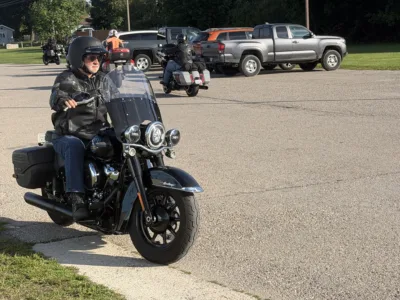
ALPENA -- U.S. Senator Gary Peters, D-Michigan, visited the Thunder Bay National Marine Sanctuary (TBNMS) on Tuesday as part of his motorcycle farewell tour across Michigan. Peters started the tour in Bay City on Monday and will conclude the tour in East Lansing on Friday.
The five-day “Thank You, Michigan” tour will make stops in Bay City, Alpena, Marquette, Traverse City, Grand Rapids, and East Lansing. Throughout the tour, Peters will be joined on the ride by veterans, union workers, motorcycle safety advocates, and constituents.
Peters will leave Congress and retire at the end of the calendar year. Abdul El-Sayed, the Democratic candidate, or Mike Rogers, the Republican candidate, will take Peters' place in Washington D.C. after the November election is decided.
Peters said he believes the most rewarding accomplishment in his career was the Fairness for Veterans Act that was signed by President Barack Obama in 2016.
According to Peters, the amendment helps veterans receive care who may have been given a less than honorable discharge, or bad paper discharge, from the military due to negative behavior resulting from mental traumas such as post-traumatic stress disorder (PTSD) or Traumatic Brain Injury (TBI).
Prior to the amendment, a less than honorable discharge was often given for instances of minor misconduct such as being late to formation and missing appointments, according to a Peters press release from 2016. A less than honorable discharge makes servicemembers ineligible for certain veteran benefits.
Peters said that since the act has been signed into law, close to 10,000 service members have benefited from this bill. He added that veterans groups estimate that there are close to 40,000 service members not receiving care for PTSD or TBI because of bad paper discharges.
"We have a sacred obligation to our men and women who serve, that we stand by them when they come home," he added. "There are a lot more people out there today who are suffering from PTSD and are not getting help and they probably don't realize that they could get help."
Peters said that while in office, he wished he could have solved political and ideological divides in government which make it difficult to find compromises.
"It's getting harder to find or to get people that want to work across the aisle," he said. "It's because the society now, we're just so partisan. We're so polarized, people look at the other party, not as another party, but sometimes as an enemy, and you can't work with an enemy."
"I wish I could have been able to change some of that," he added.
While at TBNMS, Peters reminisced with TBNMS employees regarding his diving experiences in the sanctuary. He also spoke about the importance of re-authorizing the Great Lakes Restoration Initiative (GLRI), which allocates federal tax dollars to the restoration of the Great Lakes.
"The authorization of it ends this year," he said while giving remarks at TBNMS. "I'm the primary sponsor of the bill to extend it for five more years. I'll be leaving in a few months. I've said this is my number one priority. We got to get this done before I leave."
According to the federal Great Lakes Restoration website, federal agencies have funded over 8,000 projects for over $4 billion. The GLRI was launched in 2010 as a nonregulatory program to accelerate efforts to protect and restore the Great Lakes.
"My colleagues from around the country are now realizing how important the Great Lakes are for the country," he said. "The Great Lakes is not just a regional asset."
"Folks now understand that the Great Lakes is a national resource," he added. "In a very thirsty world, having a body of freshwater here is incredibly important. I'm cautiously optimistic we're going to get that done."
Peters told The News that the bill is making "headway" in Congress.
"We've been doing a lot of groundwork and there is strong bipartisan support," he said. "Hopefully, we'll get it done.
Currently the bill is sitting in the Senate.
Throughout his two terms, Peters has been an advocate for Northeast Michigan and helped spear-head funding for many local projects for facilities such as the Alpena Combat Readiness Training Center, the Alpena Community College, the Alpena Fire Department, and more.
He also supported the NOAA center in Alpena and fought to have it open quickly near the end of the COVID-19 pandemic when other federal parks and museums were beginning to reopen.
As a member of the Senate Armed Services Committee, Peters also helped secure funding for the annual Northern Strike training, and ensured the longevity and relevancy of the local military base.
Peters began his public service as a Rochester Hills City Councilman in 1991, according to Peters' website. In 1994, Peters was elected to the Michigan State Senate and served two terms. He also volunteered for the U.S. Navy Reserve at age 34, where he earned a Seabee Combat Warfare Specialist designation and rose to the rank of Lieutenant Commander. After the Sept. 11 terrorist attacks on our country, he volunteered again for drilling status and served overseas as part of his Reserve duty. He later earned a diploma from the College of Naval Command and Staff, U.S. Naval War College.
Kayla Wikaryasz can be reached at 989-358-5688 or kwikaryasz@TheAlpenaNews.com.