
Northern Strike sharpens aeromedical evacuation for joint operations
Trending
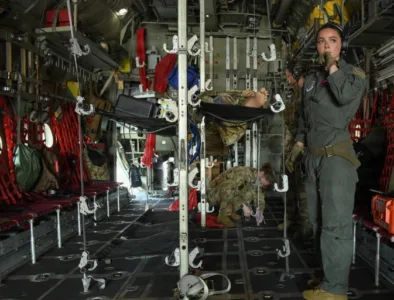
ALPENA - Aeromedical evacuation crews converted a C-130 Hercules from a cargo aircraft into a flying hospital on Tuesday as part of joint training during Exercise Northern Strike 26-2, practicing the rapid movement of patients under realistic, high-pressure conditions.
Lieutenant Colonel Sam Lingle, commander of the Oklahoma Air National Guard's 137th Aeromedical Evacuation Squadron, explained the core mission.
"Aeromedical Evacuation is basically transporting wounded warriors, civilians, Department of Defense, and foreign partners from the point of injury to stateside or back to their home origin," Lingle said. "For this training exercise the crew just got off a C-130 plane where they converted it from a cargo mission to a flying hospital."
The crews are universally qualified on any airframe that can accommodate a stretcher. That includes helicopters as well as fixed-wing aircraft such as the C-130, C-17 Globemaster III, KC-135 Stratotanker, and KC-46 Pegasus. Once they receive a mission assignment detailing the patients to be moved, they reconfigure the aircraft, load the patients, manage their care throughout the flight with the limited medical gear available aboard, and deliver them to their destination.
The conversion process transforms a multi-mission cargo or tanker plane into a temporary medical ward. Crews install stanchion litter systems to secure stretchers, set up oxygen systems, cardiac monitors and other essential equipment, and create the workspace needed for continuous en route care. Patients often arrive after preparation at an En Route Patient Staging System facility near the flight line. The aeromedical evacuation crew then assumes responsibility for the duration of the mission, treating cases that range from sports-related injuries and pediatric patients to intensive care patients.
For the most critically ill, including those on ventilators, an augmentation team known as a critical care transport team provides specialized support. These team members are not part of the core flying crew but deliver the advanced care required for the sickest patients.
Lingle noted the squadron's real-world experience includes extremely long flights.
"We have flown 20-hour missions from Iraq and Afghanistan all the way back to the states in one mission," Lingle explained. "For patients that are severely injured and need to get back we will refuel en route to getting them to their destination."
Capacity can range widely, according to Lingle.
"We can transport anywhere from one patient all the way up to 92, I believe," he added.
Northern Strike 26-2 involves more than 9,000 service members from 36 states and territories along with international partners. Medical personnel are exercising the En Route Patient Staging System in conjunction with aeromedical evacuation operations, creating a realistic continuum of care from ground staging to airborne transport. The joint environment allows crews to work alongside partners from other units and services.
Training under these conditions is especially valuable, Lingle said, because it forces teams to adapt while integrating with joint partners and the staging system.
"During this particular training the crew got a lot of exercise injects added to their flight that they were not expecting," Lingle said. "They got out there expecting to get two-litter patients and then it turned into four-litter patients, then suddenly they had 42 people on their plane they were not expecting."
The response highlighted the adaptability the mission requires.
"They had to pivot yet they almost had an on-time take off," he said. "They were able to re-configure really quickly and get those 42 people on their way."
This is Lingle's second time participating in Northern Strike. The squadron also takes part in Sentry South and other exercises throughout the year to maintain readiness for both combat and domestic contingency missions.
Lingle described favorable conditions this year.
"The weather has been great, and the flying has been great, because of the weather," Lingle said. "The views around here are hard to beat, and the community has always been really good to us, and we appreciate that."
The ability to rapidly reconfigure aircraft, manage limited resources in flight and coordinate with joint partners and staging systems remains central to the aeromedical evacuation mission. At Northern Strike, those skills are refined under the kind of unexpected pressure crews may face when real lives depend on an on-time takeoff and steady care from the point of injury to definitive treatment.
Josh Jambor can be reached at jjambor@thealpenanews.com.