
Airmen rebuild airfield after simulated blast during Northern Strike
Trending
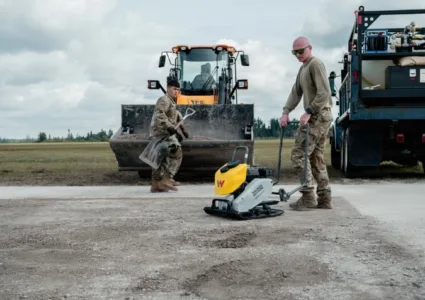
ALPENA - A single crater can ground an entire airfield. Master Sgt. Joe McMullan and airmen from the 139th and 131st Civil Engineer Squadrons spent the day on Tuesday proving they could put one back into service.
McMullan, assigned to the Missouri Air National Guard's 139th Civil Engineer Squadron based in St. Joseph, Missouri, led an Expeditionary Airfield Damage Repair training at Alpena Combat Readiness Training Center (CRTC) during Northern Strike. The work centered on a 20-by-20-foot crater and the precise sequence required to make the airfield usable again.
"It's more of an expeditionary repair, for this scenario we have a 20×20 crater," McMullan said. "There is a lot of logistics involved as far as organizing, lining up your equipment, and making sure you have the materials you need."
The process begins immediately after the simulated explosion. Crews first remove all debris from the hole. They then backfill it with material, compacting, and leveling until the fill meets exact specifications. Only then can the surface support aircraft safely.
"When we do the explosion, we want to make sure that everything is cleaned out of the hole, like debris," McMullan explained. "Then we start backfilling the hole, filling it with material and making sure it hits certain specifications so we can continue that mission getting whatever aircraft through safely."
Once the backfill is verified, airmen place a fiberglass mat over the repaired area. The mat is designed to flex under the weight and movement of landing aircraft.
"Once we have all the material in the hole and we know everything is up to specifications then we place a fiberglass mat over the top. That mat is meant to have expansion and contraction to accommodate whatever aircraft that lands on it," McMullan said.
The mat is bolted down only on both ends. The sides remain free so the material can expand and contract as an aircraft rolls across it. Crews secure the bolts with a mortar mix that holds them firmly in place. The design allows the surface to move slightly with the plane while still providing a stable, debris-free landing zone.
Time to complete a repair varies. It depends on the size of the hole, the volume of debris, the weather, the surrounding landscape, and the specific operational situation. What works in one climate or terrain may need adjustment in another.
Other CRTCs across the United States conduct airfield damage repair training, McMullan noted, but the approach used at Alpena follows a different model. This year, the squadron practiced a new method. Last year marked the first time aircraft landed on the completed repair. This year is the second.
McMullan is participating in Northern Strike for the third time. He said the training always includes something new.
He said the hands-on nature of the work stands out for him. Much of the squadron's preparation happens through computer-based instruction. Field exercises let airmen apply those lessons directly.
"The comradery that you get when you're out in the field training hands on is the best part. We do a lot of computer-based training so it's nice to allow these airmen to get hands on and see what they have been learning," McMullan said.
The local community has made the temporary duty more enjoyable. McMullan has left the training area a few times and found the atmosphere welcoming.
"I like it, I've been out on the town a couple of times, it's a great atmosphere and I have been treated well. Everyone in the community is very supportive," he said.
The 139th Civil Engineer Squadron is a Prime BEEF unit trained to establish, operate, and maintain air bases under both garrison and contingency conditions. Expeditionary airfield damage repair forms a core part of that mission. In a contested environment, a single crater can stop flight operations. The ability to clear debris, restore the base course to specification, and cover the repair with a flexible mat returns the airfield to service more quickly and keeps aircraft moving.
McMullan emphasized that success rests on preparation and attention to detail. Equipment must be staged correctly. Materials must be on hand. Every layer of fill must meet the required standards before the mat goes down. The bolts and mortar must hold. The mat itself must be free to flex. Small deviations can compromise the repair and put aircraft at risk.
The training also builds the less tangible skills of working as a team under time pressure and imperfect conditions. Airmen learn to adapt methods to the specific crater in front of them rather than relying on a single fixed template. Climate, soil, and available resources all influence the approach.
For McMullan, the combination of technical precision, logistical planning, and shared field experience makes the training valuable. The new method introduced this year adds another layer of familiarity with the evolving techniques. Watching aircraft land on last year's repair and preparing for the same outcome again reinforces confidence in the process.
The work at Alpena gives the 139th Civil Engineer Squadron a realistic setting to practice the full sequence (from debris removal through final mat placement) while operating alongside other units. The focus remains on the practical steps that restore an airfield and the people who perform them. McMullan's description of the crater repair, the fiberglass mat and the importance of hands-on repetition captures both the technical demands and the human side of the mission.
Josh Jambor can be reached at jjambor@thealpenanews.com.