
Warfighter Scuba returns to marine sanctuary
Trending
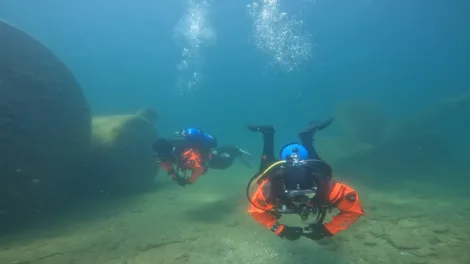
ALPENA -- Alumni divers from the nonprofit program Warfighter Scuba brought Purple Heart veterans back to the Thunder Bay National Marine Sanctuary (TBNMS) to get certified in dry suit diving.
Warfighter Scuba is a program based in Roatan, Honduras which teaches combat-wounded veterans to scuba dive, healing emotional and physical wounds. Veteran Nick Powers founded Warfighter Scuba in 2017.
Kevin Sheard, a member of the Warfighter Scuba board of directors, brought a cohort of three participants and two instructors in August 2025 for the first time. This past week, Sheard returned with alumni members of the program to fully experience TBNMS and get certified in dry suit diving.
Sheard explained that the cold, rough conditions of Lake Huron make diving more complicated and challenging. He said that last year's participants had no experience in diving and still challenged themselves to dive in conditions that some seasoned divers find taxing.
He said an alumni participant this summer called the first day diving, "humbling."
"You’re facing weather, you’re facing colder temperatures," Sheard said. "Those guys pushed themselves ... when he said it was humbling, it’s not a joke. This is big boy, serious diving up here. You can’t just pop in with a jacket and follow a group and take a tour."
Mike Fahey, a Purple Heart recipient and Warfighter Scuba alumnus, said that the dry suit certification training was challenging in itself, but the added environmental challenges made the experience a little more daunting.
"It’s a humbling experience," Fahey said. "Learning this new skill with a dry suit ... it really does add a layer of that technical level. Just to progress your career as a scuba diver."
Sheard said that wet suits worn by divers allow water to penetrate the suit and then a person's body heat warms the thin layer of water. Dry suits keep water completely out.
He added that diving in the Great Lakes is "a little more strenuous."
Unlike diving four times in Roatan, divers can only do two dives per day in the sanctuary waters.
"Four dives a day would wipe somebody completely out here, just because of the temperature differential and all of the calories that you’re burning to stay warm ... it’s not toasty down there."
In total, Sheard said that divers dove for 80 minutes on Wednesday. Last year, because participants were diving with wet suits, their diving time was cut in half.
Despite the challenges that diving presents veterans with, Warfighter Scuba continues to be an innovative program aimed at supporting veterans and their families.
Ian Morris, a Purple Heart recipient and Warfighter Scuba alumnus, said that his introduction to Warfighter Scuba has led to a new passion for diving.
"I thought this is probably just going to be one week, and that would probably be it," Morris said. "I really enjoyed it ... you just feel so relaxed. By the end of that week, I knew that it was going to be something that I was going to continue to do."
"The great thing, I think about Warfighter, is that it’s not just that it doesn’t have to be just that one trip," Morris added. "To be able to come back, get more certifications, and continue to get in the water."
Sheard said that diving is beneficial for wounded veterans "because it gives them a week to decompress the stress."
Fahey said that prior to participating in Warfighter Scuba, he was "one of those guys that was very nervous."
He said "I respect the ocean, that's not my world."
However, because of the veteran experiences instructors and participants shared, his anxiety about the program was subdued.
"Because of the way these guys teach, interact, and just all around carry themselves ... they speak the same language as us," Fahey said. "Veterans all speak a little bit of a different language. These guys all speak that language with fluency."
"Because of that, it brought my anxiety down," he added.
Sheard said that teaching veterans how to dive gives them new skills in the civilian world while providing specialized support.
"Giving them a new life skill, putting them back in touch with folks that went through similar experiences," Sheard added.
He explained that there has also been research done on the potential benefits of breathing compressed air, or enriched air, which he said acts as a "mini barrel treatment or hyperbaric treatment."
"It can help with scars, wounds," Sheard added. "It gives your cells kind of a boost. There's also been some science that has talked about how it can rebuild neural pathways or open new ones, so that can help with stress and anxiety and some other things as well ... they’re finding out more and more things, how it’s beneficial for you."
Sheard explained that Warfighter Scuba has become popular in veteran communities across the country, creating a backlog of 400 interested candidates. He added that if Warfighter Scuba had more funding and more support, the organization could bridge gaps to get more participants through the program.
"Our biggest restriction is funding," Sheard said. "If we had unlimited cash, we’d send all 400 through in the same year. But that’s the biggest thing. We do as many fundraisers as possible."
Those who would like to donate to the nonprofit can do so via warfighterscuba.org/.
Kayla Wikaryasz can be reached at 989-358-5688 or kwikaryasz@TheAlpenaNews.com.