The role of science in forest and wildlife management
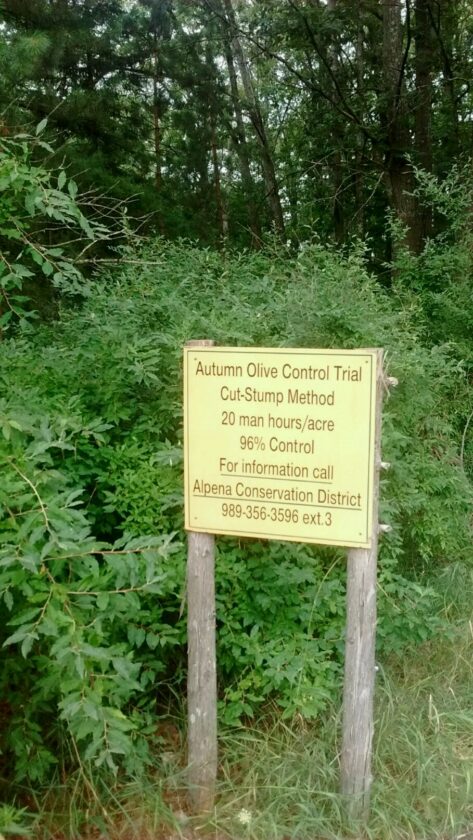
Courtesy photo
The context and application of the word “conservation” have changed over time.
Autumn olive, for instance, is a nonnative woody shrub that was suggested for planting by State and Federal agencies for conservation purposes. Landowners were told that this plant could stabilize soils and provide wildlife food. Both were true, but this plant is also highly invasive and dominates many sites to the detriment of native biodiversity and ecological function. 20th century conservation actions led to 21st century restoration needs (see figure).
While the possibility for lessons learned in forest and wildlife management are abundant, their incorporation into what we do on the ground are all too rare.
Why? Well, let us start with a little history first.
In Our Wildlife Legacy (1962, Funk and Wagnalls), a textbook that shaped the mentors that shaped me, Dr. Durward Allen provided a useful baseline to compare scientific involvement of agencies and organizations over time. Dr. Allen was the perfect person to do so. With degrees from both the University of Michigan and Michigan State University, Dr. Allen was a scientist for the State of Michigan and the US Fish and Wildlife Service before his tenure at Purdue University. It was Dr. Allen that started the wolf-moose study at Isle Royale National Park.
Early and mid-20th century research from across the country was cited in his textbook to illustrate what was then the state-of-art wildlife science. It was clear that many government agencies and other organizations involved in forest and wildlife management employed staff that published peer-reviewed science.
In Michigan, for instance, Department of Natural Resources employees, such as Louis Verme who received his Master’s degree under the G.I. Bill published numerous articles on white-tailed deer from Cusino Wildlife Research Station. Other dedicated research areas from which scientists published studies included our nearby Hunt Creek Fisheries Research Station.
But the role of science in agencies and organizations even then was unstable and underappreciated. Dr. C. Leonard Huskins was quoted to say the response to new scientific information from stakeholders took three steps: “first…don’t believe it; second, it is of no importance anyway; and third, …knew it all the time (pg. 279).
By the 1990s Secretary of Interior Bruce Babbitt pulled scientists out of Federal agencies with land management responsibility to form the National Biological Survey under the belief that a specialist agency would avoid politics and be more objective. As described by Dr. Frederic Wagner, “questions were raised about the removal of research support…” and its impact on land management (1999, BioScience, 49:219-222).
Many State agencies followed suit. While a greater proportion of current staff in many agencies and organizations likely have advanced degrees relative to 20th century levels, I would offer that even fewer (proportionally or in total) are involved in publishing in peer-reviewed journals.
In total, too few agencies and organizations currently involved in forest and wildlife conservation have staff that do science. And too few scientists are directly involved in discussing science with land managers and other stakeholders. Instead, research funding and a culture of science were in large part shifted to academic institutions.
Why does this matter?
In the scientific literature new ideas, or lessons learned, are presented in an evidence-based way. Scientists are those that produce this literature and, in doing so, are aware of work being done by others. Without scientists bringing up new concepts and challenging old concepts there is a tendency to simply do what has been done in the past, with no lessons learned. Misguided, antiquated conservation actions can do more harm than good. Groups comprised of only laypeople or land managers, for instance, may be missing out on the changes that are occurring in our knowledge base.
Moreover, in a society that struggles with evidence-based, professional debate, a culture of science–created by those doing science–is necessary. Science and land management are both imperfect human activities, and all involved must appreciate how to objectively deal with challenges to tradition and group think. Debate is a good thing, if structured and data-driven. Scientists develop thick skin through critical peer-review and this intellectual grit useful for constructive debate can be a benefit to agencies and organizations if allowed to permeate.
Finally, in a scientific culture, writing and speaking are more precise and information presented is less absolute. Study methods are transparent and their weaknesses and limitations presented along with results. For instance, population estimates of wildlife species are usually presented as a range of values, not one point, with an estimate of uncertainty (error) around these range of values. By doing this, and communicating why this is done, laypeople are made aware of the inherent imperfections and challenges of such work.
Someone once said that forest and wildlife management are working hypotheses. In other words, we should explicitly acknowledge (and cite!) what current science shows us, but also appreciate that our understanding of the natural world is imperfect and changes. Only by having a culture of science can agencies and organizations involved in conservation meet their missions. A definition of science can be found here: https://sciencecouncil.org/about-science/our-definition-of-science/
For more on the importance of science in wildlife management: https://www.youtube.com/watch?v=161Y_YOO3eY
Dr. Greg Corace is the forest and wildlife ecologist for the Alpena-Montmorency Conservation District. For more information, including assistance with the Qualified Forest Program and related forest planning and management, email Greg: greg.corace@macd.org.
Local News
Alpena County Personnel Committee meets Tuesday
The Alpena County Personnel Committee will meet on Tuesday at 10 a.m. in the Howard Male Conference Room and via ...
Honorary Kiwanian
Big things in store for Alpena Lions Club in 2026
Good job Amelia!
Day is done