
My Stories program preserves cherished memories of patients in hospice

News Photo by Reagan Voetberg Kristie Lukes opens the box that a patient’s family would receive that has participated in the My Stories program. The box contains a note and flash drive with the patient’s video stored on it.

News Photo by Reagan Voetberg Kristie Lukes opens the box that a patient’s family would receive that has participated in the My Stories program. The box contains a note and flash drive with the patient’s video stored on it.

News Photo by Reagan Voetberg Kristie Lukes displays what an introduction slide might look like. One example she showed was a picture of mountains and trees.

News Photo by Reagan Voetberg Kristie Lukes has a wall full of thank-you notes from families in her office.
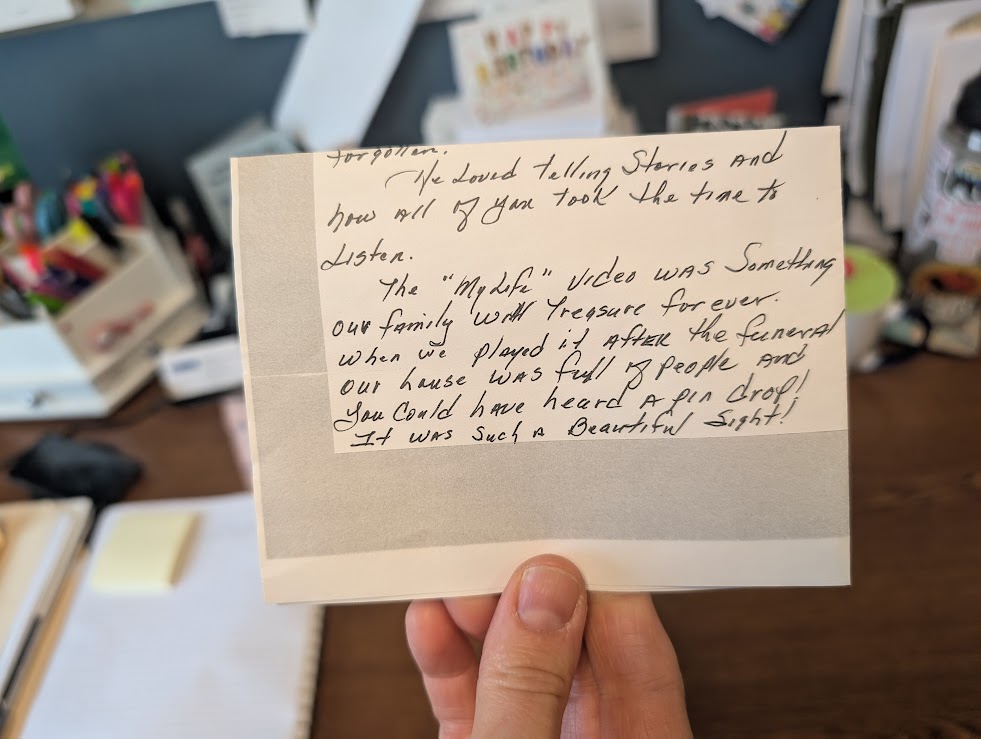
News Photo by Reagan Voetberg Kristie Lukes holds up a letter sent to her by the family of a patient. It reads, “He loved telling stories and how all of you took the time to listen. The ‘My Life’ video was something our family will treasure forever. When we played it after the funeral our house was full of people and you could have heard a pin drop! It was such a beautiful sight!”

News Photo by Reagan Voetberg Kristie Lukes displays what an introduction slide might look like. One example she showed was a picture of mountains and trees.

News Photo by Reagan Voetberg A My Stories box that would hold a flashdrive is seen.
News Photo by Reagan Voetberg Kristie Lukes opens the box that a patient’s family would receive that has participated in the My Stories program. The box contains a note and flash drive with the patient’s video stored on it.
News Photo by Reagan Voetberg Kristie Lukes opens the box that a patient’s family would receive that has participated in the My Stories program. The box contains a note and flash drive with the patient’s video stored on it.
News Photo by Reagan Voetberg Kristie Lukes displays what an introduction slide might look like. One example she showed was a picture of mountains and trees.
News Photo by Reagan Voetberg Kristie Lukes has a wall full of thank-you notes from families in her office.
News Photo by Reagan Voetberg Kristie Lukes holds up a letter sent to her by the family of a patient. It reads, “He loved telling stories and how all of you took the time to listen. The ‘My Life’ video was something our family will treasure forever. When we played it after the funeral our house was full of people and you could have heard a pin drop! It was such a beautiful sight!”
News Photo by Reagan Voetberg Kristie Lukes displays what an introduction slide might look like. One example she showed was a picture of mountains and trees.
News Photo by Reagan Voetberg A My Stories box that would hold a flashdrive is seen.
Trending
ALPENA -- The Hospice of Michigan in Alpena preserves the stories of patients, not in a book or photo album, but on a flashdrive.
It's called the My Stories program. Patients in hospice are given the opportunity to video record their stories and memories for their loved ones to hear once they've passed. Patients do not have to pay a dime to record their life stories.
Alpena's Hospice of Michigan Volunteer Program Coordinator Kristie Lukes talked about how meaningful the My Stories project is to patients and their families. Lukes coordinates volunteers to help patients with their recordings.
Lukes explained further what My Stories is.
"It's a recording of the patient's life and the stories that they want to share with family and patients," she said. "So it becomes kind of a legacy project."
They typically ask the family for privacy so that patients feel comfortable opening up about whatever stories they would like to share.
"Patients can share whatever they like," Lukes said. "Memories and stories from their youth and then up to high school, or when they first met their wife or spouse. So it can be really, really special and we try to just let it roll with the patient telling the stories."
The recording process itself is very flexible. If a patient needs a break from recording or needs to recollect their thoughts, the recording can be paused for as long as necessary.
Patients can choose to share their recording with their family while they are still alive or after they have passed. Both can be meaningful ways for a patient to tell their story.
"Sometimes they show it with the family," Lukes said. "So if the family has questions, they're still around to answer those questions. A lot of the time, the families don't see those videos until the patient passes, so that can be something really special that the family watches after the patient passes."
The videos are edited by volunteers to include music in the background. They also include an intro slide featuring a picture that relates to the patient's story, with 'My Story' typed over it. The next slide shows the patient's name and date of birth before the recording begins.
The hospice tries to get recordings done as early as possible for patients. Patients can enter hospice when they have six months or less to live, which is not a lot of time as it is. As patients decline, it can be difficult or impossible to create a My Stories video.
For patients with memory loss, it can be frustrating to try and recall memories, Lukes said. Recording patients on oxygen can also be challenging.
"We can still definitely do the recording, but it takes some finagling," Lukes said.
If patients struggle with where to start, the hospice has a list of pointers that can help jog their memory. Volunteers will sometimes frame the recording like a conversation, which can be helpful for some patients. Other times, families suggest that their loved ones discuss certain topics.
Lukes said that the program had been in place for a long time -- before she started working in her position at the hospice three years ago.
"We just hope that the My Stories recording will be a valued and cherished legacy to the family after a patient passes," she said.
If you would like to volunteer for Hospice of Michigan, the My Stories program, or other programs, visit hom.org to fill out a volunteer application.