Bittersweet end, nail-biter home
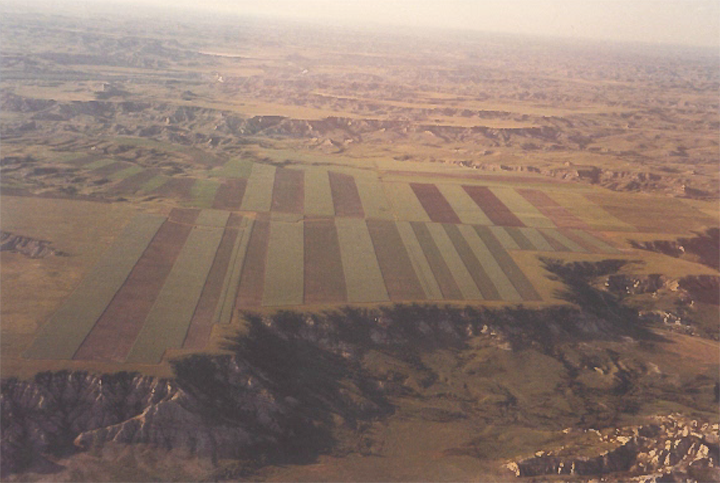
Courtesy Photo Plains meet mountains out West in this photo taken from the window of William Kelley’s airplane.
EDITOR’S NOTE: The following is the third in a series of stories adapted from William Kelley’s book, “Wind Socks, Grass Strips, and Tail-Draggers.” Last week, Kelley and his brother-in-law prepared for their first cross-country flight.
The first day, we made it to Fargo, North Dakota.
The end of the second day found us in Helena, Montana.
Probably, much like motorcycle riders, people who hang around airports seem inclined to help one another. It is a natural fraternity in both cases.
In Fargo, we spent the night with some friends. They provided us a place to sleep and food for supper and breakfast. At the Helena airport, there were pilots willing to drive us to a motel and restaurant. That was a big help, since we did not know anyone in that town.
The third day found us early in the air. Grangeville was my brother-in-law’s hometown, which was just a short jump over the mountains from Missoula, Montana. He was anxious to get home to see his parents and sisters. I was anxious to see the prairie and mountains of that area. So we made an early start.
There are some fairly high mountain passes in that area, so we had to climb to 8,500 feet in some places to safely navigate those passes. Sometimes, we had to climb higher if we wanted a more direct flight path rather than following the passes.
The descent into the Grangeville traffic pattern is always a bittersweet experience. It is a good feeling to reach the terminus of the flight, but an empty feeling to know the destination has been reached. For the time being, the trip is over. It is a feeling I experienced on many of my flights.
That first long, cross-country flight showed us that, with plenty of proper planning, it is possible to safely pilot a small plane over a great distance.
Since we were in some of the greatest recreational backcountry in our nation, we prepared to enjoy the area. After we had spent ample time connecting and reconnecting with the family, we borrowed my brother-in-law’s father’s pickup truck. In the back of that pickup truck, we loaded camping gear and headed into the wilds near Dixie, Idaho.
That trip was memorable for reasons beyond the fact it was my first long, cross-country flight.
We camped high up in the mountains where the potatoes did not want to boil because of the elevation. We had no pressure cooker. Also, the summer sleeping bag I so carefully arranged on the camping cot was totally inadequate for the near-freezing temperatures experienced in the high country after the sun sets.
A cow elk with calf let loose her call from the small stream near our camp early the next morning. It is one of the most beautiful sounds in nature, but, to an unsuspected camper shaking from the cold, it can be an alarming wakeup call.
That trip did prepare me for other flying adventures, including the first trip to Alaska. I learned to maximize the little space in the baggage compartment behind the seat. Even then, I always seemed to include items not used on the trip. Some of the items were survival equipment, which I am thankful I did not have to unpack.
The return trip only took two days. There is a big difference between a 20- to 30-mph headwind and a tailwind of that speed.
When the latitude of Alpena and Grangeville are checked on a map, there is not much difference between the two. Once we reached Fargo, North Dakota on the way west, we pretty much followed the I-94 freeway. We did leave the highway at Miles City, Montana to continue more directly westward toward Helana, and on to MIssoula and Grangeville, but the compass heading was always westerly.
On the return flight, we made the same stops made on the way west. However, after fuel at Ironwood, I figured to shave a few minutes off the flight by flying over Lake Michigan.
We had been flying at 5,500 feet for several minutes when my brother-in-law, lulled by the drone of the engine, drifted off to sleep. I began a steady climb as we headed on our easterly course. The cabin grew colder as the altitude increased. He awakened as we approached 13,500 feet on the altimeter, at about the same time the western shore of Lake Michigan passed beneath us. Had we voted on the decision to fly over the lake, his vote would have been “no.”
He looked at his thumbnail to see if it had turned blue. Hypoxia can be indicated by fingernails turning blue from the lack of oxygen. Above 10,000 to 12,000 feet for an extended period of time, hypoxia does become a concern unless oxygen is provided. His nails were their natural color, and he went right back to sleep once I turned on the cabin heat.
We only saved seven or eight minutes, with a lot of nail-biting in the process.
I did fly over Beaver Island and some smaller islands as we continued over the lake. I figured that, at that altitude, we could glide 20 to 25 miles so we would always have some land within that distance should the engine stop.
Of the numerous trips west over the years, I have never flown across Lake Michigan any more than to fly over the Straits of Mackinac and the Mackinac Bridge when crossing from one peninsula to the other.
I decided I am not in that much of a hurry.
Check The News next week for the next installment. William Kelley was a teacher for 32 years and has been a pilot since 1966. He lives in Herron on the family farm where he was born and raised.
Local News

Northland secures $10,000 for Bay Athletic via elevate program
Alpena County personnel committee meets Tuesday
ALPENA - The Alpena County Personnel Committee will meet on Tuesday at 10 a.m. in the Howard Male Conference ...
Michigan mulls changes in elk hunt regulations
Harmful algae bloom awareness program in Harrisville

You Are Loved Women’s Conference