
Huron Pines finishes fifth bridge in remodeling project
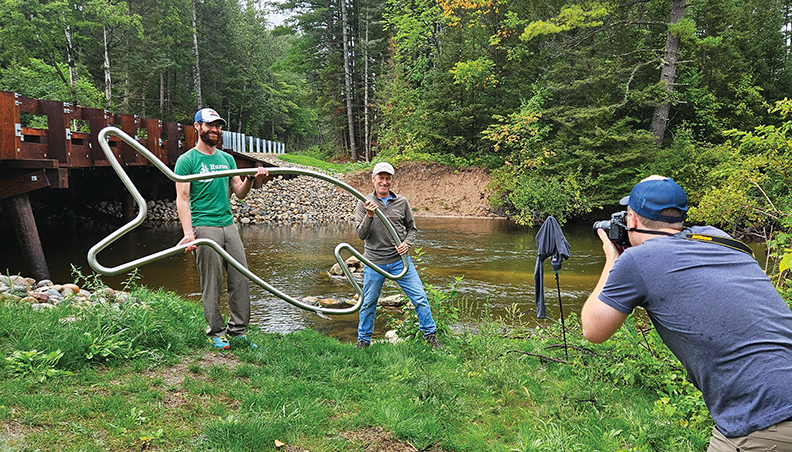
News Photo by Mike Gonzalez From left, Josh Leisen and Terry Heatlie pose with a fish stand from the World Fish Migration Foundation for a picture taken by Chris Engle at the Thunder Bay River bridge that goes across Hall Road on Thursday.
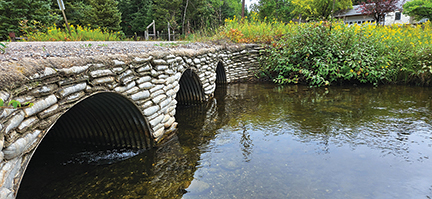
News Photo by Mike Gonzalez A bridge built with cemented sandbags and metal tubing sits in the Thunder Bay River on Hossler Road on Thursday. The bridge will possibly be replaced by Huron Pines some time between 2024 and 2025.
News Photo by Mike Gonzalez From left, Josh Leisen and Terry Heatlie pose with a fish stand from the World Fish Migration Foundation for a picture taken by Chris Engle at the Thunder Bay River bridge that goes across Hall Road on Thursday.
News Photo by Mike Gonzalez A bridge built with cemented sandbags and metal tubing sits in the Thunder Bay River on Hossler Road on Thursday. The bridge will possibly be replaced by Huron Pines some time between 2024 and 2025.
Trending
ATLANTA -- Huron Pines, a nonprofit organization with goals to help Great Lakes ecosystems, finished constructing its fifth bridge in a restoration project for the Thunder Bay River.
The timber bridge on Hall Road replaces an old model that used undersized culverts and concrete headwall.
The undersized culverts, which look like small arches for the river to flow through, makes the water move faster as it goes through the passage, creating problems for fish that swim upstream in the river during the springtime.
Chris Engle, communications associate with Huron Pines, said fish passage is important in the Thunder Bay River because fish like salmon and brook trout travel to lakes and spawn.
He said the pressure builds up when water hits the headwall and the large amount of water is pushed into a small entryway.
"Think of it like putting your thumb on a hose to spray everywhere," Engle said. "Because that thumb is there, the water that's building up needs to go out, so the stream starts to go out farther and faster. That's sort of what's happening to the fish."
Josh Leisen, senior project manager at Huron Pines, said flooding was also common with the headwall model. Because water took longer to go across the headwall bridge, the water level was elevated, which caused any runoff, rain, snow, or other water sources to build up and flood over. Dirt and sediment washed away from the road, which deteriorated the bridge faster.
The project was heavily supported through Environment Protection Agency grants and Huron Pines collaborated with the National Oceanic and Atmosphere Administration too. Because of the deteriorating road and the cost it would take to consistently repair, it motivated Montmorency County Road Commission to give labor and equipment to build a better bridge.
The timber bridge uses lumber already cut and fit for the gap and comes with asphalt on the top for snow plows to scrape snow off of. The river now has a stable flow and allows safe fish passage up the Thunder Bay River.
Terry Healtie, habitat restoration specialist with NOAA Fisheries and technical program director of the project, brought a large metal frame of a fish that comes from the World Fish Migration Foundation to pictures with it in celebration of safe fish passage.
I was kind of enlightened by this project, because it's not like the river was blocked physically," Heatlie said. "Because of the culverts, that water is moving so fast during the wrong times of the year that brook trout can't bypass it because of the velocity, which is a major impediment."
The project started in 2019 and the fifth bridge was completed near the end of July. Now, 90 miles of the Thunder Bay River is reconnected for fish passage.
Leisen mentioned Huron Pines may restore two other bridge crosses, which would be completed between the years 2024 and 2025.