
When you watched movies from your car in Northeast Michigan
Trending
ALPENA -- For the better part of three decades, Northeast Michigan residents enjoyed the experience of drive-in movie theaters.
Outdoor movie memories abounded, from sneaking in unpaid passengers in the vehicle's trunk to children enjoying the theater's playground and recreation offerings to loading up the family station wagon with "brought in" refreshments or a night of passion.
The history of drive-in movies goes back to May 1933 in Camden, New Jersey, when industrialist Richard Hollingshead designed and patented the nation's first drive-in movie. It started in his residence's driveway, where he tied a movie screen between trees, placed a radio behind the screen for sound, and strategically placed the projector on a vehicle's hood.
The following June, he opened the Automotive Movie Theater with the slogan, "The whole family is welcome, regardless of how noisy the children are."
His concept created a vehicle ramp system to park at various heights and angles facing the screen.
For admission, Hollingshead charged 25 cents per vehicle and 25 cents per occupant, with a maximum of $1 to be collected.
In 1950, Hollingshead's patent was determined invalid and royalties were no longer paid to him from other emerging drive-in theaters.
Drive-in theaters rapidly blossomed across the nation, mostly on inexpensive rural acreage.
A Smithsonian Magazine article noted that, by 1958, the nation had 4,063 outdoor theaters.
During the 1950s and into the early 1970s, technology enhanced the drive-in movie sound experience, with more sophisticated car window speakers later converting to sound coming over the car's radio. Playgrounds were expanded and go-kart tracks and miniature golf courses opened, along with other related amusement venues.
Drive-in owners saw additional revenue could be generated through snack and refreshment bars. In addition, during the daylight hours, swap meets, flea markets, car shows, and rock concerts could also generate income.
By the late 1970s and early 1980s, outdoor theaters began to close with the advent of VHS and Beta video tapes, followed by television movie channels and later on-demand television. In many regions, a shift to daylight savings time caused movies to not begin until well after 9 p.m., stimulating lower attendance.
More impactful, drive-in movie owners were facing increased property taxes. Their land became much more valuable and was sold off for retail, housing, or industrial development.
Northeast Michigan was not immune to the nation's drive-in movie boom.
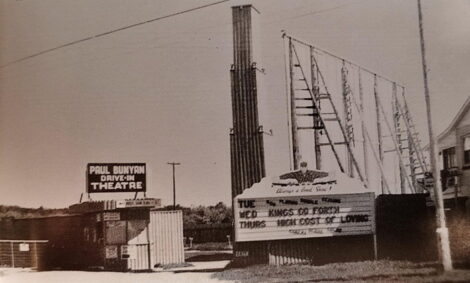
The Alpena drive-in was on U.S.-23 north, Thunder Bay on M-32 West, and Paul Bunyan near Hubbard Lake.
Accommodating 200 cars, the Paul Bunyan was built in 1949 and remained open to approximately 1968.
In a Water Winter Wonderland website posting, Gary Dagenais stated he lived across the street from the theater.
"The theater was not the region's first outdoor theater, but the third," he said. "The first was a half mile north of Hubbard Lake Corners, next to Cedar Grove Tavern. I believe the theater lasted only one year.
"The second theater was the Sky Vue, and, once again, was there for only one or two years," he added. "This theater was located in Alpena County on Hubbard Lake Road in the field just north of Diamond's store, across from the Stone Bar."
A 1956 Alpena News account revealed the Paul Bunyan's movie screen was damaged by a tornado.
To date, that property, at Hubert and Bear Springs roads, remains vacant, with two visible driveways.
The Thunder Bay drive-in opened on June 28, 1955, on 10 acres with a 100-foot viewing screen. The complex accommodated up to 400 cars.
In an Alpena County History Facebook posting, former Hillman resident Helen Thompson noted her father helped build that outdoor theater.
A 1955 Alpena News account stated 25,000 feet of lumber was used to construct the 64-foot-high viewing screen. Upon the theater's opening, playground equipment was installed for children to enjoy.
From the Water Winter Wonderland website, David Rouleau recalled the theater's acreage was purchased from his grandparents.
"Living nearby, I heard the intermission reels so many times from my bedroom that I can still replay the whole 10 minutes in my head," he said.
A notable event for the Thunder Bay happened on July 5, 1981, when rocker Alice Cooper performed a concert.
"I was 13 at the time, and, of course, thought this whole business was cool as beans, but my family thought otherwise," Rouleau said. "The adults policed our front lawns in case any crazy teenagers tried to trespass. I watched a lot of the concert from our back fence. I remember Cooper's crew on the concession stand roof with the big screen being used for images during the show."
The complex closed in the late 1980s and was demolished in 1993.
The Alpena drive-in opened in 1952. The complex could accommodate over 450 cars. The massive viewing screen was complemented by dual sound speakers mounted upon poles. An Alpena News account noted those speakers were connected by four miles of wires.
The concession stand was designed for a cafeteria-style approach and even offered a baby bottle warmer.
September and October 1970 Alpena News accounts detailed the drive-in's new owner began showing R- and X-rated films. State Police confiscated the films. The Alpena County prosecutor brought charges against the owners, which were eventually dropped.
"In order to present adult fare, the theater had bright lights placed in such a way as to prevent highway travelers from seeing the action on the screen," Rouleau recalled.
During the 1970s or early 1980s, the theater opened a go-kart racetrack.
In 1985, after a 32-year run, the theater closed. It is now the site of the Arzo Sports and Fun Park recreation complex.
In June 1989, the Alpena Township Fire Department responded to fire with the vacant drive-in theater's screen.
Research from the Drive-In Movie website reveals there are currently 300-plus drive-in theaters across America. The preponderance of the drive-ins are located in Florida, Texas, and on the West Coast.
This past year, overlooking Lake Huron's Thunder Bay, an outdoor screen and sound system were temporarily placed by Joe Rybarczyk for an outdoor movie.
From an Alpena County Facebook posting were memorable comments on going to the drive-in. Alpena resident Chuck Piontkowski recalled he "went there many times with my girlfriend and, sometimes, we saw the show, sometimes we were the last to leave."
Lachine resident Betty Hunt stated: "I remember leaving and taking the speaker box with me. Had to go back and hand it to the owner. How embarrassing, and he was so nice about it."
Scott Habermehl commented: "I will have to wait for a couple people to pass before I can share my stories."
Numerous other Facebook postings reflected grand memories at the region's outdoor theaters. Many recalled the family's station wagon offering a third-row seat for movie viewing or area to fall asleep.
Perhaps a marriage proposal occurred in the eighth parking row from the front?
Jeffrey D. Brasie is a retired health care CEO. He frequently writes historic feature stories and op-eds for various Michigan newspapers. As a Vietnam-era veteran, he served in the U.S. Navy and U.S. Naval Reserve. He served on the public affairs staff of the secretary of the navy. He grew up in Alpena and resides in suburban Detroit.