Michigan sailors perish in 1963 loss of nuclear submarine

Courtesy Photo The USS Thresher is seen patrolling ocean waters in this undated photo.
CAPE COD, MASSACHUSETTS — Sixty years ago, on April 10, 1963, 129 U.S. Navy officers, crew members, and civilian technicians perished aboard the nuclear submarine U.S.S. Thresher.
The Thresher’s sinking remains America’s most significant loss of lives aboard a nuclear submarine.
On board were Michigan crew members Chief Petty Officer/Torpedoman Robert Eugene Johnson, of Wyandotte, with family in Southgate, Chief Petty Officer/Radioman Walter Jack Noonis, from Anchorville, with family in Dearborn Heights, Petty Officer Second Class/Electronic Technician Thomas Charles Kantz, from Detroit, with family in Ann Arbor and Clawson, and Petty Officer Second Class/Machinist’s Mate Marvin Theodore Helsius, of Trout Creek.
Each of those Michigan residents had an extensive submarine career.
The U.S.S. Thresher was designated as an attack submarine. The design, at that time, made it fast, quiet, and deadly. The submarine was homeported out of Kittery, Maine.
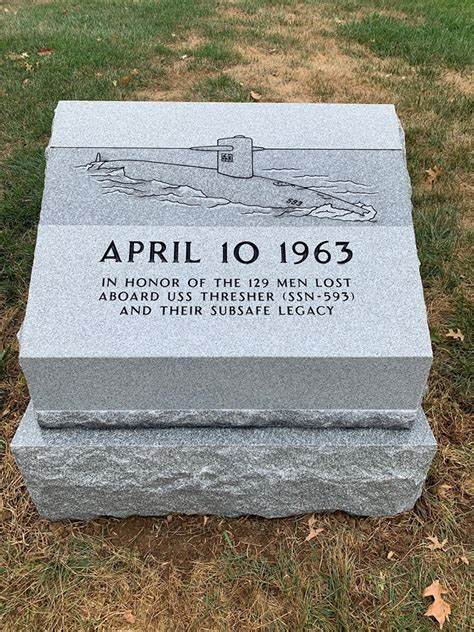
Courtesy Photo The USS Thresher memorial is seen at Arlington National Cemetery in this undated photo.
After being commissioned in August 1961, the submarine went through a series of Atlantic Ocean and Caribbean test and training sea trials. While in Puerto Rico, the submarine experienced a nuclear reactor shutdown and diesel generator challenges. When moored at Port Canaveral, Florida, the Thresher was clipped by a tug, which damaged a ballast tank. Repairs were undertaken at Groton, Connecticut’s Electric Boat Co.
The Thresher reentered test training off the coast of Key West, Florida.
The submarine later returned to a Portsmouth, Maine shipyard for a scheduled six-month post shakedown inspection.
On April 9, 1963, under the command of Lt. Commander John Wesley Harvey, the Thresher departed Kittery with a naval crew and civilian technicians of 129. They were heading into the Atlantic for a series of deep-diving trials. Accompanying the Thresher was the submarine rescue ship the U.S.S. Skylark.
According to accounts provided by the Thresher Base United States Submarine Veterans Society, on April 10, 1963, the submarine and Skylark were about 220 miles off Cape Cod shores. Early that morning, the Thresher began a series of deep dives.
Near 9:16 a.m., communications became garbled between the two vessels. The final Thresher account the Skylark received was like “air rushing into an air tank.” Then, near 9:20 a.m., complete silence.
The Thresher was 8,400 feet below the ocean’s surface.
By mid-afternoon, 15 Navy ships were part of the search and rescue team. The morning of April 11, hope was given to despair, and the rescue ceased. The chief of naval operations, Admiral George W. Anderson Jr., announced at a late morning Pentagon press conference that the Thresher and all on board had been lost.
President John F. Kennedy ordered that from April 12 to 15 American flags be flown at half-staff for those who perished.
By late June 1963, the Navy submersible Trieste located a debris field scattered over a 33-acre field of ocean floor. In July, photography of the Thresher’s remains was undertaken.
The theories of the Thresher’s loss are varied.
Initial U.S. Navy studies indicate a significant failure of the Thresher’s salt water piping system, which relied upon silver brazing, versus welding. That pipe bursting would have caused a lack of ship control, taking it to a rapid descent to the ocean’s floor. Implosion most likely occurred between 1,300 and 2,000 feet.
A subsequent 2013 study theorized the submarine experienced a massive electrical power failure.
After the Thresher’s loss, the Navy established a program entitled SUBSAFE, ensuring safe integrity before any new or upgraded submarine’s deployment.
In 2008, through the resources of the Navy and the National Geographic Society, Robert Ballard located and surveyed the Thresher’s debris field, as well as that of the U.S.S. Scorpion, which was lost in 1968. Subsequently, Ballard also surveyed the remains of the passenger ship H.M.S. Titanic.
On YouTube is featured the folk group the Kingston Trio performing “The Ballad of the Thresher.” Other Thresher videos can be found on YouTube.
With the most significant number of lives lost of any nuclear submarine, a Thresher memorial is located in Arlington National Cemetery.
The Thresher Base memorial group will offer a tribute this coming April. Information on that event and on the submarine can be found at thresherbase.org.
Jeffery Brasie is a retired health care CEO. He frequently writes historic feature stories and op-eds for various Michigan newspapers. He is a U.S. Navy and U.S. Naval Reserve veteran and served on the public affairs staff of the secretary of the Navy. He grew up in northern Michigan and resides in suburban Detroit.
Nuclear Submarine incidents with fatalities
United States
* U.S.S. Thresher: April 10, 1963, loss of 129 lives off the Cape Cod coast
* U.S.S. Scorpion: May 22, 1968, loss of 99 lives off the Azores shores
Soviet Union and Russia
* K-8: April 11, 1970, loss of 52 lives in the Atlantic Ocean off Spain’s shores
* K-429: June 23, 1983, loss of 16 lives during a test dive. Submarine refurbished and in 1985 flooded at port mooring. Decommissioned in 1987.
* K-219: Oct. 3, 1986, loss of six lives off Bermuda’s coast
* K-278 Komsomolets: April 7, 1989, loss of 42 lives in the Barents Sea
* K-141 Kursk: Aug. 12, 2000, loss of 118 lives in a Barents Sea explosion
* K-159: Aug. 28, 2003, loss of nine lives in the Barents Sea
Source: “Submarine Accidents: A Statistical Assessment,” by C. Tingle
Profile of the USS Thresher
* Built at the Portsmouth (Maine) Naval Shipyard
* Keel laid: May 28, 1958
* Launched: July 9, 1960
* Commissioned: Aug. 3, 1961
* 278 feet, six inches in length
* 31-foot, eight-inch beam
* Speed: 33 knots (38 mph)
* Standing on-board crew: 16 officers and 96 enlisted
* Lost at sea during a deep-diving test April 10, 1963
Source: U.S. Navy historical records and the Thresher Base United States Submarine Veterans Society
-
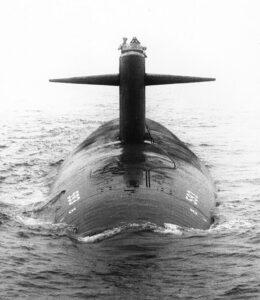
- Courtesy Photo The USS Thresher is seen patrolling ocean waters in this undated photo.
-
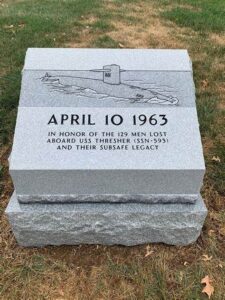
- Courtesy Photo The USS Thresher memorial is seen at Arlington National Cemetery in this undated photo.
Local News
Longing for summer

Alpena MSP post accepting donations for survivors of sexual assault

Harrisville library hosts Sole Survivor program

Gubernatorial candidate Mike Duggan visits Rogers City

Trail Roamers donate to Friends Together