WITH VIDEO: APS addresses surging special education numbers
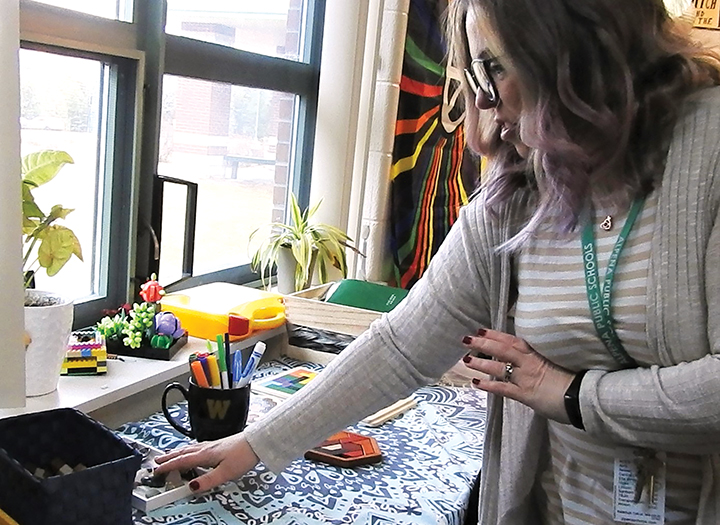
News Photo by Julie Riddle On Thursday, Brandy Shooks, English special education teacher at Thunder Bay Junior High School, explains sensory tools used by students requiring extra educational assistance in her English resource room.
ALPENA — Lots of kids need extra help these days. Schools must — and will — keep stepping up to meet those needs, local school officials say.
Ordered by the state to provide a plan of action to make sure its junior high special education population gets the help it needs, Alpena Public Schools officials say they already have some needed processes in place to combat a surge of students with special needs.
Those efforts constitute a good first step in addressing record-high levels of students requiring special education accommodations in Alpena schools, according to Meaghan Gauthier, APS assistant superintendent for instruction.
Check out the video below. Viewing on mobile? Turn your device horizontally for the best viewing experience. Story continues below the video.
In late November, the Michigan Department of Education named Thunder Bay Junior High School on a list of schools it cited as underperforming in the handling of its special education population.
The junior high made the list because it failed to reach state standards in several areas, including school attendance, standardized test participation, and access to a librarian.
According to the state, APS officials must submit a plan saying how they’ll address those areas and accept help from the state in making needed corrections.
Before receiving that designation, district officials already knew they needed to address an exploding population of students with special classroom needs, Gauthier said.
After the 2020-2021 school year, when schools had to offer students multiple ways to attend school, some students returned reeling from the impact of upended classrooms.
The year before schools had to send kids away to learn from home, APS counted 211 students who needed individualized education programs, or IEPs.
Two years later, when schools returned to some version of normalcy, 426 of the district’s 3,768 students — or 11 % — needed those services.
Staggered by that number, Gauthier checked the district historic headcount log, which dates back to the 1950s.
In all that time, only one span — the 2007-2010 school years — included special education numbers exceeding 400 students, and the district’s student count was at least 600 students higher in those school years.
Data doesn’t clarify if the jump in students needing an IEP in the 2021-2022 school year — on which the state based its designation — represents students new to the district or previous students returning with new needs, Gauthier clarified.
Education experts say a special education population of more than 5% or 10% strains a school’s system, taking too much focus away from the rest of the student body, Gauthier said.
This school year, 13% of APS students — 489 of 3,788 students, as of the fall school count date — require an IEP.
The district has enough staff with the required training to meet that need, but not enough to grow, Gauthier said.
While the district has not created a written plan of action to submit to the state, it has designed and implemented processes that will help take care of kids with extra needs, she said.
Since the beginning of the school year, the district has designated time for special education and other teachers in core departments to meet with other teachers who handle the same material. With the vast majority of their time dedicated to students, teachers need that protected time to collaborate and strategize how to help students reach intended outcomes.
Administrators plan to roll out a reading intervention program at the start of the second semester, targeting students in the subject area resource rooms where some students with IEPs receive lessons in an environment tailored for their educational needs.
The reading program, a computer-based program accompanied by training for teachers, will strengthen vital skills and help students master the standards the state asks them to meet, Gauthier said.
A partnership with the Northeast Michigan Community Service Agency will provide several new truancy officers who, along with school success workers, will help APS track student attendance and catch problems before they get worse to meet the state’s attendance concerns.
To meet the state’s expectation of 100% participation in standardized assessments, APS hopes to create off-site testing locations to make testing more approachable for students who learn remotely or through the district’s homeschool partnerships.
Such steps, and others the district will take, are “a great step in the right direction,” but the district can’t let up on finding ways to help its struggling students, Gauthier said.
When Brandy Shooks, special education teacher in a seventh- and eighth-grade English resource room, started her job, she wasn’t sure the simple-seeming tools in her classroom would actually help kids with special education needs.
A tableful of puzzles, sensory tools, and other hands-on objects look like toys, and a visitor might think students are ignoring their lessons as they work with their hands or wander to a table to place a piece in a puzzle, Shooks said.
Some kids need such tools to do their best thinking, however, the teacher said.
“You’re like, wow, this really does make a big difference,” she said, explaining the importance of the room’s dimmed lighting and other considerations students might not find in a standard classroom.
Every kid has something special to contribute to the world, and it’s up to schools to give them what they need to reach that potential, Shooks said.
A complex problem like helping kids through educational and behavioral struggles requires unrelenting focus and multiple solutions, Gauthier said.
“I’m confident in the strategies we’re taking,” she said. “But I know we have to do more.”
IEPs by the numbers
Alpena Public Schools students requiring individualized education programs, 2019-2022.
School Year IEPs
2019-2020 211
2020-2021 290
2021-2022 426
2022-2023 489
Source: Alpena Public Schools
Local News

Hoitenga supports flexibility for Northern Michigan schools impacted by storms and flooding

U.S. Fish and Wildlife to survey Great Lakes tributaries to search for invasive sea lampreys
Lake Huron walleye: The new centerpiece of Michigan’s Great Lakes fishery

Montmorency County police update
America at 250: First Transcontinental Railroad had immediate impact on nation that continues to be felt today