
Tragic 1913 Michigan Christmas Eve party claims 73 lives
Trending
CALUMET -- In Michigan's Upper Peninsula, the Keweenaw Peninsula juts northward into massive Lake Superior.
Halfway up that peninsula lies the historic copper mining community of Calumet (formerly known as Red Jacket).
In 1913, Calumet's population was nearing 4,500. Today, the U. S. Census puts the population under 700. Historic records indicate there are 2,000 miles of mine shafts and drifts under or near the city.
The region attracted immigrants from Italy, Croatia, Germany, and Finland who worked in the copper mines. The primary mining employer was the Calumet and Hecia Mining Co. (C&H). For the better part of two decades, the company was seen as the world's largest copper producer.
Mining publications and local newspapers reveal that, in July 1913, the Western Federation of Miners (WFM) initiated a strike, seeking a $3 daily wage, eight-hour workdays, enhanced safety conditions, and union representation. For months, negotiations between the WFM and C&H management were at a stalemate.
Among the mineworkers, there was a significant division of some supporting the strike and others wanting to work. The Michigan National Guard was brought in and those desiring to work were escorted safely into the mines by the Guard.
As the 1913 Christmas holiday approached, leaders of the WFM decided to host a Christmas party for members and their families. The event would be held at Calumet's Societa Mulua Beneficenza Italiana, more commonly known as the Italian Hall.
Opened in 1908, the two-story structure had a Great Atlantic and Pacific grocery store and saloon on the first floor and massive meeting hall with a balcony occupying the second floor.
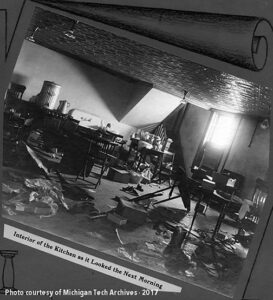
Entrance to the second-floor meeting hall was through an exterior stairway that was narrow and steep. Subsequent records revealed there was a fire escape accessible through the kitchen preparation area and several nearby windows. Few, if any, of those in attendance at the Christmas party knew of those emergency escape areas.
Records indicated between 600 and 700 men, women, and children were in attendance. The party was organized to collect and distribute gifts and candy, as well as food.
Sometime during the festivities, in English, over music and chatter, a man shouted "fire."
The crowd surged into a stampede toward the narrow downward stairway. This massive exit occurred within minutes, literally cramming and stacking dozens upon dozens on the stair steps to the ceiling.
A total of 73 people, including 59 children, perished. Dozens survived multiple crushing injuries.
The sad factor was there was never a fire.
Rumors abounded who shouted "fire". Was it a drunk from the lower-level saloon, a representative of C&H, an anti-union sympathizer, or someone who thought there indeed was a fire?
Another rumor said the stairwell exit doors swung only inward, causing a human crush. That proved not to be true.
Makeshift morgues were created to help identify those who perished. Dozens of burial caskets were transported to Calumet. The tragic event became international news.
WFM members dug grave sites at the nearby Lake View Cemetery. News accounts revealed the Dec. 28 funeral procession attracted 20,000 spectators. Union members lifted children's caskets above their shoulders and horse-drawn sleighs and hearses carried the adult coffins.
Numerous hearings were conducted on the disaster. Many of those interviewed did not speak English, so facts were hard to collect.
In early 1914, a U.S. House of Representatives subcommittee conducted a hearing in Calumet. The theory continued an anti-union man from the Citizens Alliance was the individual who shouted "fire."
The person who yelled "fire" was never identified.
In years to follow, safety rules were established such as prominently identifying emergency exits, establishing total room occupancy, and the criminalization of shouting "fire" in a public space.
The 1913 strike ended in April 1914.
However, in the decades forward, bitterness continued between workers and mine management.
In 1984, the Italian Hall was demolished. Saved was the exterior archway, which was over the stairwell entrance. That arch and a 10-foot memorial plaque were placed in the nearby Keweenaw National Historic Park.
In recent years, on Christmas Eve, 73 luminaries on a pathway leading to the arch are lighted in honor of what some call "Michigan's largest mass murder."
Jeffrey D. Brasie is a retired health care CEO. He frequently writes feature stories and op-eds for Michigan publications. A native of Alpena, he resides in suburban Detroit. He is a U.S. Navy and U.S. Naval Reserves veteran and served on the secretary of the Navy's public affairs staff.