
Veteran shares war memories after memorable Honor Flight trip
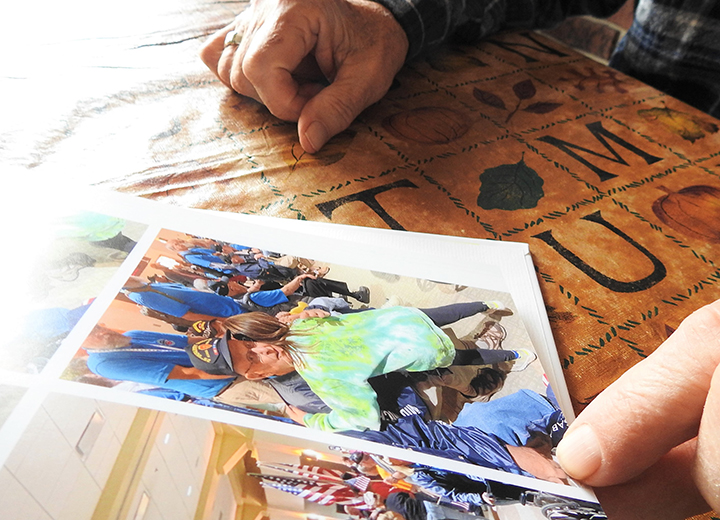
News Photo by Julie Riddle Merlin Schaedig displays a photograph, printed in a memory album, of an unexpected hug from a girl who greeted him at the end of a recent Honor Flight with an envelope of notes of appreciation for his military service in this photo taken on Friday at Schaedig’s home.
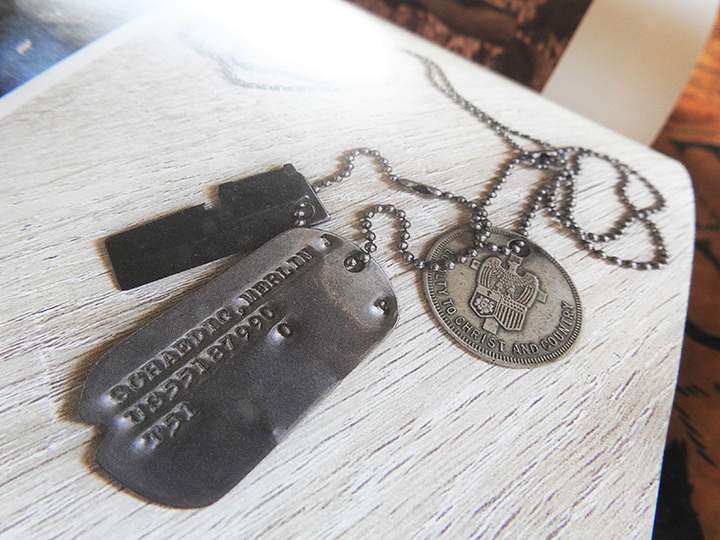
News Photo by Julie Riddle Merlin Schaedig’s dog tag and, top, a can opener used for eating c-rations during the Korean War appear in a photograph printed in a memory album in this photo taken on Friday.
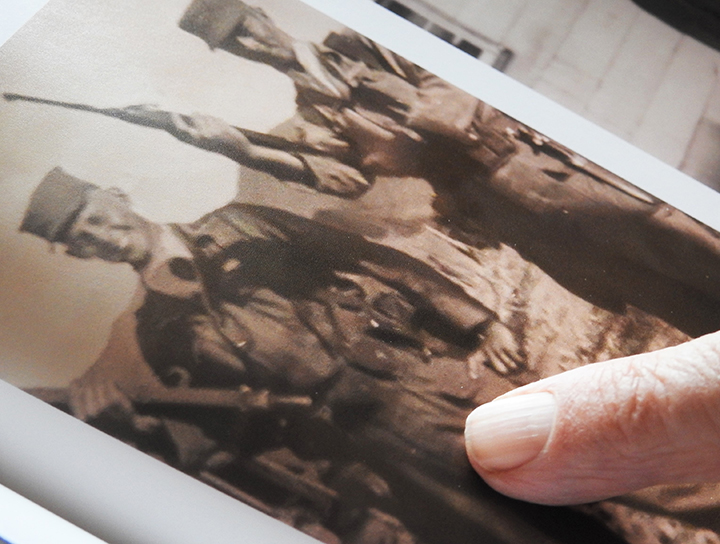
News Photo by Julie Riddle A hazy photograph, taken around 1952 and printed in a memory album, depicts Rogers City resident Merlin Schaedig as a young man fighting in the Korean War in this photo taken on Friday.
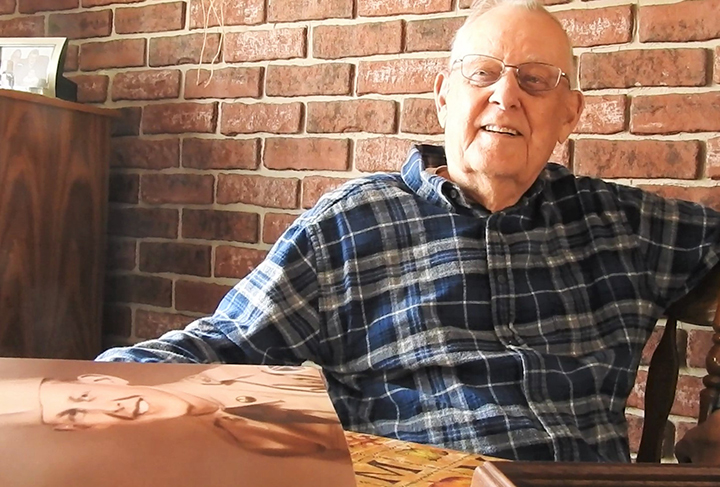
News Photo by Julie Riddle Rogers City resident Merlin Schaedig, now 92, smiles at a photo of himself at about 21 at his home on Friday.
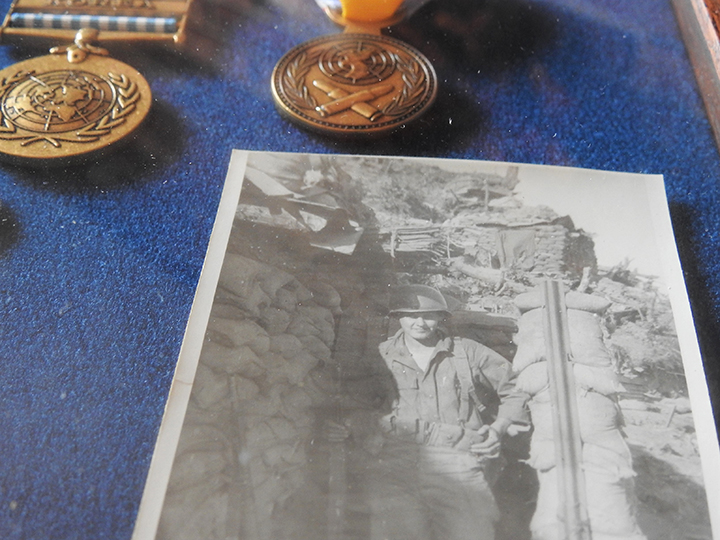
News Photo by Julie Riddle Soldier Merlin Schaedig, then about 21, appears in a bunker during the Korean War in this photo taken at Schaedig’s home on Friday. The photograph appears in a case holding medals recognizing Schaedig for his military service.
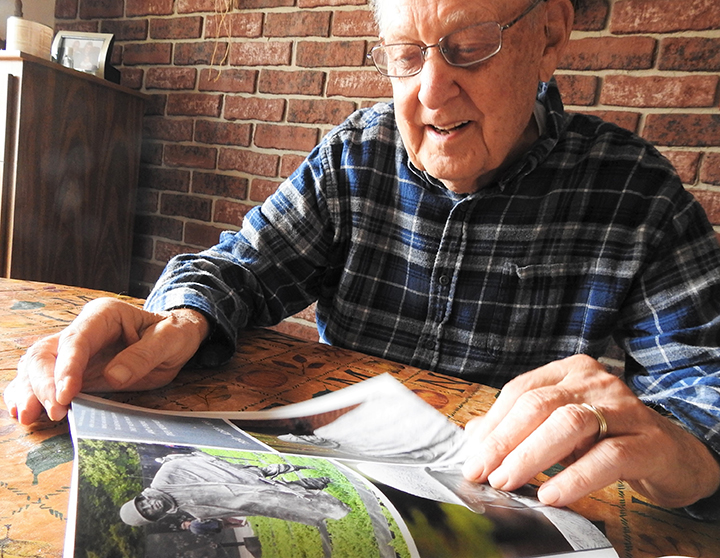
News Photo by Julie Riddle In his home on Friday, Rogers City resident Merlin Schaedig looks at photos of the Korean War Veterans Memorial as he describes a recent trip to Washington, D.C. honoring him and 79 other veterans for their military service.
News Photo by Julie Riddle Merlin Schaedig displays a photograph, printed in a memory album, of an unexpected hug from a girl who greeted him at the end of a recent Honor Flight with an envelope of notes of appreciation for his military service in this photo taken on Friday at Schaedig’s home.
News Photo by Julie Riddle Merlin Schaedig’s dog tag and, top, a can opener used for eating c-rations during the Korean War appear in a photograph printed in a memory album in this photo taken on Friday.
News Photo by Julie Riddle A hazy photograph, taken around 1952 and printed in a memory album, depicts Rogers City resident Merlin Schaedig as a young man fighting in the Korean War in this photo taken on Friday.
News Photo by Julie Riddle Rogers City resident Merlin Schaedig, now 92, smiles at a photo of himself at about 21 at his home on Friday.
News Photo by Julie Riddle Soldier Merlin Schaedig, then about 21, appears in a bunker during the Korean War in this photo taken at Schaedig’s home on Friday. The photograph appears in a case holding medals recognizing Schaedig for his military service.
News Photo by Julie Riddle In his home on Friday, Rogers City resident Merlin Schaedig looks at photos of the Korean War Veterans Memorial as he describes a recent trip to Washington, D.C. honoring him and 79 other veterans for their military service.
Trending
ROGERS CITY -- Merlin Schaedig can recite the exact date he entered the military more than 70 years ago.
"I still remember my dog tag number, too," said the Rogers City resident, now 92, sitting at a table in his dining room last week. "You never forget that."
Schaedig was among 80 veterans recognized this month by the mid-Michigan hub of the National Honor Flight Network.
A one-day trip to Washington, D.C. gave him and the other veterans a look at memorials built in their honor and, for some, a long-awaited recognition of their service to their country.
The passage of time hasn't dimmed Schaedig's memories of serving overseas during the Korean War, listening to the voices of the enemy in the dark and watching friends die.
"It's an experience I wouldn't do again," Schaedig said, eyes growing moist as he reminisced about the long nights, uncertain days, and lingering pride of a soldier on the front line. "But it's an experience I wouldn't give up for anything."
'REALLY SCARY'
A cheering crowd welcomed the Rogers City resident when he and 79 other veterans disembarked in Traverse City from the airplane that carried them on a whirlwind trip on Oct. 5.
No such crowd met the soldier when he arrived back in the U.S. in the early 1950s, though he'd heard tales of ticker tape parades for other veterans.
"We came in on a Sunday, so we didn't get any," Schaedig said, shrugging off the quiet homecoming after he spent 11 months on the front line.
In early 1952, Schaedig and his fellow soldiers lived in bunkers overlooking enemy territory near a place called the Punchbowl, three men to a bunker.
The men took turns standing watch from dusk until dawn.
"We had a lot of time to pray at night, I tell you that," Schaedig said.
Sometimes, they'd go on listening patrols. Other times, soldiers went on combat patrols, expected to engage the enemy.
"It's really scary when you're going out in the dark," he said. "You don't know what you're going to run into out there."
Every 30 days, they'd get to shower and get a good night's sleep, he said.
DANGER UP CLOSE
At night, with the enemy 300 yards away, he could hear North Korean soldiers talking in the darkness.
He remembers the day when a mortar shell dropped among the soldiers' sleeping quarters while they were on the other side of a hill.
"If anybody'd been in there, we'd probably all been killed," he said.
There on the ridge -- and, later, an outpost 1,200 yards in front of the line -- mortar fire and firefights claimed some soldiers' lives and left others injured.
Schaedig escaped physical injury but had to help retrieve dead and injured men from enemy territory on stretchers.
On Christmas Eve, while the men eagerly waited for their Christmas dinner to be delivered in a personnel carrier, a barrage startled them into action.
"Man, we all just dove in amongst these logs," he said. "That's probably the closest I came to getting killed. A lot of dirt and shrapnel was just flying over me."
'HE KEPT ON GOING'
He arrived on the front line in the cold of January.
"Freezing weather, and you're sitting out there on patrols all night," he remembered. "It wasn't very pleasant."
Rest and recreation leave in Japan meant a few days of good meals. Most of the time, on the front line, soldiers ate c-rations, the canned pork and beans, hamburgers, or other basic fare they learned to heat over a fire, occasionally losing a can that exploded from cooking for too long.
Occasionally, members of the Korean Service Corps Battalion brought a hot meal, carrying food strapped to their back for several miles to reach American soldiers on the front line.
Schaedig was eating a hot breakfast when a mortar round hit the man who had just delivered it, "and it blew him right over the bank," he said.
He only rarely has nightmares about being on the front line -- on the other side of which lay uncertainty and an ominous, often invisible enemy.
One time, on Heartbreak Ridge, his men had just crossed into enemy territory when a lieutenant who had just joined the squad, his first time on the front line, turned around and fled.
Schaedig, a squad leader at the time, tried to stop the man.
"He just kept on going," Schaedig remembered. "The last I heard of him, he was in the rear getting court martialed."
A TOUR TO REMEMBER
His country offered a lukewarm reception when Schaedig finished his military responsibilities. But the veterans returning home from this month's Honor Flight couldn't help feeling appreciated, he said.
The Korean War, Vietnam War, and World War II veterans -- one 100 years old -- on the flight woke at 4 a.m. for their trip, arriving home at 9 p.m. the same day.
Fortified by bag meals ("We had a lot of Arby's," Schaedig said), the veterans visited national veterans memorials, gazed at the soaring towers and solemn granite of the nation's capital, and watched the changing of the guard near white tombstones at Arlington National Cemetery.
At the Korean War Veterans Memorial, Schaedig found the engraved name of Russ Schlabaugh, his closest friend in basic training who was killed shortly after they arrived on the front line.
Throughout the day, groups greeted the veterans with flags and cheers and eager thanks.
"The applause that we got was out of this world," said Schaedig, eyes glowing.
Check out the video below. Viewing on mobile? Turn your device horizontally for the best viewing experience. Story continues below the video.
'THAT'S UP HERE'
He was "just a young fellow" when he fought for his country, Schaedig said, describing the medals assembled in a display case he keeps on his wall, including the combat infantryman badge of which he is proudest.
In sepia photos from his time in service, captured in a memory book, he's smiling, laughing with friends or standing confidently by the side of a fellow soldier, ready to do what his country needs of him.
Other remnants of the military service recognized by honor flights and national memorials aren't captured in photographs.
Schaedig remembers planes swooping in for airstrikes in the distance, passing first with smoke bombs, then with rockets, then with machine guns, diving into a nearby valley and then whooshing back into view among the sounds of artillery explosions.
He remembers being scared, but doing the job, anyway.
He doesn't have photos of such memories, but can see them still, 70 years later.
"That's up here," he said, tapping his forehead.