
WITH VIDEO: March for Our Lives comes to Alpena

News Photo by Steve Schulwitz Carol Lund shows off a painting she made honoring the people who died during the Sandy Hook Elementary School shooting in 2012. Lund participated in the March for Our Lives walk in Alpena on Saturday.

News Photo by Steve Schulwitz Alpena Police Department’s Lt. Eric Hamp talks to participants before the March for Our Lives walk in Alpena Saturday. Hamp urged those at and near the event to remain peaceful and respectful to each other and their views.
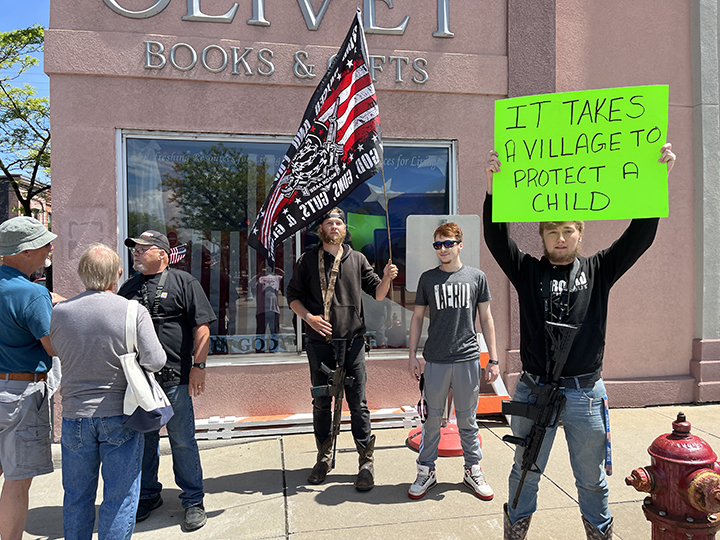
News Photo by Steve Schulwitz Gun rights supporters wave their signs at a rally in Alpena on Saturday. The rally coincided with the local March for Our Lives that began across the street.
News Photo by Steve Schulwitz Carol Lund shows off a painting she made honoring the people who died during the Sandy Hook Elementary School shooting in 2012. Lund participated in the March for Our Lives walk in Alpena on Saturday.
News Photo by Steve Schulwitz Alpena Police Department’s Lt. Eric Hamp talks to participants before the March for Our Lives walk in Alpena Saturday. Hamp urged those at and near the event to remain peaceful and respectful to each other and their views.
News Photo by Steve Schulwitz Gun rights supporters wave their signs at a rally in Alpena on Saturday. The rally coincided with the local March for Our Lives that began across the street.
Trending
ALPENA -- Local advocates for stricter gun laws held a March for Our Lives rally in Alpena on Saturday while people against tighter gun control laws -- some of them armed -- rallied on the opposite side of the street.
The March for Our Lives began at the Alpena County Courthouse and moved through downtown Alpena, including a stop at Culligan Plaza, before continuing back to its place of origin.
The counter rally took place across from the courthouse with several armed participants, but most of that crowd did not march through town.
Several March for Our Lives rallies happened around the country on Saturday in response to several recent mass shootings, including one in Uvalde, Texas that killed 19 students and two teachers.
After the Alpena March for Our Lives participants stopped at Culligan Plaza, they were met by several men protesting proposed heightened gun laws. They had assault-style rifles slung around their chests and expressed their opposition to tougher gun regulations, which raised tensions between the two sides.
There was some brief yelling near the plaza, but it wasn't immediately clear if both groups had a vocal exchange or one side tried to agitate the other.
As people on both sides of the issue gathered before the march, local police increased their presence near the courthouse and along the march route.
Before the march began, the Alpena Police Department's Lt. Eric Hamp talked to participants on both sides of the street to remind them to remain peaceful and respectful to each other and their views. He also urged participants from both sides to report any threats or violence.
Local March for Our Lives organizer Claire Kipfmiller said the goal of the march was to raise awareness about gun violence and mental health issues.
Kipfmiller said she is in favor of more restrictions on guns, but stressed the march was not about banning guns. She said some firearms should be more difficult to acquire than others and some guns should be banned.
Check out the video below. Viewing on mobile? Turn your device horizontally for the best viewing experience. Story continues below the video.
"Who needs an AR-15?" she said, referring to an assault-style semiautomatic weapon. "What do you need that for? If you want to go out and deer hunt, you have more than your right to own a gun. I'm not talking about a gun like that. I'm talking about a gun that can murder 20 children in less than two minutes."
According to the Gun Violence Archive, as of June 5, there have been 246 mass shootings in the U.S. since the start of the year. There were 692 in 2021.
A mass shooting is defined as a shooting in which four or more people are injured or killed, not including the shooter or shooters.
Micheal Mantis, who helped organize the rally opposing more restrictive gun laws, said the goal of that rally was to provide counterpoints to the March for Our Lives. He said removing guns from society can make places like schools, churches, and other so-called soft targets less safe.
"What we are saying is, it is important to use the tools that we have to protect kids," Mantis said. "Why do we have guns at banks or at government buildings but we don't have someone armed at all our schools? We're not here to harass or intimidate anyone. We are here to speak up for our rights."
Among those rallying in support of gun rights was Geyer Balog, a Republican candidate for the 106th state House District that includes Northeast Michigan.
Balog will square off against fellow Republicans Cam Cavitt and Larry Hull in the August primary. The winner will face Democrat Marie Fielder, who is unopposed in the primary, in the general election in November.
Despite their differences in the gun control debate, participants in both rallies on Saturday agreed that mental health is also a primary concern.
"I think, more than guns, this is about raising mental health awareness and raising awareness of universal care," Kipfmiller said. "When people are happy and healthy, they aren't looking to shoot up a school. They aren't looking to go into a crowd and kill 100 people because they are being taken care of mentally, physically, and financially."
"We need to look at the mental health of people with guns, not taking away the civil rights of people other than them," Mantis said.
In response to the recent mass shootings, a bipartisan group of U.S. senators on Sunday announced compromise legislation that would make the juvenile records of gun buyers younger than 21 available when they undergo background checks. The suspects who killed 10 Black people at a grocery store in Buffalo and 19 students and two teachers at an elementary school in Uvalde were both 18, and many perpetrators of recent years' mass shootings have been young.
The agreement would offer money to states to enact and put in place "red flag" laws that make it easier to temporarily take guns from people considered potentially violent, plus funds to bolster school safety and mental health programs.
The Associated Press contributed to this report.