Learning opportunities abound with Science on a Sphere at GLMHC
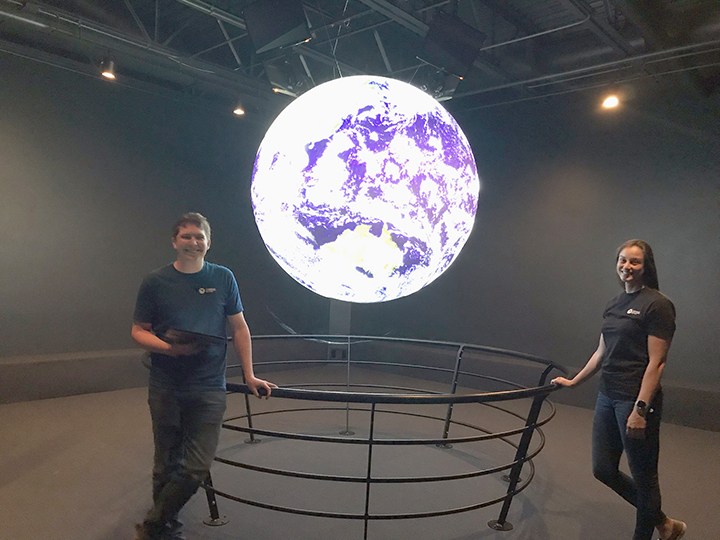
News Photo by Darby Hinkley Maritime Archaeologists Caleb O'Brien, left, and Cassandra Sadler pose with the suspended carbon fiber globe known as Science on a Sphere at Alpena's Great Lakes Maritime Heritage Center.
ALPENA — You can learn a lot from a digital program on a flat screen, but you can learn in a more interactive way on a digital sphere.
Science on a Sphere is an exhibit at Alpena’s Great Lakes Maritime Heritage Center, owned and operated by the National Oceanic and Atmospheric Administration. The NOAA building is known by locals as the visitor center, the shipwreck museum, or the sanctuary building, as it pertains to research and shipwrecks found in the Thunder Bay National Marine Sanctuary.
Science on a Sphere is a suspended carbon fiber globe that spans 6 feet in diameter, hanging from the ceiling with wires. Presentations are digitally projected onto the sphere for audiences to enjoy from all angles.
Caleb O’Brien is a maritime archaeologist working at NOAA’s GLMHC for the summer. He hails from southern Indiana.
“Science on a Sphere, because it’s obviously a sphere, it allows us to do interactive presentations on things like the world, and since the world has so many complex problems, such as environmental, ecosystems, it allows us to make those complex problems more simple and interactive for people to understand,” O’Brien explained.
He will be leading interactive presentations at 11:30 a.m. each Thursday throughout the summer. The interactive presentation will be on ocean acidification, he said.
“Ocean acidification is the waters of the ocean slowly gaining acidity due to increased carbon dioxide in the atmosphere,” O’Brien said. “And, the reason that we decided to do this presentation is that it relates to some ongoing research here at the sanctuary. So, for the next two years, the sanctuary is going to be studying Great Lakes acidification to see if the same effects are noticed in the Great Lakes that we notice in the ocean.”
The sphere is always running a variety of 30-minute programs daily while the visitor center is open, from 8 a.m. to 5 p.m., seven days a week. Programming is set up to change monthly.
“We have close to 50 or 60 different presentations lined up,” O’Brien said. “It’ll have a constant loop.”
“It’s super engaging,” said Cassandra Sadler, a newly hired maritime archaeologist for Thunder Bay National Marine Sanctuary. “And it’s something that, from a museum perspective, we can print off images of a map and hang them all around the room, but this is a tool that can be used for years to come, because it’s constantly changing. You’re going to have to reprint those maps and make new exhibits every time. Whereas, this, you can really take it and adapt it to whatever new projects you’re working on.”
She added that the programs can be shared with other museums that also have a similar sphere.
“It allows us to visualize things that you normally wouldn’t,” O’Brien added. “One thing we were looking at yesterday was the hurricane season of 2012, so, being able to actually see the paths of the hurricanes.”
He added that it’s a lot more interesting seeing that information on a globe versus just a TV screen.
One of the programs shows all of the shipping routes throughout the world.
“So, when you focus in on the U.S.,” Sadler said, “It just showed how much of a center America was, in terms of shipping, in the world. You can visualize it.”
Sadler, originally from Delaware, earned her master’s degree in maritime archaeology from the University of West Florida.
This is not the first time she’s been to Alpena.
“Last summer, I worked with the National Park Service with the Historic American Engineering Record, and I actually came to Alpena and worked with the Great Lakes Fisheries Heritage Trail to document a number of historic commercial fishing vessels around Michigan,” Sadler noted.
She said so far, she likes Alpena, and everyone has been very welcoming.
“I actually grew up in a smaller town than this,” Sadler said. “It’s been such a warm welcome to Alpena. Everybody is really friendly.”
For more information about Science on a Sphere, visit sos.noaa.gov.
“It’s, I would say, one of our most important interpretive tools,” said Stephanie Gandulla, TBNMS maritime archaeologist. “Because you can really visualize ecosystems around the planet. You can even visualize other planets.”
She added that they use it at the Thunder Bay International Film Festival in January as well, because movies can be played on it.
“Another exciting feature with Science on a Sphere is that educators can go online to the Science on a Sphere website, and tailor a program to whatever curriculum they might be working on at the time,” Gandulla added. “For example, Earth sciences. What better way for students to visualize the planet than looking at the sphere right here?”
Local News
Alpena County Library board approves updated reconsideration procedure
DDA looking to fill tiny shop, Water Street Commons
Department of Natural Resources (DNR) Weekly Fishing Report
Tawas/Au Gres: Anglers reported catching walleye in fair numbers in 60 feet of water using both crawler harnesses ...
Free N95 masks available due to wildfire smoke
ALPENA — The City of Alpena and Alpena County are partnering to provide free N95 masks to residents as wildfire ...
City Clerk accepting nominating petitions from candidates for the elective offices
ALPENA – The City Clerk is accepting nominating petitions from candidates for the elective offices of two council ...