
Northeast Michigan police coverage stretched by limited, busy staff
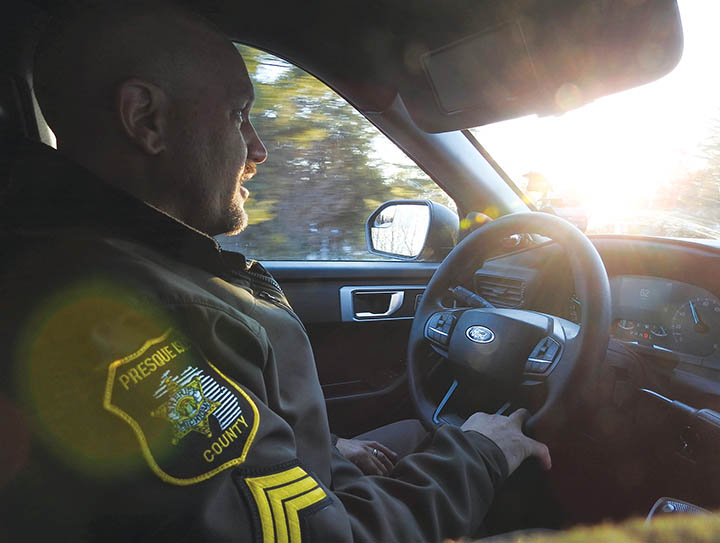
News Photo by Julie Riddle Sgt. Darin Rabeau, of the Presque Isle County Sheriff’s Office, patrols the county shortly after sunrise recently.
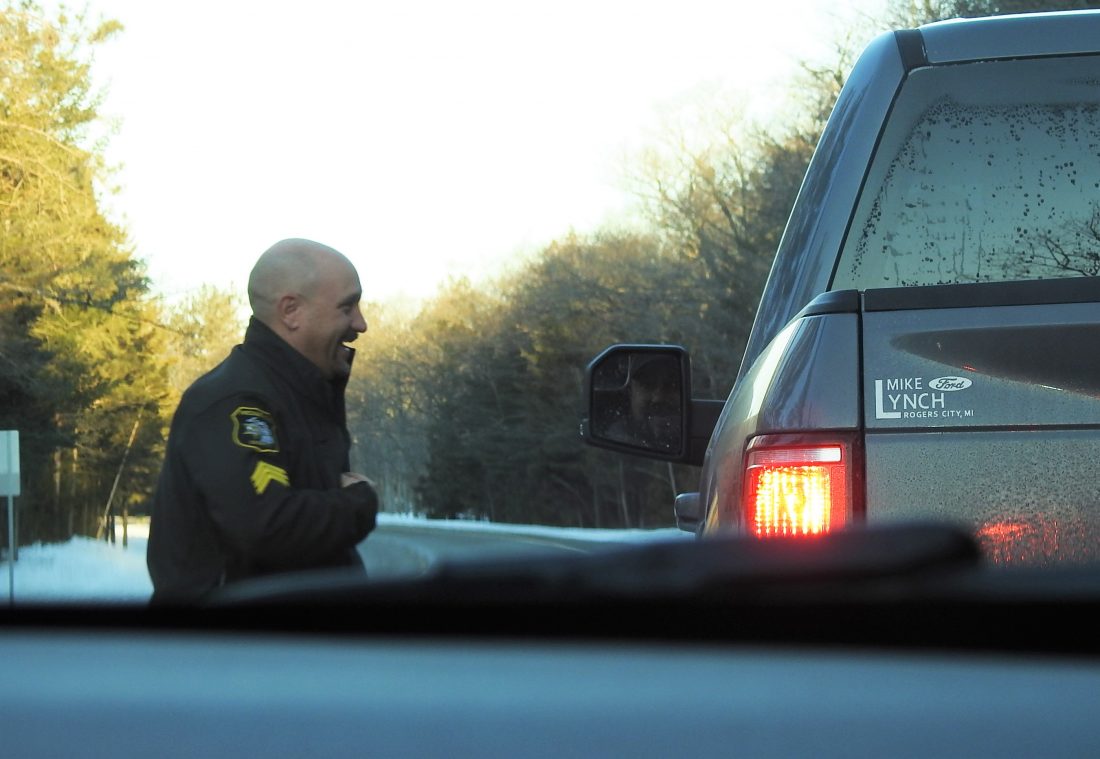
News Photo by Julie Riddle Sgt. Darin Rabeau, of the Presque Isle County Sheriff’s Office, interacts with a resident after giving a warning at a traffic stop during road patrol recently.
News Photo by Julie Riddle Sgt. Darin Rabeau, of the Presque Isle County Sheriff’s Office, patrols the county shortly after sunrise recently.
News Photo by Julie Riddle Sgt. Darin Rabeau, of the Presque Isle County Sheriff’s Office, interacts with a resident after giving a warning at a traffic stop during road patrol recently.
Trending
ALPENA -- More than three quarters of Northeast Michigan residents have no dedicated municipal police force and instead rely on agencies whose officers may be far away when an emergency happens.
Only two Northeast Michigan municipalities, Alpena and Rogers City, have their own police force, while two others, Harrisville and Onaway, contract with their sheriff's offices for at least some dedicated coverage.
County sheriff's offices and the Michigan State Police cover everyone else.
Leaders at those agencies say an officer will always respond to a call, though that officer could be half an hour or more away.
Most Northeast Michigan police agencies would not say how many officers are on the road at any given time, making it hard to know when and where coverage is strongest.
The News reviewed Northeast Michigan police coverage in light of recent developments that show residents can't take for granted the safety net police provide: With a serious shortage of corrections officers to work the county jail, Alpena County recently pulled some deputies off of road patrol to cover jail security. And Rogers City, following a tax settlement that cost the city tens of thousands of dollars a year, says it may need a new property tax to fund its police department -- anything but a sure win with voters already paying for record inflation and skyrocketing gas prices.
Policing costs serious money, with Northeast Michigan police agencies' budgets topping a combined $12 million. Most local governments can't afford to hire officers or hire more officers.
Even when they can afford to hire more people, police leaders say they struggle to find applicants for open positions.
Shortages force agencies to get creative with scheduling and partnerships to police Northeast Michigan communities.
Police officials could offer no easy solution to the overstretched coverage.
"If you come up with it," said Presque Isle County Undersheriff Chris Flewelling, "please let us know."
A LONG WAY AWAY
Police leaders firmly say they provide coverage for all of Northeast Michigan.
However, with limited staff and busy schedules, officers can't be everywhere in the region's 2,500 square miles at once, they acknowledge.
In Presque Isle County, even with a Sheriff's Office at full staff, dispatchers sometimes have to tell callers they'll have to wait an hour for an officer, Flewelling said.
Onaway hired Flewelling's agency to provide 40 hours of nighttime coverage per month. Coverage days and hours vary, with the county's 12 deputies signing up to take extra shifts in Onaway as they are able.
In addition to road patrol, officers transport inmates to court hearings or medical care or cover court duty, sometimes leaving nobody available to respond instantly to a call, Flewelling said.
Recent instructions in that county to limit patrol miles because of high gas prices means officers may or may not be close by to respond to the recent increase Sgt. Darin Rabeau has seen in domestic violence, sexual assault, and mental health crisis calls.
Deputies on duty at the same time often linger at opposite sides of the county to increase the chances one of them will be close to an emergency, he said.
HELP WANTED
A countywide property tax ensures Montmorency County Sheriff Chad Brown can provide 24-hour road patrol with at least two officers on duty at all times and up to five working some shifts.
Even on a full shift, however, an urgent call or request for backup may require temporarily reassigning a non-road patrol officer, calling in an off-duty officer, or asking for assistance from the State Police, a neighboring sheriff's office, or the Michigan Department of Natural Resources' law enforcement division, Brown said.
Many complaints require two officers for safety reasons, meaning officers have to wait for backup to arrive from another town, he said.
His county recently approved the addition of three deputies.
Permission to hire doesn't always lead to more officers on staff, however.
Like agencies across the country, Northeast Michigan law enforcement leaders say they struggle to find applicants for uniformed positions.
Alpena County budgets for 13 officers for its Sheriff's Office, including the sheriff, undersheriff, an animal control officer, and a school liaison officer. The office has been understaffed for several years, making thorough road coverage nearly impossible, Undersheriff Erik Smith said.
"How do you do 24-hour road patrol with only nine people, 365 days a year?" Smith said.
Fifteen years ago, the Alcona County Sheriff's Office employed 15 full-time officers, including an officer assigned to the Huron Undercover Narcotics Team, a full-time school resource officer, and a detective.
The office has dwindled to 11 full-time officers, one of whom works part-time in schools. Sheriff Scott Stephenson has not filled the HUNT and detective positions in an effort to help keep road patrol staffed.
His current budget allows for two more full-time deputies, and "I'd be pretty excited to be able to fill those," Stephenson said.
The Michigan State Police does not share staffing numbers or the minimum number of troopers on the road.
Troopers provide backup coverage in counties with few road patrol officers but are not guaranteed to be in any particular county in their coverage area, said 1st Lt. John Grimshaw, commander of the Michigan State Police-Alpena Post. The Alpena Post covers Alpena, Presque Isle, Montmorency, Alcona, and Oscoda counties.
'A GIGANTIC TASK'
The shortages force police agencies to juggle schedules and look for creative partnerships to keep officers on the road.
The Alpena Police Department promises two officers on duty at all times within city limits. At night, three officers patrol the city, usually in separate patrol vehicles.
The city has budgeted for 20 officers but has only had 18 for at least the last 20 years, according to Lt. Eric Hamp.
He spends large chunks of time managing schedules, adjusting for officers unavailable for patrol because of court appearances, training, or time off.
"And that never stops, ever," Hamp said. "It's a gigantic task."
Rogers City residents have 24-hour coverage from a six-member police department -- down from eight officers in 2008 -- which includes the police chief, a sergeant, and a school resource officer, in addition to three patrol officers.
Rogers City Police Chief Jamie Meyer would not say how many officers are on duty at one time.
A DNR officer helps cover shifts for the Rogers City Police Department, in addition to his full-time DNR work, Meyer said.
DNR officers can make traffic stops and respond to emergencies, but that work is not their primary responsibility, nor are conservation officers guaranteed to be in their assigned county while on duty.
Alcona County has contracted with the DNR to perform off-road vehicle, marine, and snowmobile patrols and to patrol U.S. Forest Service sites. Harrisville hired the county to provide officer presence in the city, usually 20 to 25 hours per month.
Stephenson, the sheriff, recently established a satellite office on the county's west side and hopes to set up another on the northern border to give deputies a place to do paperwork or conduct meetings while on the road, a step Stephenson hopes will improve response times and deter crime.
"We owe it to our community, our county, to work those roads," Smith, of Alpena County, said. "We need to get those officers back out there."
Julie Riddle can be reached at 989-358-5693 or jriddle@thealpenanews.com. Follow her on Twitter @jriddleX.
Police Budgets
Budgeted expenses for Northeast Michigan police agencies:
Alpena Police Department: $2,387,411
Rogers City Police Department: $487,600
Alpena County Sheriff's Office: $6,014,010
Presque Isle County Sheriff's Office: $838,100
Montmorency County Sheriff's Office: $885,100
Alcona County Sheriff's Office: $1,595,490
Source: County and municipal budgets