
WITH VIDEO: Honoring heritage with homemade paczki in Posen
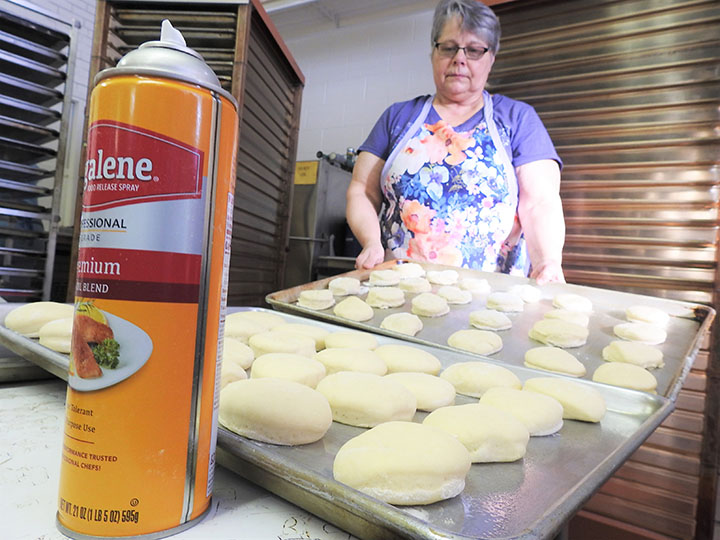
News Photo by Julie Riddle In front of a wall of panned paczki dough, Paulette Bordeau holds trays of the treats at the St. Casimir Catholic Church school building in Posen on Saturday.

News Photo by Julie Riddle Dough oozes from a pan as St. Casimir Rosary Sodality members make paczki at the church’s school building in Posen on Saturday.

News Photo by Julie Riddle Paczki-makers fish pastries out of hot oil at the St. Casimir Catholic Church school building in Posen on Saturday.

News Photo by Julie Riddle Rows of cooling paczki in the background, a fresh paczek displays a sponge-like center at the St. Casimir Catholic Church school building in Posen on Saturday.

News Photo by Julie Riddle Representing a new generation of paczki makers, a young worker holds a pan of freshly fried paczki at the St. Casimir Catholic Church school building in Posen on Saturday.

News Photo by Julie Riddle Paczki sizzle in hot oil in the St. Casimir Catholic Church school kitchen in Posen on Saturday.

News Photo by Julie Riddle In a busy kitchen, St. Casimir Rosary Sodality members prepare paczki for their annual pre-Lent fundraiser in Posen on Saturday.

News Photo by Julie Riddle Marcy Idalski, left, and Diane Kamyszek prepare dough for the annual St. Casimir Rosary Sodality paczki sale in Posen on Saturday.

News Photo by Julie Riddle Paulette Bordeau slides a tray of paczki dough onto a rack in the St. Casimir Catholic Church school kitchen in Posen on Saturday.

News Photo by Julie Riddle A member of the St. Casimir of Posen Rosary Sodality flattens dough at the annual paczki sale in the church’s school kitchen on Saturday.
News Photo by Julie Riddle In front of a wall of panned paczki dough, Paulette Bordeau holds trays of the treats at the St. Casimir Catholic Church school building in Posen on Saturday.
News Photo by Julie Riddle Dough oozes from a pan as St. Casimir Rosary Sodality members make paczki at the church’s school building in Posen on Saturday.
News Photo by Julie Riddle Paczki-makers fish pastries out of hot oil at the St. Casimir Catholic Church school building in Posen on Saturday.
News Photo by Julie Riddle Rows of cooling paczki in the background, a fresh paczek displays a sponge-like center at the St. Casimir Catholic Church school building in Posen on Saturday.
News Photo by Julie Riddle Representing a new generation of paczki makers, a young worker holds a pan of freshly fried paczki at the St. Casimir Catholic Church school building in Posen on Saturday.
News Photo by Julie Riddle Paczki sizzle in hot oil in the St. Casimir Catholic Church school kitchen in Posen on Saturday.
News Photo by Julie Riddle In a busy kitchen, St. Casimir Rosary Sodality members prepare paczki for their annual pre-Lent fundraiser in Posen on Saturday.
News Photo by Julie Riddle Marcy Idalski, left, and Diane Kamyszek prepare dough for the annual St. Casimir Rosary Sodality paczki sale in Posen on Saturday.
News Photo by Julie Riddle Paulette Bordeau slides a tray of paczki dough onto a rack in the St. Casimir Catholic Church school kitchen in Posen on Saturday.
News Photo by Julie Riddle A member of the St. Casimir of Posen Rosary Sodality flattens dough at the annual paczki sale in the church’s school kitchen on Saturday.
Trending
POSEN -- In a hot kitchen, women wearing aprons harrumphed and rolled their eyes at the mention of the imposters.
"They call them paczki," said Gladys Purol, whumping her palm onto a slab of white dough splayed on a stainless steel table. "But they're really just doughnuts."
In Posen - a Northeast Michigan Polish enclave where Old Country traditions run deep and true - the packaged pastries ubiquitous in Michigan grocery stores and gas stations in late February fall flat in the face of the golden, decadent desserts made by generations of the town's Polish mothers and grandmothers.
Check out the video below. Viewing on mobile? Turn your device horizontally for the best viewing experience. Story continues below the video.
Ginny Wozniak, who ringleads the organized chaos that is the annual St. Casimir Rosary Sodality paczki sale, says many downstaters don't understand the beauty that is a true Polish paczki.
As the uninitiated taste the real thing, dense and rich and made fresh from her mother's recipe, their faces light up with surprise and delight, Wozniak said.
"That," she tells them, "is what we call paczki Up North."
On Saturday, St. Casimir Catholic Church women labored in the kitchen of the church's school building, cutting and frying 340 dozen pastries.
Polish immigrants introduced paczki - pronounced POONCH-kee and already a plural, with a singular of paczek - often eaten as a final indulgence before the Christian season of Lent.
Before 6 a.m. on paczki day, the first shift sets to work measuring and mixing the 24 pounds of butter, five 50-pound bags of flour, 35 dozen eggs, and 30 pounds of sugar - plus a secret ingredient - needed to make the more than 4,000 paczki that will be gone by day's end.
The second shift pounds and pokes the raised dough into submission, then cuts circles with tin cans until rising dough lumps fill every vertical surface of the kitchen.
Meanwhile, the women keep flattening and cutting, arms in nonstop motion as they work side by side, talking about their kids and their lives and the warmth of the kitchen.
Laurie Krajniak, fingers massaging a dough slab, remembered eating the homemade Polish food served at the school when she was a student there.
"It's our heritage," she said, telling of grandparents who moved to Northern Michigan from Poland, the other women nodding their own family histories.
They reminisced, with tiny moans, about their mothers handing them paper bags containing paczki and sugar to shake up and about their fathers coming home with fresh milk and a smile.
"We always knew we were going to get something special," said Paulette Bordeau, hastening to swear to her 100% Polish background, despite her French name.
At another workstation, Diane Kamyszek remembered helping with potato pancake dinners at the church when she was a girl.
Young people today don't bake from scratch, and many are moving away and not coming back, Kamyszek said, wondering whether the region's culinary traditions can withstand such challenges.
"Yeah, I don't know," she said, patting the dough. "I don't know what the future holds for paczki."
Then again, she said, her son in Ohio recently asked her for tips on making the Polish treat.
Meanwhile, oil in a row of pans sizzled, ready for frying.
"Anybody want an apron?" Lori Olsen asked cheerfully, proffering a handful of red Rosary Sodality aprons with no takers. "What the heck, you people?"
The room buzzed with industriousness as women weaved out of each other's way, trays of dough cutouts held aloft, and piles of golden orbs were carted away to cool on long, paper towel-lined tables in the school gym.
Soon, people would come, faces glowing with anticipation, to pick up their dozen-to-a-bag paczki and tubs of homemade frosting.
"My mother used to do it, her mother used to do it, her mother used to do it," Wozniak said in the gym, rows of fresh paczki cooling by her side. "The tradition is there. If we don't, who's going to do it?"