
‘Blueberry Jam’ discussion and poetry Friday at Art in the Loft
Trending
ALPENA -- The community is invited to a discussion and reception on Friday night at Art in the Loft, centering around a piece called "Blueberry Jam."
The event, from 6 to 8 p.m., will also offer a poetry open mic time hosted by The Poetics Lab with help from Joe Bastow of Susan Lane Foundation.
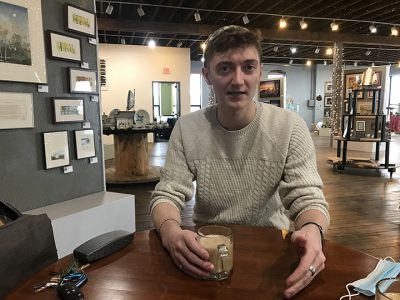
Mitchel Dipzinski is the artist behind "Blueberry Jam," as well as the founder of The Poetics Lab.
His vision for the evening is to bring community members of all walks of life together to talk about his piece, which he felt compelled to create after hearing hate speech and anti-gay rhetoric at Alpena Public Schools Board of Education meetings held in the fall of 2021.
He explained his art installation, as well as the name.
"The basis of this is that it is three letters that were sent to the community, that were brought to my attention, and published in one way, shape or form, either online or through emails, or just made public by the author themselves," Dipzinski explained.
He added that all names have been redacted because his intention is not to single anyone out, but to address these issues as a community.
"These letters are surrounding conversations that took place at the Alpena school board," he said, adding that the August 2021 Town Hall meeting started it all.
Dipzinski, a self-proclaimed "queer man," speaks boldly about the rights of those in the LGBTQIA+ community. He just wants to see them treated humanely by and equally to their straight peers.
"Being a minority individual, being a queer man in this space, I looked at the words and the language and the rhetoric, and all of those pseudonyms with this, and saw the dangers behind it," Dipzinski explained. "I was actively speaking out against these letters at these events, and was actively speaking out against the rhetoric that was happening at the board of education meetings. I was advocating for these students, because it seemed like hardly anybody else was."
The 24-year-old grew up in Alpena and, partly due to hate speech and discrimination, couldn't wait to leave. He thought he would never come back, but now he realizes that Alpena needs more people like him to speak out for those who are bullied or too shy or hurt to speak up for themselves.
"I felt the immense pain while reading these, that I knew my students were going to feel," he said, adding that parts of the letters also attacked people of color, not just gay, bisexual, or transgender individuals.
"So what I did was I stripped away that extra stuff," he said of the letters, in which he redacted many of the words, but left those with the most poignant impact. "I said, 'This is what's being said here, and community members aren't speaking out against it.' So, I took these letters, and I stripped 'em bare and left 'em raw."
The reasoning behind his title, "Blueberry Jam," came from a story told at the board of education meeting in August, in which the assistant superintendent stated that schools should be run like an ice cream salesman who picked out his blueberries based on the best of the best. After the story, a parent inquired, "What about the 'bad' blueberries?"
Herein lies the problem, and the inspiration for Dipzinski's work.
"The idea of that being, the people who don't conform," he noted.
Speaking of not conforming, Dipzinski has a few words to share about the term "queer."
What exactly does it mean, and why and how is it acceptable nowadays, when it was taboo 20 years ago?
"That really depends on the person," he said of whether you'd prefer to be called "gay" or "queer."
At any rate, it is OK to ask how an individual would like to be addressed. It is still not OK to call a person "a queer."
Yes, there is a difference.
"Queer is more of the umbrella term for sexuality, romanticism, and the attractionality side of it," he noted. "And then you have a term like 'trans' which is the umbrella term for the gender-specific side."
It's a lot, and it's OK to admit you don't get it … yet.
"For me to identify as queer, it's more the personal preference of it, it doesn't define me as 'Oh, he's just a gay man.' I kind of feel more identifiable with the entire community as a queer man, than just saying I'm a gay man. It's a personal preference of mine, and I know other people feel a little bit different," Dipzinski said. "And I also know a lot of the older generation in the LGBTQ community, have faced 'queer' as a negative term."
He explained the evolution of the word.
"The queer community has taken, essentially, that word that used to be a derogatory term, and has reclaimed it as a source of empowerment," Dipzinski noted. "We've been able to call ourselves queer, wear it as a badge of honor, rather than let others dehumanize us with it."
He added that people say they are coming up with new terms every day, and it's hard to keep up, "as an excuse to not learn it."
"It's true -- they're coming up with new terms to better encompass groups," Dipzinski explained. "So, it's worth it to learn them, but it's OK to not know them ahead of time."
He said, "The general community member may look at it and say, 'Why do we need to know someone's sexuality? Why do we need to know someone's gender?' To be completely honest, you don't need to know someone's sexuality to give them the space to exist," he explained. "But, the problem is, there's a certain group of individuals within the community that has come forward and said, 'I don't like it, so you don't get to do it.' And that's not OK."
Doors will open before 6 p.m. on Friday, and blueberry-themed refreshments and desserts will be served. There will also be a cash bar available for those 21 and over. The event will begin with the open mic for poetry readers, who are asked to keep their readings to 3 to 5 minutes per person.
Then at 7 p.m., Dipzinski will speak about his piece, leading the discussion, then opening up the floor for a question and answer session.
Audience members are politely asked to maintain a respectful level of discussion. Anyone purposefully attempting to disrupt the event will be asked to leave immediately.
The Poetics Lab will be hosting a monthly open mic up until their June workshop series, said Dipzinski, who co-founded the organization with Dom Witten.