
Next generation of biologists stock Black Lake with endangered species
News Photo by Julie Riddle Madeleine Larson, 4, releases a sturgeon fingerling into the Upper Black River near Onaway on Saturday.

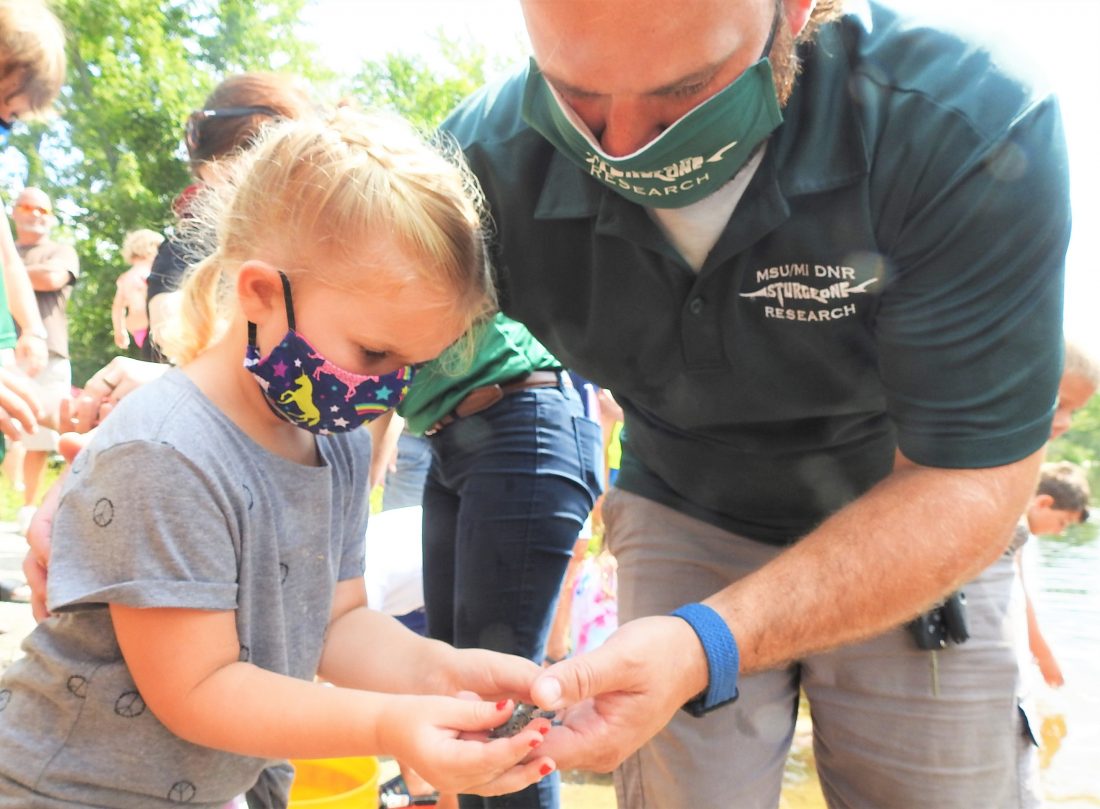
News Photo by Julie Riddle Children gather around as Tim Cwalinski, senior fisheries biologist with the Michigan Department of Natural Resources, places a sturgeon fingerling into the hands of curious visitors to the Black River sturgeon hatchery near Onaway on Saturday.

News Photo by Julie Riddle Tim Cwalinski, senior fisheries biologist with the Michigan Department of Natural Resources, transfers sturgeon fingerlings into a truck to be released in the Upper Black River near Onaway on Saturday.

News Photo by Julie Riddle Children release sturgeon fingerlings in the Upper Black River near Onaway on Saturday.

News Photo by Julie Riddle Children release sturgeon fingerlings in the Upper Black River near Onaway on Saturday.

News Photo by Julie Riddle Children release sturgeon fingerlings in the Upper Black River near Onaway on Saturday.

News File Photo A sturgeon fingerling is released in the Upper Black River near Onaway in this August 2021 News archive photo.
News Photo by Julie Riddle Madeleine Larson, 4, releases a sturgeon fingerling into the Upper Black River near Onaway on Saturday.
News Photo by Julie Riddle Children gather around as Tim Cwalinski, senior fisheries biologist with the Michigan Department of Natural Resources, places a sturgeon fingerling into the hands of curious visitors to the Black River sturgeon hatchery near Onaway on Saturday.
News Photo by Julie Riddle Tim Cwalinski, senior fisheries biologist with the Michigan Department of Natural Resources, transfers sturgeon fingerlings into a truck to be released in the Upper Black River near Onaway on Saturday.
News Photo by Julie Riddle Children release sturgeon fingerlings in the Upper Black River near Onaway on Saturday.
News Photo by Julie Riddle Children release sturgeon fingerlings in the Upper Black River near Onaway on Saturday.
News Photo by Julie Riddle Children release sturgeon fingerlings in the Upper Black River near Onaway on Saturday.
News File Photo A sturgeon fingerling is released in the Upper Black River near Onaway in this August 2021 News archive photo.
Trending
ONAWAY -- With blessings and well-wishes, 500 miniature fish wriggled into the Upper Black River near Onaway on Saturday, hopefully to return in 15 to 25 years as armored-plated giants.
After missing the 2020 release because of COVID-19 restrictions, researchers and a throng of children sent hundreds of sturgeon fingerlings on their way to Black Lake as part of an ongoing effort to strengthen the state's population of the protected species.
Several hundred people on Saturday toured the Black River sturgeon hatchery outside of Onaway -- which bills itself Michigan's sturgeon capital -- and helped release the three-inch fingerlings.
"That fish, someday, ought to be bigger than your dad," Tim Cwalinski, senior fisheries biologist with the Michigan Department of Natural Resources, said as he placed a small fish into the cupped hands of two boys touring the hatchery.
Children traditionally take part in the annual release of the ancient species with bony plates in place of scales.
About 20 young people crowded around a bucket at the edge of the Black River near its mouth into Black Lake on Saturday, waiting their turn to send a fish to its new home.
Little but fierce, solid and heavy for their size, the small sturgeon poked their long snouts into the air with calm determination as small hands gently transferred them to their new home.
Urged to tell the fingerlings to "live long and prosper" and to bless the small creatures on their journey, the children marveled as the fishlings explored the water near their toes.
Check out the video below. Story continues below video.
"They really don't know what to do," one young helper said, nudging a small fish toward bigger waters.
"See you in 25 years," a nearby adult said to a fish. "Come on, get out there and make babies."
The 498 sturgeon released into Black Lake and 490 released into Mullet Lake in Cheboygan County on Saturday will help replenish an important cultural and ecological resource, according to Douglas Larson, research assistant with Michigan State University who manages the Onaway hatchery.
Lake sturgeon reproduce millions of eggs every year, yet those eggs sometimes lead to almost no adult fish.
"Quite literally, everything that can eat sturgeon larvae, do," Larson said.
Researchers studying larvae at the Onaway hatchery hope to find keys to increasing sturgeon survival rates.
Students in the hatchery's classroom program contribute to sturgeon studies by raising and studying the fish. This year, students have kept an eye on cameras recently installed in the river near the hatchery, scanning for known predators of young sturgeon.
Other recent research at the hatchery will help scientists understand how sturgeon smell their way back to the waters in which they were born up to 25 years later and how extreme weather conditions or water levels impact the frequency with which adult sturgeon return to their native waters to spawn.
The students who collect data for researchers and the young people eagerly releasing the fish that can grow to be 200 pounds and 7 feet long and live for 100 years are the next generation of biologists who will protect the sturgeon, listed as an endangered species in Michigan, Larson said.