Alpena to benefit from sister sanctuary
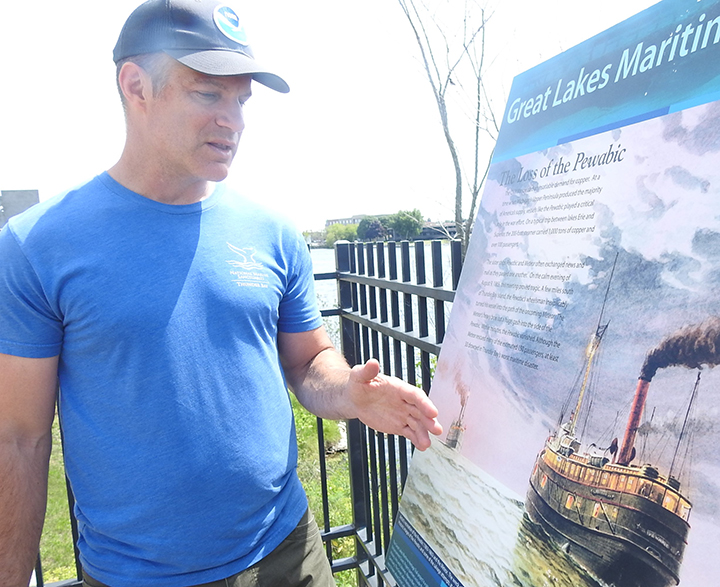
News Photo by Julie Riddle Jeff Gray, superintendent of the Thunder Bay National Marine Sanctuary in Alpena, on Monday describes a shipwreck protected in the sanctuary’s waters.
ALPENA — Alpena can no longer claim to host the only national marine sanctuary on the Great Lakes — a change Jeff Gray, superintendent of the Thunder Bay National Marine Sanctuary in Alpena, called nothing but good news.
The recent creation of a second freshwater sanctuary, on the shores of Lake Michigan north of Milwaukee, offers opportunity for collaboration and connections that will enhance the story Alpena and her shipwrecks are already telling, Gray said.
“All boats rise with the tide,” Gray said, anticipating that the new addition in Wisconsin, a future boon to its communities and shipwrecks, “will be a great thing for Northeast Michigan, as well.”
On June 22, the National Oceanic and Atmospheric Administration announced the designation of 962 square miles of Lake Michigan, encompassing 36 historically significant shipwrecks, as the Great Lakes’ second marine sanctuary.
The new sanctuary’s boundaries become official and enforceable in early August, according to Russ Green, former deputy superintendent of the Alpena sanctuary.
Now Great Lakes regional coordinator at NOAA’s Office of National Marine Sanctuaries — and instrumental in the creation of the Wisconsin sanctuary — Green said the communities backing the new sanctuary used Alpena’s support of its sanctuary as a playbook.
“We could draw on a real-world experience of what engagement means, rather than start from scratch,” Gray said. “That perspective on what you can accomplish and what it means to be engaged in the community was really defined in Thunder Bay.”
Alpena’s sanctuary, located in Lake Huron’s Thunder Bay, has held its title as the only such sanctuary since its inception in 2000.
While the sanctuary’s 4,300 square miles may seem a large area, “It’s a pretty small chunk of the Great Lakes. If we can do more to bring communities to care about the history of the lakes, we can protect everything better,” Gray said.
Gray and his staff already work closely with the more than a dozen other national marine sanctuaries along the country’s mainland coast and on Hawaii and American Samoa islands.
The two Great Lakes sanctuaries will share resources, equipment, and educational programming for the benefit of both, Gray said.
A mapping vessel not used in Alpena every day, for example, could be sailed around the tip of the lower mitten to map wrecks in the Wisconsin sanctuary. Dive teams from either sanctuary could conduct their research in either location to help with large projects, once the Michigan staff gets up and running, Gray said.
One day, Gray hopes, a network of sanctuaries on the Great Lakes will catch public interest in what he called one of the world’s most important natural resources.
On Wednesday, NOAA published an early draft of a management plan for a third freshwater sanctuary, proposed on eastern Lake Ontario in New York.
Since the designation of the Wisconsin sanctuary in June, people have asked Gray if Alpena’s loss of the title of the country’s only freshwater sanctuary makes him sad.
Not at all, Gray said. The possible benefit for both sanctuaries — and for their communities — is too great for regrets.
Besides, Gray said, “We’ll still be the first.”
Local News
Quilt Guild meets Thursday
ALPENA — The Gone to Pieces Quilt Guild is hosting a meeting on Thursday at the first United Methodist Church of ...

Local firefighters aid in battling Oscoda County wildfire

Alpena enplanement numbers up in April
Feeding Kids Ministry hosts craft show
ALPENA- Feeding Kids Ministry is hosting its spring craft bazaar on Saturday from 10 a.m. until 3 p.m. at 500 S. ...

All animals love walks