
Shifting weather could mean Great Lakes damage, scientists say
Trending
ALPENA -- Small changes in weather patterns could lead to large impacts on Lake Huron, putting the shipwrecks, boardwalks, and other shoreline infrastructure in harm's way in the future, Michigan scientists say.
Those scientists say weather anomalies affecting water also impact the land -- and vice- versa -- and, when one is threatened, the other is, too.
Two climate-related phenomenons affect Lake Huron currently, environmental experts say: a moderate increase in the area's annual average temperature and an increase in precipitation.
Over the years, the region has slowly warmed, meaning ice covers the Great Lakes less frequently. That's helped cause more powerful rain storms and frequent lake-effect snowfall.
Those events, which contribute to high water levels, have begun to take a toll, as local governments and residents pay thousands to protect or repair infrastructure, climate experts say.
Richard Rood, a University of Michigan climate professor, worked on a peer-reviewed study with the Great Lakes Integrated Sciences and Assessments that found "heavier storms are projected and the frequency and intensity of them has increased," and "more precipitation will cause more high-water damage to shorelines, coastal infrastructure, and flooding."
In Northeast Michigan, "there likely won't be one big event that will last or change things forever, but a gradual change will occur and is occurring," Rood told The News. "If you look out into the future, the most robust thing we will see is it will keep getting warmer for the next several decades. With it, it is reasonable to expect more flooding and drought."
LAKE RISE, SHORE DAMAGE
Over the last five years, significantly more precipitation dropped on Northeast Michigan, according to the National Weather Service.
Since the beginning of 2015, Alpena has averaged almost 40 inches of precipitation per year, more than 11 inches more than the yearly average during the 30-year period from 1981 through 2010 that scientists currently use as a benchmark to define a normal climate. A new 30-year benchmark period will begin at the end of 2021.
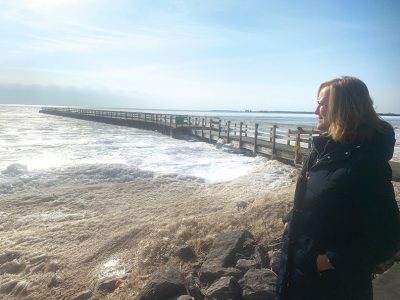
The added water in Lake Huron has helped push water levels to record highs, and that high water, pushed by high winds in recent years, has damaged shoreline properties, piers, sidewalks, buildings, and roads. Last year, the Michigan Department of Transportation needed to make emergency repairs on U.S.-23 in Presque Isle County when erosion threatened to collapse the highway onto the beach.
National Weather Service meteorologist Dan Cornish said most of the precipitation has come as rain. Storms aren't as frequent, but the storms that happen produce heavier downpours.
"It definitely contributed to the rise of the lakes and caused the associated damage to the shore," he said.
Rood, of the University of Michigan, said both water temperatures and air temperatures will creep higher, which will produce even more rain in future years.
He said the lakes will freeze over less often and for shorter durations, which will continue to challenge shoreline communities like Harrisville, Alpena, and Rogers City with continuing shoreline damage.
The Great Lakes Integrated Sciences and Assessments study says ice cover will continue to decline in Lake Huron, leading to more winter lake-effect precipitation and increased winter wave activity.
The National Park Service says air temperatures have risen 2.3 degrees over the last 32 years, and temps continue inching upward. That has led to warmer and shorter winters and more precipitation.
'IMPACTS ON FISH AND WILDLIFE'
More rain and thaw leads to increased water runoff from farm fields, Jim Kessler, a scientist at the National Oceanic and Atmospheric Administration Great Lakes Environmental Research Laboratory said.
That runoff could put Thunder Bay at risk of severe algae blooms down the road.
He said the fertilizers and chemicals used to aid plant growth on land end up in the rivers and lakes after heavy rain. Although it's unlikely today, severe overgrowth of algae could disrupt and alter the lake's ecosystem, wildlife, and human health if patterns continue to evolve at the current rate.
"The stormwater contains fertilizers, nutrients, and toxins that potentially could impact the lake," Kessler said. "If you put nutrients on land to make plants grow, they end up in the lake, and then plants grow in the lake, too. When the algae dies and decays, it robs oxygen from the water, which may have impacts on fish and wildlife, and create scums on the water."
Katie Wolf talks about the effects of climate change on the Great Lakes. Story continues below video.
'REDUCE THE CHANCE OF ARTIFACTS' SURVIVAL'
High water levels, larger waves, and a chemical shift in Thunder Bay could have lasting impact on the 4,300-acre Thunder Bay National Marine Sanctuary off Northeast Michigan's coast, including the nearly 100 historic shipwrecks it protects.
Stephanie Gandulla, a NOAA research and media coordinator and maritime archaeologist in Alpena, said a United Nations Education Scientific and Cultural Organization study showed historic structures are vulnerable to changes in temperature, wind, and moisture.
The study said the preservation of artifacts such as shipwrecks depend on a "delicate balance of conditions. Changes to these conditions may reduce the chance of artifacts' survival."
Gandulla said NOAA has the ability to monitor climate change trends in Northeast Michigan, and she hopes that becomes a priority moving forward.
"The waters of Thunder Bay National Marine Sanctuary are a real-world scientific laboratory, and a perfect place to do investigative and monitoring research on a variety of climate change issues," she said. "We strive to encourage and facilitate Great Lakes scientists to do their research right here off the shores of Alpena in Lake Huron."
Sarah Waters, a NOAA education coordinator, says people can learn about the impact of climate change with the use of interactive displays at the sanctuary's museum in Alpena. The more people know about the problem, the more likely progress will be made addressing it, she said.
"The visitor center's Science on a Sphere theater provides a powerful visualization of how Earth's human and climate systems interact, and many of the playlists are full of community-level solutions for climate change that are already taking place in communities like Alpena," she said. "Solutions that all of us can work towards together. The fantastic thing about SOS is that you can still access a mini version of it online while our visitor center is closed" because of the coronavirus pandemic.