Northeast Michigan’s long-term trends show population declines, hurting development
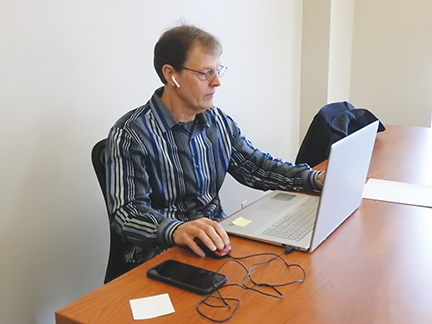
News Photo by Crystal Nelson Mike Mahler, economic development director at Target Alpena, works in the Alpena Area Chamber of Commerce office on Feb. 1.
ALPENA — Northeast Michiganders are dying faster than they’re being born, state data shows.
While that can hurt economic development, officials tend to look beyond such statistics and consider other trends within the population, officials said.
Since the 1970s, Northeast Michigan residents have died at a faster rate than they were born, one trend bringing down the region’s overall population, State Demographer Eric Guthrie said.
Since 2009, the number of deaths in Northeast Michigan have exceeded births by an average of 410 people per year, Guthrie said. In 2018, the most recent year for which data is available, deaths exceeded births by 461 people across Alpena, Presque Isle, Montmorency, and Alcona counties.
As officials await the release of 2020 census data this spring, those kinds of statistics can be worrisome. A shrinking population like ours makes it harder to attract development, Mike Mahler, economic development director with Target Alpena, said.
However, Mahler said, birth and death rates are only part of the equation. He said he knows people are moving out of urban areas to less-populated places like Northeast Michigan, and he’s seen evidence of people moving here.
“It’s inexpensive. The quality of life is nice. We don’t have a lot of crime,” Mahler said. “So I think there are people discovering this part of the country and finding it may be a suitable place to live.”
ENOUGH MIGRATION?
But views like Mahler’s might be overly optimistic, according to a 2019 state report.
When an area is in natural decline through deaths exceeding births, the only way for the population to increase is through migration — people moving to a place from elsewhere in the state or country, Guthrie, the state demographer, said.
The 2019 report projects migrations will increase slightly in Northeast Michigan through 2045, but not enough to replace the number of people who die each year.
Presque Isle County is projected to see the steepest decline in population — 3.2% between 2020 and 2030. Demographers project Alpena County will lose 2.6% of its population and Montmorency County 0.1%.
Alcona County is the only community that might buck that trend, projected to grow 1.4% by 2030.
Such trends impact many areas of a community, not just whether new businesses open or close.
A school district, for example, uses birth rates to help project enrollment, which makes up most school revenue in Michigan, Alpena Public Schools Superintendent Dave Rabbideau said. School officials also look at the current student population, graduation numbers, and how many kids will come into kindergarten based on Head Start enrollment, Rabbideau said.
Alpena and Presque Isle counties will continue to see births decline through 2045, according to the state report, while the number of births in Montmorency County will increase slightly starting in 2030. Alcona County’s births should remain stable through 2045, according to the report.
‘PREPARING TO STAY STEADY’
However, the number of residents in a community is not the only factor in determining success, officials said.
An aging community like Northeast Michigan, for example, attracts developers who serve that group, Mahler, of Target Alpena said. He pointed, for example, to the recently opened, $12 million Besser Senior Living Facility.
“I think the demographics themselves will potentially interest investors,” he said.
And there’s only so much development a community can support.
While Alpena’s population has declined, the city is mostly constructed, meaning the population is stable, said Andrea Kares, Alpena’s director of planning, development, and zoning.
“Typically, when a city is built out, you’re not really preparing for growth or decline, you’re preparing to stay steady,” she said. “Alpena has been doing that.”
Kares said planners tend to see population changes the most when economic development in the community either increases or declines. She said there is still room for new development in some parts of the city and opportunities for developers to remodel or rebuild blighted buildings.
——
Deaths exceeding births
The average number of deaths that have exceeded births each year since 2009 in each county:
Alpena: 101
Presque Isle: 100
Montmorency: 91
Alcona: 118
Source: The Michigan Department of Health and Human Services
Local News

An Ossineke sunrise
DNR area fishing report
LANSING - On Wednesday, the Michigan Department of Natural Resources released it Northeast Michigan fishing report. ...

A happy Doughnut Day

AAA launches “E-Ride Ready” campaign

Whitmer seeks presidential disaster declaration for communities impacted by April severe weather and flooding