
Cell phone dead zones can stop calls for help, but improvements underway
Trending
ALPENA -- When Presque Isle County 911 Coordinator Renee Szymanski got the email on Jan. 4 saying a new Verizon cell tower had been installed, she couldn't wait to tell her coworkers.
"I'm like, 'Oh, my gosh, you guys. This is so exciting. We have a new tower that's up,'" said Szymanski, reporting, with a sigh of relief, that cell phone coverage is looking up in Northeast Michigan.
Despite cell phone provider maps promising almost complete coverage, many locals can rattle off a list of "dead zones" where they know their calls will drop and text messages won't go through.
An inconvenience most of the time, unreliable cell coverage becomes a health hazard when residents' car breaks down, a loved one has a health crisis, or they are injured in the woods.
Coverage is getting better, emergency managers report, but, sometimes, calls for help aren't going to get through.
"If you're in a dead spot, that call is just dead in the water," Szymanski said.
CAN'T COUNT ON 911
In September, Presque Isle County resident Ken Rasche was injured near his hunting camp in the southern part of the county.
Coverage maps provided by his carrier promise voice and text coverage in that location.
But, as he lay immobilized in the woods, Rasche's repeated calls to 911 wouldn't go through.
Rasche waited eight hours for someone to find him.
"You can't count on reaching 911 in these parts," Rasche said. "You just can't."
In recent weeks, a new Verizon tower was erected near Hawks, and, now, much of the surrounding area -- including the woods near Rasche's hunting camp -- has full coverage, Szymanski, the 911 coordinator, said.
Coverage in the county seems to be getting better, and police are relieved, Szymanski said. She's heard many complaints that people couldn't call 911 because they were in dead zones, and deputies trying to respond to calls sometimes couldn't use their own phones.
It's an increasingly important issue as more and more Americans drop their landlines and rely on cell phones for all communication. Of the 6.5 million calls that came into Michigan 911 centers in 2019, only 13% originated from landlines, according to the most recent report of the National 911 Program.
Even police radio coverage was bad until the county -- like other counties in the area -- converted to a stronger radio system in the past year.
In rural areas, where reception bars on a cell phone ping-pong from full to almost no coverage, the towers popping up in Presque Isle County and elsewhere in the area could be lifesavers, Szymanski said.
HOPE FOR IMPROVEMENT?
A representative of AT&T said the company recently added a new tower in Glennie, in Alcona County, and is working with county officials to boost capacity to towers in the Alpena area.
"We consistently look for ways to improve the network experience for our customers and first responders," said Dale Ingram, spokesman for AT&T.
Coverage maps display approximate outdoor coverage, but actual coverage may vary. Coverage isn't guaranteed and is subject to change without notice, Ingram said. He didn't clarify what would cause coverage to change, other than bad weather.
Verizon representative Andrew Testa said the company has "implemented a variety of solutions to improve both coverage and capacity" in the Alpena area, with more improvements expected this year.
Coverage maps are verified for accuracy and updated often, the representative said.
Patchy cell coverage, a problem across the nation, is frustrating for public safety officials as well as residents, according to Joni Harvey, state 911 administrator.
Neither the State 911 Committee nor the Michigan Public Service Commission verify cell coverage claims, and decisions about the need for new cell towers and equipment are left up to carriers, Harvey said.
Improvements to location data are on their way, Harvey said.
Thanks to an initiative of the U.S. Department of Transportation to create what it calls Next Generation 9-1-1, future 911 calls may see upgrades such as live video feeds, emergency calls made from social media accounts, and automatic sharing of information from medical alert devices or automobile crash sensors.
'STILL PRETTY DARN GOOD'
Meanwhile, responders have to help people as best they can when coverage is bad.
In some parts of Alpena County, drivers who pass a crash may have to continue for miles before they can call to report what they saw, according to Sgt. Michael Jones, of the county Sheriff's Office.
The west end of Alpena County has bad cell coverage, markedly worse for those with service from a company other than Verizon or AT&T, according to Alpena Fire Chief Bill Forbush.
City paramedics responding to a rural call use high-power cellular modems in their ambulances to maintain a digital connection to the 911 call center. The modems don't help with voice coverage, but they keep data and GPS working in places with bad cell coverage, Forbush said.
Those places are getting fewer and farther between, said Jeff Brackett, 911 director in Alcona County.
New towers have reduced the number of dead zones where someone may not be able to call for help, though it may mean adjusting their position by a few feet, he said.
"Our cell coverage is still pretty darn good for a 600-square-mile country," Brackett said.
Still, he listed several locations -- especially near Lake Shore Drive, north of Harrisville -- where cell coverage is lousy. He said he wouldn't want to have to make an important phone call there.
Residents have struggled to make calls at the base of a hill near Alcona Pond west of Glennie and at the north end of Hubbard Lake. A new Verizon tower just north of Churchill Point has improved reception around Hubbard Lake in the past few years, Brackett said.
'A LITTLE TELEPHONE SECRET'
Every year, downstaters snowmobiling or hunting in the region's hundreds of square miles of woodlands get lost.
"Happens all the time," Brackett said. "You ask, 'Do you know where you are?' 'No.'"
Whether from the woods, a farm's back 40, or a cluster of houses blocked by a hill, most calls to 911 from places in bad coverage areas can get through, but may be unable to keep their signal, Brackett said.
As soon as a call reaches a 911 dispatcher, a service called Rapid SOS -- purchased recently by Alcona County -- immediately grabs the phone's location and populates the dispatcher's screen.
Even if a call is lost, responders know where it came from and can notify responders, Brackett said.
In Alpena County, an app called Smart 911 lets residents input information about their health and homes that is immediately available to dispatchers when a 911 call goes through. A similar program in Alcona County collects information via paperwork, available at the Alcona County Commission on Aging? Senior Center in Lincoln. If a 911 call is dropped before the caller can say much, information from people registered for those services is still available to dispatchers.
Texts often go through when phone calls don't, Brackett said. The Federal Communications Commission recommends always trying to call 911 first. When no other options exist, however, people who need help can text the details of the emergency to 911.
Text-to-911 isn't widely available nationally, the FCC cautions, but all four counties in Northeast Michigan have purchased the service.
Sometimes, the old-fashioned way is the best way.
Howard Carpenter, who lives just outside Alpena on a stretch of Werth Road known for in-and-out cell coverage, said he and his wife kept their landline for emergencies.
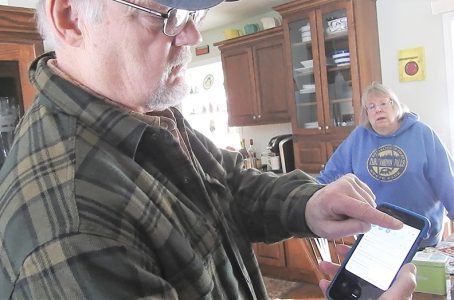
"I wouldn't feel safe if I had to get 911 with this," Carpenter said, giving his cell phone a shake. "More than likely, it would work. It isn't like this is a terrible service. But it isn't a very good service. It's not totally dependable."
Cell phone coverage is extended to its maximum capacity when someone dials 911, according to Donna Baranyai, 911 director for Montmorency County.
"It's kind of a little telephone secret," Baranyai said.
In her county, too, coverage has improved as new towers go up.
Residents wondering if they'll be able to reach 911 are welcome to do a test run, as long as they notify dispatchers by calling the county's non-emergency number first, Baranyai said.