
‘Narcotics is a unique animal’
Inside the undercover task force battling drugs in Northeast Michigan
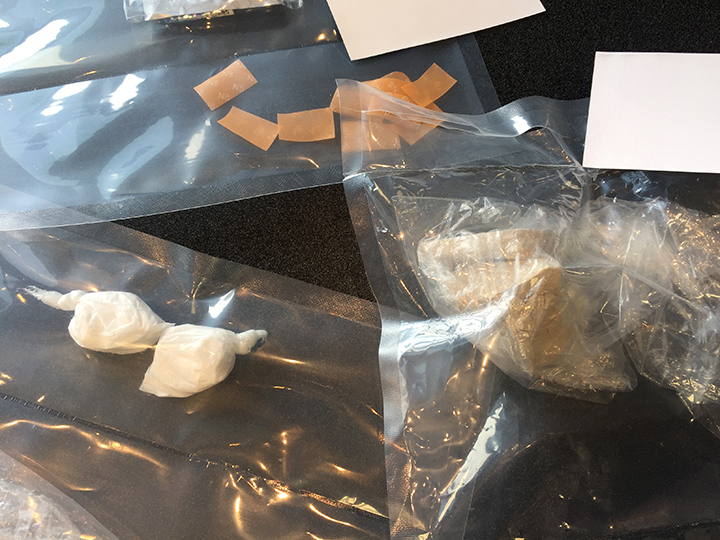
News Photo by Julie Riddle At the Huron Undercover Narcotics Team headquarters, police evidence bags hold an “eightball” (7 oz.) of cocaine, worth about $600, suboxone strips, worth $200, and 35 grams of heroin, worth about $5,500.
ALPENA–Three times in the span of a few days at the beginning of March, the Huron Undercover Narcotics Team team roared in like a lion, arresting drug dealers and putting a dent in the flow of illegal and deadly drugs in Alpena.
Like it or not, opioids are in our community, Det. Lt. Stuart Sharp of the Michigan State Police, commander of the Huron Undercover Narcotics Team, said in an interview this week.
They’re real, and they’re here.
And HUNT is doing something about it.
On March 3, HUNT officers arrested two Alpena residents, seizing 40 grams of heroin that had been delivered to Alpena from the Detroit area. Those arrests prevented the distribution of 400 doses of a highly-addictive drug and removed two drug traffickers from Alpena streets.
On March 4, an Alpena man was arraigned on charges of delivery of cocaine that he had obtained from southeast Michigan and packaged for local delivery. At the time of his arrest, he had 7 grams of suspected cocaine secreted on his person, packaged for street sales.
The same day, an Alpena woman was arrested for delivery and possession of deadly drugs and maintaining a drug house. The next day, two of her associates from Flint and Lansing were arrested at the woman’s residence on a major Alpena street, both accused of attempting to deliver heroin.
That is what HUNT does.
‘EVERYBODY WANTS STATISTICS’
“Everybody wants statistics. Everybody has some quantitative value to show what they do to show their bang for a buck,” Sharp said. “But narcotics is a unique animal.”
Numbers and data can begin to paint a picture of the work of HUNT. But there is no real numerical way to demonstrate the greatest value of their work: the bad that is not done, Sharp said.
HUNT is a multi-jurisdictional narcotics task force serving Alcona, Alpena, Montmorency, and Presque Isle counties. The team, comprised of officers from the Michigan State Police and local law enforcement agencies, is dedicated to reducing the trafficking and availability of narcotics in our community, as well as the associated violent crime that often accompanies it. The team was formed in 1990, and has since arrested nearly 3,000 criminals and removed more than $8 million worth of drugs from our streets.
HUNT operates in secret. Officials won’t reveal the identity of the team’s members or even how many there are.
Secrecy is needed to protect the officers involved in high-stakes investigations.
HUNT is one of 21 such task forces in Michigan, working in partnership to combat the effects of illegal drug creation, sale and use.
In 2017, HUNT seized 276 grams of cocaine, 87 grams of heroin, and 200 grams of methamphetamines from the four counties it serves, taking a street value of $187,095 worth of illegal substances out of our streets, workplaces, parking lots, and schools.
‘NO ROOM TO DO THINGS INCORRECTLY’
There is, Sharp knows, a perception that HUNT officers are dirty cops. That they conspire to catch low-level users and kids in the high school parking lot. That they bend the rules and cut corners.
Nothing could be farther from the truth, Sharp said.
The officers who join HUNT go through rigorous training. They use highly advanced technology, criminal analysts, federal agencies, the best of whatever is available to conduct their investigations, which take months, with each detail meticulously scrutinized and each decision weighed.
“There’s no room to do things incorrectly,” Sharp said, “because then we would lose the public trust and defeat what we’re doing.”
HUNT officers know that their every action has to stand up to scrutiny in a courtroom. If their work is to have lasting results, they have to follow guidelines, work with caution, and use all resources at their disposal.
“When we build a case, it’s rock-solid,” Sharp said. “We put an awful lot of people in prison because of the quality of our cases.”
‘THESE ARE NETWORKS’
The selling of narcotics is a well-organized crime, Sharp said, requiring structure for drugs to reach our corner of the state.
That structure, he explained, could look like one person in our community acting alone, driving down to a source city — maybe Detroit, Saginaw, Bay City — to buy a quantity of drugs, coming back to Alpena and selling them. What may look simple is actually a network of sellers and buyers and distributors connected to negotiate the flow of drugs into the hands of end users.
“These are networks of people that are organized, working in collaboration, and conspiring to commit crimes,” Sharp said.
Those using drugs illegally are to be held accountable for their actions, as with any other crime. But the end goal is to get the source, Sharp said. The HUNT team utilizes information from informants, officers, and the public via anonymous tips to get to the individuals at the base of the structure that brings drugs to our area.
The cost of opioids doubles between Detroit and here, Sharp said. Street-level gangs from downstate have learned to set up shop in our area, knowing they will secure a higher price for their wares.
Too, there is a measure of safety for drug traffickers when they come north. While a big city may seem like an ideal place to hide, a lower population equates to a reduced threat of being caught.
‘IT’S UNBELIEVABLY HERE’
You do not see the good in society when you work in narcotics.
Sharp and his team have been exposed to elements of society that many believe don’t exist, at least not here.
“When you’re addicted, you don’t care about your children, yourself, your neighbor,” Sharp said.
Meth labs are often found in apartments, their chemicals — and potential for explosion — posing a danger to everyone in the building. HUNT officers often see pregnant females, children, pets, in horrific conditions. Most drug houses are filthy and reek of noxious smells.
Sharp recounted one home foul enough to make experienced investigators, who have grown accustomed to the fetid sides of life, gag.
“And there were kids that lived in that house,” Sharp said, disgust in his voice.
Sharp grew passionate as he described the side of Alpena that its residents don’t — or don’t want to — recognize.
“If people could just see that,” Sharp said. “That’s in our neighborhood. That’s here. This is not Chicago, not Detroit. This is Alpena. It could be your neighbors.”
In Sharp’s experience, people don’t think the horrible side of life is present in our small, safe-feeling town.
“It’s here. It’s unbelievably here,” he said.
With open hands turned up, Sharp searched for words to capture the value of what his team does each day.
“What we do is something that can never be measured,” he said. “If I can positively affect someone, if they don’t get hurt, killed, victimized … how could you ever measure someone not getting hurt?”
Sharp wonders how many lives have been affected by his work.
Shrugging, he said, “I’ll never know.”
Julie Riddle can be reached at 989-358-5693 or jriddle@thealpenanews.com.
Local News

Christmas on the farm and homestead

Gould joins MyMichigan urologist office
The Fitzgerald’s Legacy at the Great Lakes Maritime Heritage Center
On Saturday and Sunday, people can catch “The Fitzgerald’s Legacy and the Power of Tugs,” the latest episode ...
Churches in Alpena celebrate Advent and Christmas
Mother Nature’s canvass
Alpena library closed for Christmas, New Years
The Alpena County George N. Fletcher Public Library will be closed on Dec.24, Dec. 25, and Dec. 31, as well as Jan. ...