Hear the story of Capt. Santa and his Christmas Tree Ship
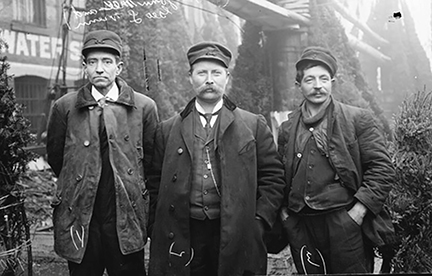
Courtesy Photos This photo provided by the Thunder Bay Sanctuary Research Collection shows Capt. Herman E. Schuenemann, center, with two others.
ALPENA — In the Great Lakes, there is an estimated 6,000 vessels that battled treacherous waves only to meet their fate on the lake floors.
Among those thousands, the Christmas Tree Ship is one of the many mysterious wrecks that has intrigued people since it vanished during a winter storm in November 1912.
The Great Lakes Maritime Heritage Center will on Tuesday feature a lecture on the Rouse Simmons schooner known as the Christmas Tree Ship.
Russ Green is the regional coordinator for the National Oceanic and Atmospheric Admninistration’s Office of National Marine Sanctuaries. He will discuss the ship’s story, along with theories about what happened the day it disappeared into the depths of Lake Michigan.
“There are so many aspects to the Rouse Simmons story that it seems to captivate a wide audience,” Green said in an email to The News. “There’s the drama of the old schooner losing its battle with a November snowstorm, the unique cargo, and the season within which it sailed, strong ties to Chicago, and the real connection that can be made to Capt. Schuenemann and his family.”
The history of the Christmas Tree Ship and its captain — who was affectionately known as Capt. Santa — is detailed in Prologue Magazine, a publication of the U.S. National Archives and Records. According to records from the archives, the schooner known as the Rouse Simmons took its maiden voyage from Milwaukee in 1868. The 123-foot ship had three masts and weighed about 205 tons. It was built to haul lumber and often traveled from Grand Haven to Chicago during its heyday.
By the start of the 20th Century, Wisconsin native Herman E. Schuenemann purchased part of the Rouse Simmons, as was common among captains who could not afford to outright buy a ship. The Simmons was over 40 years old when Capt. Schuenemann bought his portion — far from its prime — but the captain was an experienced seaman who knew the Great Lakes well.
Around that time, live Christmas trees were becoming commonplace and many of the schooners on the lakes would bring trees from the Upper Peninsula and Wisconsin to sell in Chicago, right from the ship decks.
Schuenemann’s brother, August, was one of the captains who sailed schooners full of Christmas trees until his ship, the S. Thal, foundered in November 1898 after being caught in a winter storm. There were no survivors.
Despite the perilous conditions of the lakes in the winter, schooners still made the trip to Chicago late in the year, battling the elements to deliver freshly cut evergreens. The Rouse Simmons along with Capt. Schuenemann, could be found packed with Christmas trees and decorated with lights, selling trees to families as the schooner sat docked on the Chicago waterfront. His brother’s death had not deterred him from continuing the Christmas tradition.
Records show Schuenemann’s wife and three daughters would also help make wreaths and garlands to sell alongside the trees. It is said that Schuenemann was known for being a generous man and would often give trees away for free to needy families. His tree-loaded schooner and kind nature earned him the nickname Capt. Santa, which he greatly relished. It has been commonly reported that the captain took such pride in his persona that he would save newspaper clippings that mentioned him and the Christmas Tree Ship.
On Nov. 22, 1912, the Rouse Simmons was ready to make its regular end-of-the-year trip through the frigid waters of Lake Michigan. Aboard the ship were between 3,000 and 5,000 Christmas trees, filling the hull with the scent of evergreen, ready to be sold to Chicago families. However, as the schooner was leaving, a winter storm was approaching.
The Christmas Tree Ship left the Upper Peninsula and started its voyage to Chicago like it had done so many times before. It is unknown what transpired from the time it left the harbor in Thompson to its watery grave on the floor of Lake Michigan, but, according to the National Archives, there are logs from a life-saving station in Kewaunee, Wis., that spotted a ship flying its sails at half-mast, indicating distress. When no tugboat was available to send out for assistance, the tip was passed along and a boat from the station at Two Rivers was sent to assist the vessel. Upon arrival, there was no ship to be found in the midst of the winter storm churning the lake into fury.
The Christmas Tree Ship and its crew were never seen again.
In the weeks following the ship’s disappearance, Christmas trees washed ashore on the coast of Wisconsin, leaving ominous clues to its fate.
Then, in 1924, fishermen in Wisconsin found a wallet wrapped in waterproof oilskin. Upon inspection, the contents identified the owner as Capt. Santa.
While there are many theories as to what happened to the ship, it has largely remained a mystery that has fascinated people for the last century.
When it was accidentally discovered by a diver in October 1971, there was a renewed interest in the long-lost ship and the Christmas trees that still sat in its hull.
During the lecture this month, Green will delve into some of the details that have been uncovered since its discovery and discuss his own experience diving the ship.
“There’s been a few new archaeological clues and some theories about the sinking. It will be fun to share these during the presentation,” Green said in his email to The News. “That the shipwreck still draws so much attention and speculation says a lot about this particular story, but also about general interest in how past generations lived and worked.”
Green added that the lecture will be a chance to experience one of the many stories that haunt the Great Lakes.
“The ships that didn’t make it tell us about the ones that did,” he said. “Thousands of schooners plied the Great Lakes during the age of sail — here’s a poignant and personal glimpse into one ship’s fascinating story.”
The story has captivated people for more than a century, inspiring a variety of books. Rochelle Pennington has written two books about the Christmas Tree Ship.
“It is a story which exemplifies the best of humanity,” said Pennington. “At its heart, we find courage, love, generosity, heroism, and the importance of family. The moment I first heard the story of the Christmas Tree Ship, I understood why it had endeared itself to so many people over the years and was still being shared a century later … The ship’s final voyage was not to the bottom of the lake, but into the pages of history.”
Pennington is author of “The Christmas Tree Ship: The Story of Captain Santa,” which is a book for all ages that has photos and illustrations detailing the ship’s tale. For a more in-depth look at the ship, Pennington also wrote “The Historic Christmas Tree Ship: A True Story of Faith, Hope and Love,” which is more than 300 pages with incredible details about the ship from newspaper clippings from the last 140 years.
It is a tale of holiday merriment shrouded in the ghostly history of the Great Lakes shipwrecks, leaving people eager to soak up every last detail about the captain and his ship.
For anyone intrigued by the ship and its disappearance, Green will give a lecture on the ship and its discovery at the Great Lakes Maritime Heritage Center at 7 p.m. Tuesday. The event is free for all ages.
If you go
∫ WHAT: Lecture on The Christmas Tree Ship
∫ WHEN: 7 p.m. Tuesday
∫ WHERE: The Great Lakes Maritime Heritage Center, 500 W. Fletcher St.
∫ COST: Free
∫ INFO: Russ Green, regional coordinator for the National Oceanic and Atmospheric Admninistration’s Office of National Marine Sanctuaries, will give a lecture on Capt. Herman E. Schuenemann and the Rouse Simmons –also known as Capt. Santa and the Christmas Tree Ship — which sank in Lake Michigan in November 1912.
Local News

Northland secures $10,000 for Bay Athletic via elevate program
Alpena County personnel committee meets Tuesday
ALPENA - The Alpena County Personnel Committee will meet on Tuesday at 10 a.m. in the Howard Male Conference ...

Michigan mulls changes in elk hunt regulations

Harmful algae bloom awareness program in Harrisville

You Are Loved Women’s Conference