
Exercise Northern Strike 2017 brings 6,000 military personnel into Alpena area
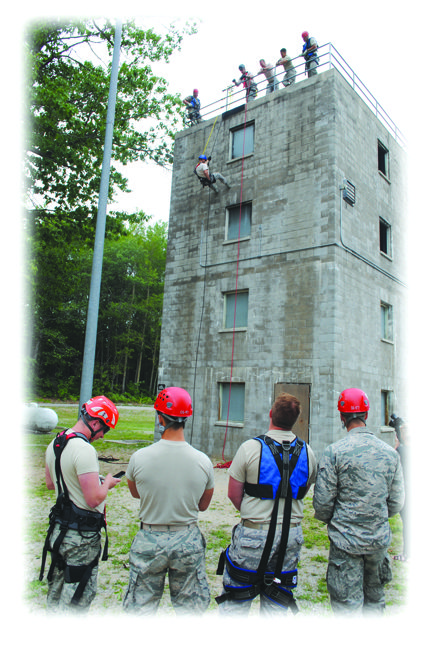
A group of American Air National Guard personnel and personnel from the Latvian Air Force work on firefighter training, in this case demonstrating how to repel with ropes from the side of a potentially burning building during a combat training exercise.
ALPENA — Residents who have noticed an increased military presence in the area are not imagining it; more than 6,000 military personnel are currently in the region as part of the Air National Guard’s Exercise Northern Strike 2017.
The month-long event is centered at the Alpena Combat Readiness Training Center where 1,000 military members from around the country and world are working on training between departments. Officials say 5,000 personnel are working from the U.S. Army Reserve’s Camp Grayling as well in the largest National Guard training exercise in the country.
According to Alpena CRTC Commander Col. J. Andrew Roberts the exercise involves members of the military from every branch from 13 U.S. states and seven coalition countries, including Canada, the United Kingdom, Denmark, Poland, Latvia and Liberia.
The exercise has been going on annually for at least six years. Roberts said because of northern Michigan’s rural environment it is the perfect location for such a wide-scale training operation.
“A big piece of that is just the lack of people up here, so if you think about it where you want to do these things you need a lot of space,” he said.
There are more than 17,000 square miles of airspace from the thumb to Canada that can be used, as well as 177,000 acres of land at Camp Grayling that is used for operations.
According to Roberts that is the largest airspace block east of the Mississippi River and one of the largest in the country for training.
Additionally resources like Lake Huron, where live fire training takes place 50 miles out on ranges with aircraft and areas like quarries in Rogers City are used by groups.
Overall, expect a few instances where the public thought foreign airmen in Alpena were Russian operatives, the public has been very supportive.
“A lot of other training sites the community didn’t like the noise but up here there is a very positive response from the community,” Roberts said.
Major General Leonard Isabelle, the assistant adjutant general and commander of the Michigan Air National Guard, said the training is very valuable to the military as a whole for the National Guard, many of which do not train extensively throughout the year as they would in Alpena for the exercise.
“This is the one time during the year that a National Guard member when they will come out and practice their job in actual simulated combat,” he said. “It’s at two week exercise, most of our participants will be here for two weeks.”
Isabelle said there is a push for realistic training and opportunities for the military, which have become more limited due to budget constraints.
“That is why Northern Strike is so important to keep our military ready,” he said. “I am very proud of the fact that we’re helping prepare members of our military.”
The exercise is helping the men and women of the National Guard, as well as others around the world perfect their techniques, Roberts said.
He highlighted the partnership with the Latvian Air Force; U.S. military aircraft use the Latvian bases and their airmen are trained on American firefighting techniques to help when aircraft go down.
“The state has partnered with the Latvian Air Force for 25 years,” he said.
Firefighting was a focus for many, including the Latvians, who learned repelling techniques for getting down buildings in fire situations.
From the CRTC’s training grounds, Air Force personnel taught the techniques, including Sgt. Wesley Cooper.
“This would work in structure fires where they would have to repel down into a roof, a rock climbing incident, or anything where a person would be stranded in an elevated position,” he said.
Another focus of this year’s exercise is search and rescue missions, including work over Lake Huron with the U.S. Navy pilots like Lt. Bobby Schneide who is flying the Navy’s Sierra search and rescue helicopter.
“They can land on carriers and any kind of small boats, they can go off land and is available for any kind of ground support that needs to be done,” he said.
According to Schneide the operations have consisted of looking for targets in Lake Huron to practice search and rescue techniques.
Whether it is training to put out aircraft fires, finding people missing in huge expanses of water or working on special ops, rest assured the military men and women are honing their abilities.
Alpena Mayor Matthew Waligora said the CRTC is a huge asset to the community and region.
“General economic impact numbers is estimated at about 120 million annually,” he said. “That is fantastic for our community. Compound that with the partnership with the fire department for training and the Michigan K9 units, with community partnerships that wouldn’t be possible otherwise.”
Jason Ogden can be reached via email at jogden@thealpenanews.com or by phone at 358-5693. Follow Jason on Twitter @jo_alpenanews.
Local News

National Weather Service issues ice storm warning for Presque Isle, Montmorency, Alpena

Community Foundation announces new officers

Rx Kids launches in Montmorency County, enrollment open

Lots happening in for Presque Isle District Library
Alpena DDA seeking donations for downtown flower fund
Pizzapalooza event for Relay for Life
ALPENA — On April 16 from 6 p.m. until 8 p.m. take a night off from cooking to Support the Relay for Life of ...