
Private school teachers have fewer civil rights protections for actions off the job
Trending
LANSING- Educators have their own lives outside of the classroom that can conflict with their professional work.
There can be a lot of stress and tension between personal and work life, according to psychologists.
In 2022, Joseph Kuilema, a former professor of social work at Calvin University, a private conservative Christian institution in Grand Rapids, was terminated because he officiated at a former student's same-sex marriage ceremony.
His ongoing lawsuit argues that the reason for his termination is associational discrimination under the Elliott-Larsen Civil Rights Act. That state law prohibits discrimination in employment, housing and real estate, public accommodations and education.
On Oct. 8, the Michigan Supreme Court heard arguments in the case to determine if the termination falls within the Elliott-Larsen Civil Rights Act since it alleges discrimination by association and not direct discrimination.
Kuilema now teaches in the School of Social Work at Grand Valley State University.
"What Kuilema's argument really boils down to is that his employment discrimination was because of sex. So the real question is does the plaintiff have to be discriminated against because of their own sex or the sex of somebody they are associated with?" Calvin University's attorney, Stephen van Stempvoort of Grand Rapids, said during the Supreme Court arguments.
He said the wording of the civil rights law makes it clear that it protects only the individual who's personally experiencing discrimination.
According to Kyle Zawacki, the legislative director of the American Civil Liberties Union of Michigan, public school teachers - unlike Kuilema - are government employees who can exercise their First Amendment Rights as citizens.

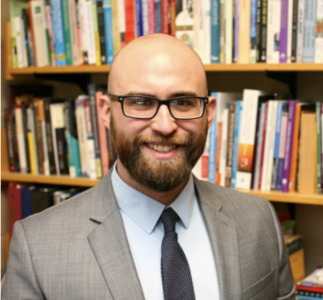
Courtesy photo Kyle Zawacki is the legislative director of the ACLU of Michigan. Credit: ACLU of Michigan
However, depending on contracts and union representation, a private employer such as Calvin University can fire employees without cause, Zawacki said.
He said it can be without cause on paper, but the employer may have seen something online from the employee that negatively reflects on the employer.
Public school teachers have a little more protection in such instances, Zawacki said.
"If you are commenting publicly about how a school is run with comments that could be seen as negative, the institution is a public body and the government cannot restrict your First Amendment right to criticize it," he said.
Zawacki said there have been many instances where public school teachers were fired for allegedly violating morality clauses, which require them to behave under certain ethical standards.
For example, teachers have been fired for having an affair or if a community member saw them drunk at a bar, even though they did it in their own personal time away from the classroom, he said.