
Using genetics to monitor walleye populations
Trending
LANSING – Walleye fishing is a big deal in Michigan's Upper Peninsula, particularly in the southwestern end of the peninsula.
Walleye make up nearly 80% of fish stocked in the region, which has a mix of lakes with natural reproduction, where walleye populations are stable or growing without stocking, and lakes where they're stocked to help meet angler demand.
That's why the region was selected for a new pilot technique, a parentage-based tagging for walleye stocking evaluation.
In 2025 and 2026, the technique was implemented in the area, funded through the Wilderness Shores Mitigation and Enhancement Fund. This new method for tagging stocked fish is more effective and cost-efficient than traditional approaches and will help fisheries managers better understand how stocking is or isn't affecting the walleye populations in key lakes.
What is parentage-based tagging?
It's kind of like Ancestry.com or 23andMe for fish.
Historically, the Michigan Department of Natural Resources used a different system that created a skeletal marking on the treated fish to evaluate stocking. This method involves treating fish with oxytetracycline (referred to as OTC), a chemical that leaves a visible mark on the otolith, the bone inside the ear of a fish.
After a fish is stocked, it may be captured later that fall or the following year by DNR staff, who then examine all fish collected for evidence of an OTC mark to help determine how many stocked fish survived.
Checking for this chemical marker requires sacrificing the fish in order to view the otolith, and marks were not always easy to detect. The quality of the visible marks varied, and environmental factors could lead to degradation of the marks over time, making it more difficult to confirm whether a fish was from a hatchery or produced naturally.
Additionally, OTC marking is labor-intensive.
Because OTC is an antibiotic, a prescription from a veterinarian is needed to use it to treat fish. Walleye fry needed to be marked three days after they hatch, so hatchery staff would have to keep the fry being marked separate from other fish, which could be hard to do with limited holding tank space.
During the chemical treatments, the walleye required monitoring from staff throughout the six-hour process, ensuring that the water temperature, oxygen and pH remained at appropriate levels for the young fish.
"Moving away from OTC reduces the workload for hatchery staff and removes some of the complications with tank space at the hatchery," said Randy Espinoza, fish culture manager at Thompson State Fish Hatchery. "Since the fry are usually stocked only days after they're hatched, spending additional time marking a portion of the young walleye introduced delays as staff sorted out which tanks of fish needed to be marked and which could immediately move out of the hatchery for stocking into ponds or area lakes."
Parentage-based tagging, on the other hand, requires less work and is less invasive.
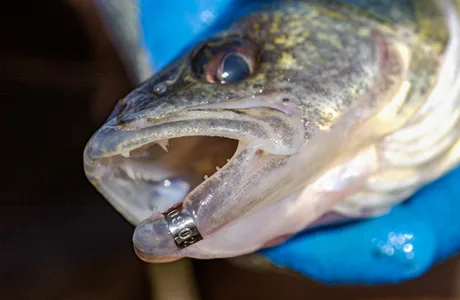
The fish does not need to be sacrificed to check its genetics, and no physical tags (which can be easily lost) are placed on the fish. Instead, it is all done with a small clip that is taken from a fin.
It starts with the adult walleye that are spawned to create offspring for stocking.
DNR staffers take a small fin clip from each of these broodstock (parent) fish and send them to Dr. Jared Homola's lab at Michigan State University for analysis.
Once the offspring of broodstock are hatched, they can be stocked with no need for OTC treatment.
Later, when DNR surveys collect walleye from area lakes, the lab uses a small fin clip collected from each captured walleye to determine whether those fish came from broodstock parents.
If the genetics match, biologists can be certain it's a stocked fish. If not, the fish was produced naturally in the system.
“Using genetics to evaluate stocking is a modern solution to a long-standing fisheries question: Which fish are succeeding, and how much are they contributing to future generations?” Homola said. "Genetics gives us a way to follow the story of stocked fish long after they leave the hatchery. The information we gain will help managers understand when stocking is working, when natural reproduction is carrying the fishery and how to best maintain excellent walleye fishing opportunities into the future."