
Trending
The Lake States have three native elm tree species. The American elm is the most common and the standard-bearer for the genus Ulmus, in the family Ulmaceae. Then, there is red or slippery elm and, finally, rock elm. Elms have long been minor components in the eastern forests of the United States. In Michigan, as much as five percent of forest volume was elm. That percentage is now under one percent.
The graceful, vase-shaped, elegance of the American elm (U. americana) rendered it popular among urban and residential plantings. Many streets and boulevards were once lined with over-arching elms, resembling the architecture of a gothic cathedral. The old trees reached a grand size with diameters occasionally pushing five feet, towering above all else in the neighborhood.
Then most of the big elms died and residential areas and parks were laid bare.
Next in line, by volume and visual quality, is the red or slippery elm (U. rubra). It tends to favor richer soils, often growing on the edges of swamps and in river floodplains. The inner bark contains a gummy gel that becomes very slippery when mixed with a bit of water. Early baseball pitchers chewed the bark and spit the slippery juice onto the ball to alter the trajectory. The "spitball" was outlawed a century ago.
Last, is the comparatively small cousin, the rock elm (U. thomasii). The tree is sometimes called cork elm because of the thick bark flanges on even the small twigs. Rock elm has particularly hard wood, thus the name, although all the elms are known for tough wood.
Leaves of elm species are similar, classically "leaf-shaped" with double sawtooth margins. Variations in the bases of leaves can be useful for identification. The slippery elm leaves are especially scratchy with a high silica content.
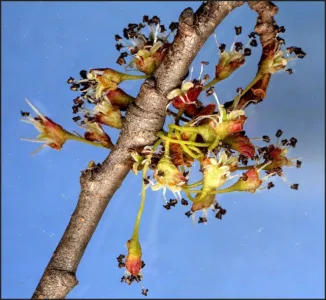
The fruits are small samaras, less than a half-inch across, and are produced in the spring. Notching and degree of "fuzziness" are helpful ID features.
All the elms have distinctly layered bark, with alternating colors. Red elm lacks the much darker layer that appears in American and rock elm. Bark characteristics may be the best ID clue to distinguish American elm from slippery elm. Again, the rock elm has those corky ridges.
Elms have not disappeared from our forest and farm landscapes. However, few now reach the large sizes of their immediate ancestors. The saving grace lies in the manner in which the exotic fungal disease spreads. Several species of bark beetles, both native and exotic, carry the fungal spores from tree to tree. The bark beetles favor trees over about ten inches in diameter. This beetle predilection allows the elms to grow old enough to produce fruit and regenerate.
There are two primary species of the fungus, Ophiostoma ulmi and Ophiostoma novo-ulmi. Both are Asian in origin and arrived in North America via Europe. The latter is the more aggressive and was largely responsible for the major destructive wave in the 1960s and 1970s.
An affected tree shows yellow "flagging" in the leaf crown, usually beginning at the top of the tree. Within a couple of years, the trees dies from the fungus blocking the transport network of the tree, which prevents water from reaching the leaves, and photosynthate from reaching the roots.
"Disease resistant" elms are usually hybrids that lack the grand qualities of American elm. Some varieties have come from large trees that have survived and may demonstrate a level of disease resistance. However, there have been no "silver bullets" to restore the niche left by the devasted native elm population.
Hackberry (Celtis occidentalis) was once taxonomically placed among the Ulmaceae. In 2003, the species was moved into the Cannabaceae family, among the hemps. Hackberry has very distinct bark ridges, visible on even older trees. The fruits are not samaras but, rather, blue berry-like fruit that ripen in the fall.
The demise of elms within our forests and across our communities is but one chapter in the book of losses to exotic diseases and insects. Forest geneticists work like Sisyphus to push uphill that boulder of tree restoration.