Investing in greenspaces bring benefits to schools, student well-being
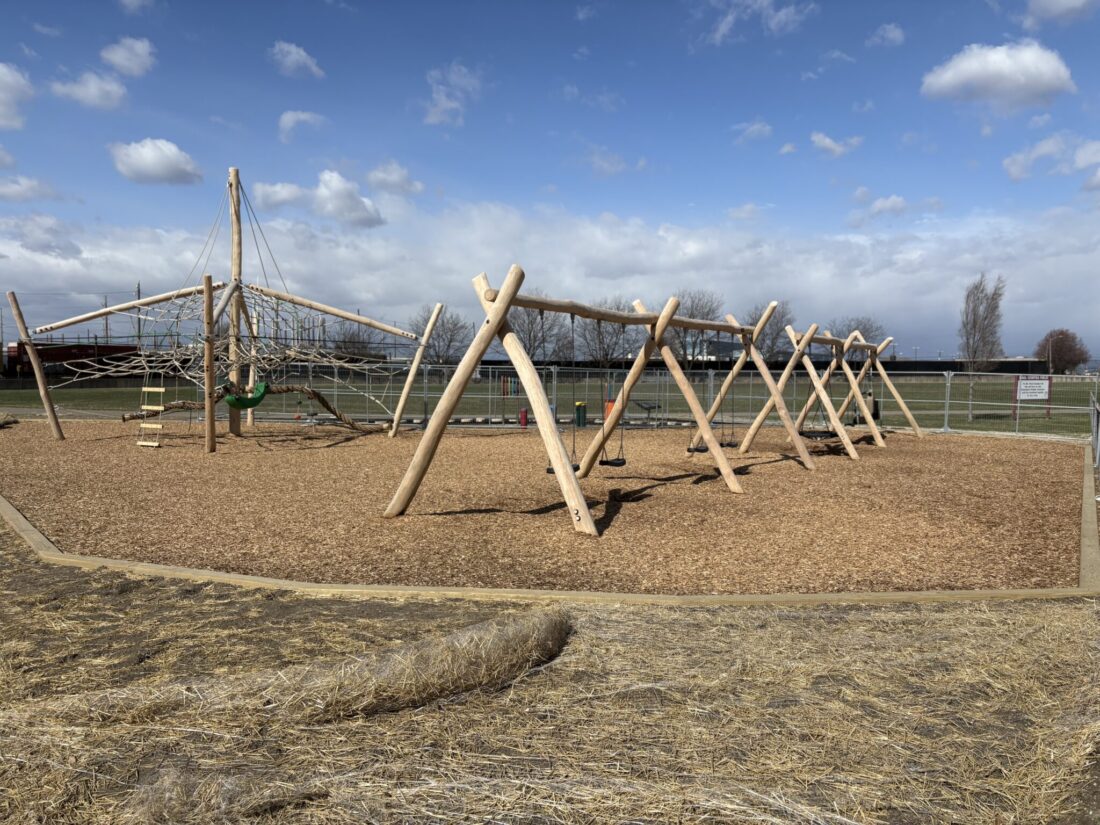
News photo by Jill Chochol Salina Upper Elementary’s schoolyard in Dearborn.
LANSING — For residents of Dearborn, creating greenspaces in the community has been an important mission for schools and researchers.
In a recent study, Natalie Sampson and a team from the University of Michigan-Dearborn partnered with Salina schools to assess their outdoor play spaces.
Industry concentrated in Southwest Detroit “spills over” into south Dearborn, where the Salina schools are located, said Sampson, a professor of public health at U-M-Dearborn.
The research, conducted with the assistance of university students in an environmental health class, connected with Salina schools to use state funding to create spaces for nature-based learning and healthy play environments.
Some Dearborn students face inequalities that make it harder for them to access healthy play environments, Sampson said.
According to the study, “On average, 77% of students in the study area qualified for free or reduced-price lunch” – an indicator of poverty.
“In Dearborn, there’s different communities experiencing day-to-day life very differently, and I think the leadership in the city in public health and the mayor are really committed to trying to tackle some of those inequities,” said Sampson.
Sampson said the city’s history of redlining, the discriminatory practice of denying financial services to neighborhoods inhabited by marginalized groups, plays an important role in how areas are zoned in Dearborn.
Although redlining has been illegal since 1968, the effects are still being dealt with today, according to Michigan State University Extension.
Sampson said studies found a relationship between such neighborhoods – “usually communities of color and lower-income communities” – and environmental hazards.
“We’re trying to look at how that shows up alongside schools. Lots of different populations are susceptible to environmental exposures, but children are among the most vulnerable,” said Sampson.
Using an environmental justice scoring system designed by the Department of Great Lakes, Energy and Environment, the researchers found that some schools in the study area had more exposure to environmental threats than 90% of the state.
Jill Chochol, the green schoolyards consultant for the Salina schools, was also involved with the study.
“Many of our students will not visit a forest – they live in an urban area. Schools, because they own the real estate, can do a lot more with their schoolgrounds to really green them up,” Chochol said.
According to the study, the schools, community and partners have raised over $2.5 million for development of nature-based playgrounds, vegetative buffers, rainwater gardens and other landscape changes.
Chochol said developing “green infrastructure” helps manage flooding and filter storm runoff.
“We’re in the Rouge River watershed, so flooding has been a big problem,” she said.
“Taking away some cement and adding grass, trees and native vegetation is all about using the environment to make the world healthier” because kids use playgrounds several times a day, she said.
According to the study, teachers used nature-based learning in the outdoor spaces, incorporating content about stormwater management, plant life cycles, the water cycle, insect life, animal life and food production.
“One of the transformations that happened at Salina is the Toledo Zoo donated a prairie.” Chochol said.
“In the prairie, the kids are going out and taking their magnifying glasses and taking their notebooks and making lists of the insects they see and looking at the birds and the grasshoppers and the bees and the wasps and all the different kinds of flowers and vegetation,” said Chochol.
Chochol said that in 2016, 16 Dearborn schools established gardens.
“Teaching kids about where their food comes from is a whole other part of green schoolyards and sustainability and connecting kids to their place, their earth,” she said.
Salina schools are now working with Detroit Salsa Co. in Lincoln Park, Michigan, to grow tomatoes for its salsa. That teaches children about the economics behind growing food, Chochol said.
The study was published in the journal Children, Youth and Environments.
Samantha Plunkett writes for Great Lakes Echo.
Michigan News
AAA warns Michigan drivers: Spring showers create dangerous driving conditions
MICHIGAN — As spring showers approach, AAA-The Auto Club Group reminded drivers in a press release on Tuesday ...
Investing in greenspaces bring benefits to schools, student well-being
DNR shares guidance on proper disposal of storm debris

Lake Huron artificial reef restores fish spawning habitat

Michigan’s main cause of wolf mortality? People